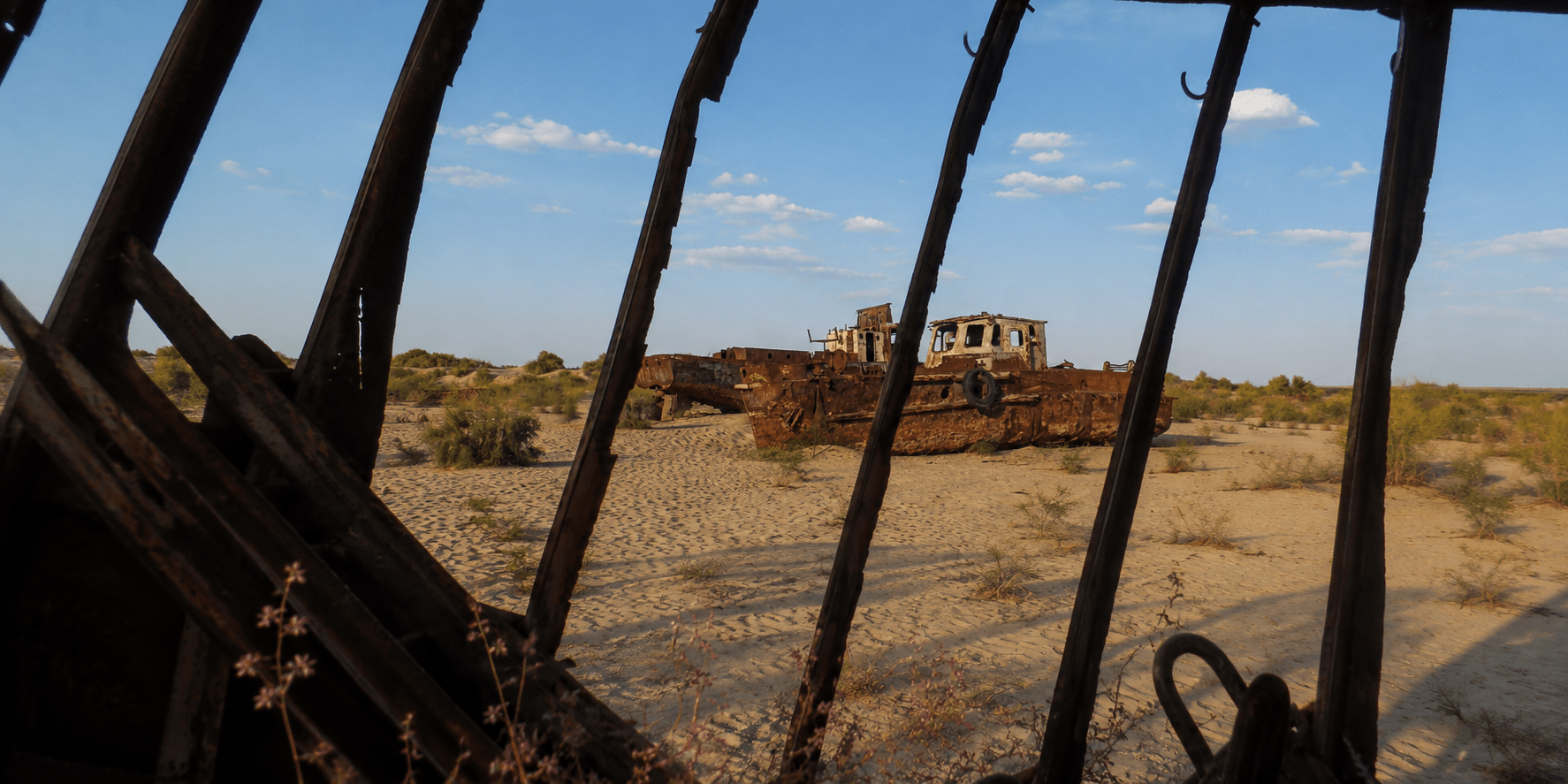
Since 2020, UNDP and Uzbekistan's forestry service have planted 823,000 saxaul trees over 658 hectares of the dried Aral Sea bed near Muynak, stabilising sand-dune drift and adding roughly 1.1 tonnes of CO2 absorption per hectare a year, though experts flag drought risk to long-t
823,000 trees
Trees planted (2020–2025)
658.2 ha
Area planted (2020–2025)
≈1,135 (UNDP) / ≈1.1 t (Mongabay) kg CO2/ha/year
CO2 absorbed per hectare of mature saxaul plantation (annual)
≈835 kg O2/ha/year
Oxygen released per hectare of mature plantation (annual)
up to 4 (UNDP) / 2–4 (Mongabay) tonnes
Sand halted by a single saxaul shrub (per shrub)
30–70 % (low-rainfall vs wetter years)
Seedling survival rate range (2020–2025)
1 USD (12,000 soms) per tree
Cost per tree (crowdfunding) (programme funding model)
Details
Maturity
Scaling
Promoter
UNDP Uzbekistan & State Committee of Forestry of Karakalpakstan
Period
2020–2025 (ongoing)
Keywords
forestry, afforestation, carbon sequestration, land restoration, desertification control
Context
The Aral Sea has lost about 90% of its water since the 1960s, exposing roughly 2.7 million hectares of salt-crusted seabed in Uzbekistan's Karakalpakstan region, a major source of toxic dust storms. Since 2020, UNDP Uzbekistan has worked with the Ministry of Ecology and the State Committee of Forestry of Karakalpakstan on the Green Aral Sea initiative to stabilise this seabed with drought-resistant native shrubs, chiefly saxaul.
Activities
Between 2020 and 2025 the programme planted 823,000 trees across 658.2 hectares (60,000 trees/30 ha in 2020, rising to 200,000 trees/200 ha in 2024, and 80,000 saxaul seedlings on 80 ha at the Kazakhdarya forestry site near Muynak in March 2025). Funding comes from the Government of Japan and public crowdfunding at $1 (12,000 soms) per tree.
Results
UNDP reports each hectare of mature saxaul plantation absorbs about 1,135 kg of CO2 and releases 835 kg of oxygen annually, and that a single shrub halts up to four tonnes of migrating sand, figures corroborated independently by Mongabay, which cites roughly 1.1 tonnes of CO2 absorbed per hectare per year and shrubs stopping 2–4 tonnes of sand.
Conclusions
The model is informing Kazakhstan's larger regional afforestation push under the World Bank's RESILAND CA+ programme, but seedling survival ranges from just 30% in low-rainfall years to 70% in wetter ones, and a Central Asian forestry specialist quoted by Mongabay warned that precipitation across Karakalpakstan fell to only 10mm over the 2020–2025 period, a real risk to the plantation's long-term survival that the programme has not yet resolved.
Implementation
Indicative cost
Low (< €50k)
Time to results
Medium (1–3 years)
Staffing & skills
UNDP Uzbekistan, Ministry of Ecology of Uzbekistan, State Committee of Forestry of Karakalpakstan, public crowdfunding donors
Conditions for success
drought-resistant native species selection (saxaul) suited to the dried seabed
phased planting expansion across successive years and sites
combined government and crowdfunded ($1/tree) financing model
Common failure modes
seedling survival drops to just 30% in low-rainfall years
precipitation across Karakalpakstan reportedly fell to only 10mm over 2020–2025, an independent expert-flagged risk to long-term plantation survival
Where it fits
Governance type
UN-agency and national government partnership
Scale
regional (dried seabed, part of a 2.7M ha target area)
Income level
lower-middle-income
Commonly funded by
National / regional programmesPhilanthropic / foundation funding
Indicative funding routes for practices of this type — always check each programme's current calls and eligibility rules.
Do you run this practice?
Claim it —
verified implementers get a public contact pathway and can propose corrections.
Data sources
Where this practice's information was retrieved from, and when.
Since 2007, Iceland's Hekluskógar project has enlisted 210+ landowners to re-establish native birch woodland around the Hekla volcano, planting 2.3M+ …
A $10M Green Climate Fund grant backing FAO-led gum-arabic agroforestry and rangeland restoration across Sudan's Kordofan states, targeting 275,000 hectares …