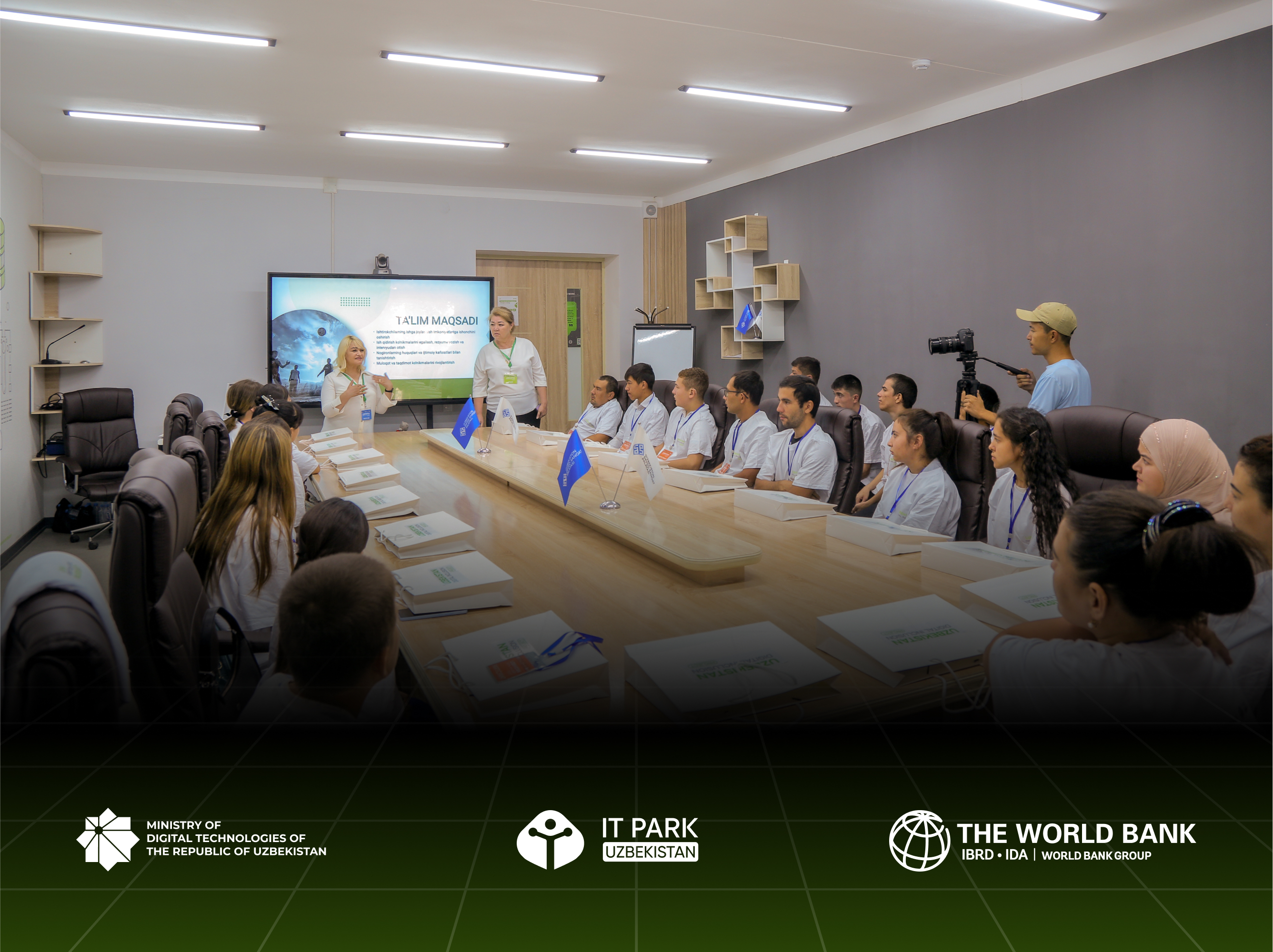
A $50M World Bank loan backs Uzbekistan's Ministry of Digital Technologies and IT Park in assessing rural digital gaps and training youth, women and people with disabilities — 450+ trained across 9 regions in the first rollout, targeting 25,000 IT-sector jobs by 2029.
50 USD million
World Bank concessional loan (approved Nov 2023)
450+ participants aged 18–30
Participants completing first soft-skills training cohort (initial rollout)
9 regions
Regions covered in first training rollout (initial rollout)
4 schools
Rural schools equipped with digital infrastructure (pilot phase)
60 computers
Computers distributed to pilot schools (pilot phase)
~25,000 jobs (target, not yet achieved)
Target IT-enabled service jobs by 2029 (by 2029)
~15,000 jobs (target, not yet achieved)
Target jobs in related industries by 2029 (by 2029)
Details
Maturity
Pilot
Promoter
Ministry of Digital Technologies of Uzbekistan / IT Park Uzbekistan, co-financed by the World Bank
Period
2023–2029
Keywords
digital skills, IT employment, rural development, ICT infrastructure
Context
The Uzbekistan Digital Inclusion Project is a national programme run by Uzbekistan's Ministry of Digital Technologies and IT Park Uzbekistan, co-financed by a $50 million concessional loan approved by the World Bank's Board in November 2023, aiming to broaden access to digital skills and IT-enabled employment for young people, women and persons with disabilities in rural and remote areas.
Objectives
The project's stated ambition, by its 2029 conclusion, is around 25,000 people employed in IT-enabled services and roughly 15,000 more in related industries.
Activities
Before rolling out training, the project conducted 2023 assessments of existing IT infrastructure in rural areas, the digital-literacy levels of rural school students and teachers, and the digital capacity of rural civil servants. Four rural schools in pilot regions then received digital smartboards, 60 computers and local-area-network equipment, and more than 450 participants aged 18–30, including women and persons with disabilities, completed soft-skills training across 9 of the country's regions.
Conclusions
As of the most recent public reporting, the project is still in an early implementation stage: the 450-participant cohort and four-school pilot are real, documented outputs, but the large 2029 employment targets are projections rather than demonstrated outcomes, and no independent impact evaluation has yet been published.
Implementation
Indicative cost
High (€500k–€5M) — Co-financed by a $50 million World Bank concessional loan covering infrastructure (smartboards, computers, LAN equipment) and training delivery through 2029.
Time to results
Long (> 3 years) — Approved November 2023, with 2023 needs assessments, an initial four-school equipment pilot and first regional training cohort completed; runs through a planned 2029 conclusion.
Staffing & skills
Ministry of Digital Technologies of Uzbekistan and IT Park Uzbekistan jointly organising training, World Bank technical and financing partner
Conditions for success
Prior 2023 needs assessments of rural IT infrastructure and digital-literacy levels before designing training
Explicit targeting of under-served groups (rural youth, women, persons with disabilities)
Multi-year financing horizon (through 2029) via a $50 million concessional loan rather than a single grant
Where it fits
Governance type
national government + World Bank loan
Scale
national, rural focus
Income level
lower-middle-income
Do you run this practice?
Claim it —
verified implementers get a public contact pathway and can propose corrections.
Data sources
Where this practice's information was retrieved from, and when.
ConexiónLab trained 8,926 young Bolivians—5,300+ women—in tiered digital skills using a Miska Mobile School and portable antenna to reach communities …