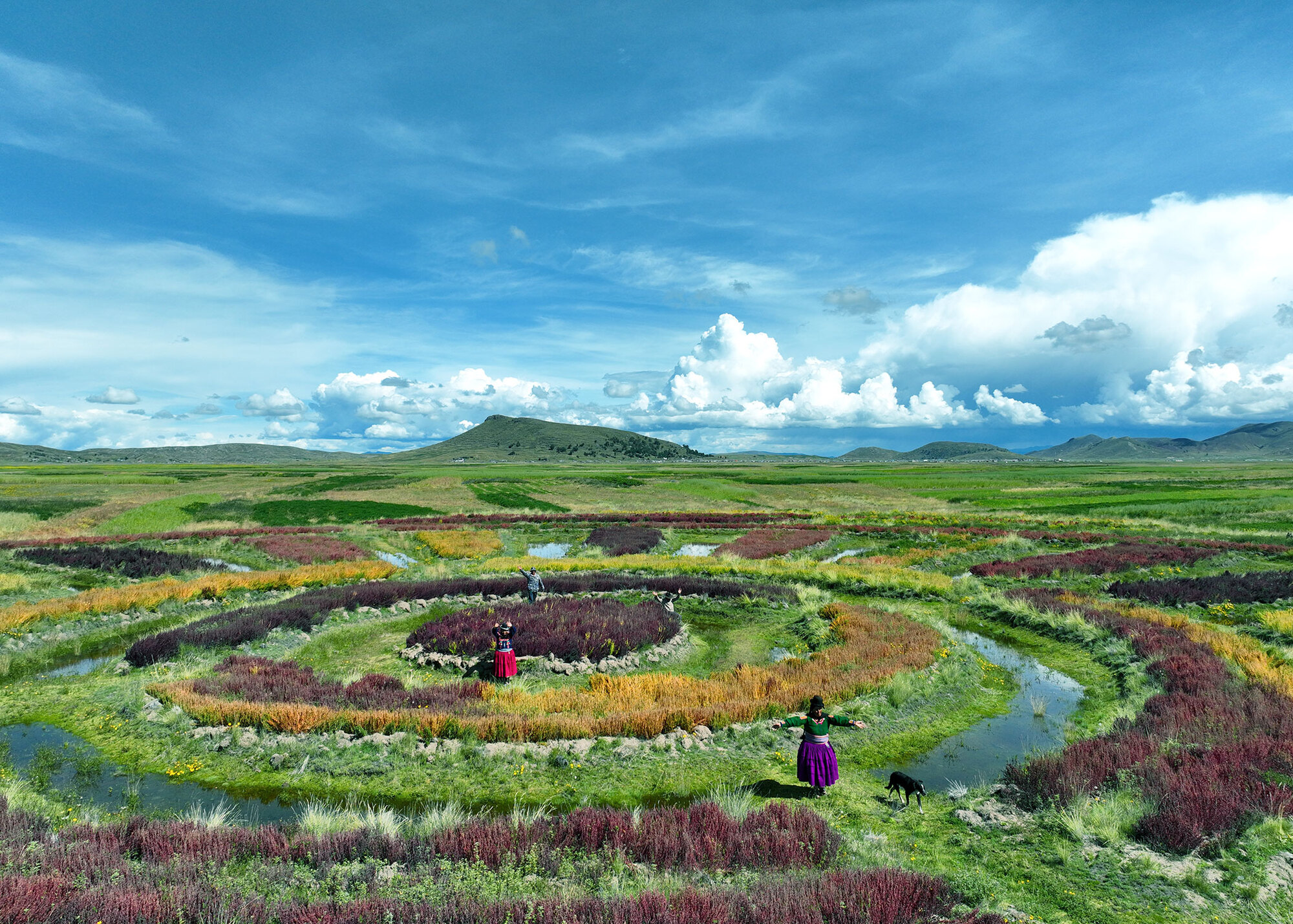
Peruvian farmers around Lake Titicaca are rebuilding pre-Hispanic waru waru raised fields, which use surrounding water channels to buffer crops against frost; a 1980s reconstruction programme restored 229 of a planned 500 hectares, with mixed results.
Instituto Nacional de Investigación Agropecuaria y Agroindustrial (INIAA), CIAS, CEPIA and local NGOs
Period
technique dated to ~300 BCE; reconstruction programme 1982-1989, revival continuing to present
Keywords
agriculture, water management, climate adaptation, cultural heritage
Context
Around Lake Titicaca, pre-Hispanic farmers built waru waru — raised planting beds separated by water-filled channels — dating to around 300 BCE, once covering an estimated 82,000 hectares across the Peru-Bolivia altiplano before falling out of use.
Objectives
Between 1982 and 1989, Peruvian agricultural research institutions (INIAA, CIAS, CEPIA) and NGOs ran a reconstruction programme around Puno aiming to rebuild 500 hectares of waru waru across 72 rural communities, to reduce frost damage to potato and quinoa crops using the beds' water-buffered warmth.
Results
The surrounding water keeps growing beds roughly 1°C warmer than nearby flat fields; by the end of the 1982-1989 programme, 229 of the targeted 500 hectares had been converted, with mixed productivity results — some plots saw large gains, particularly for potatoes, while others did not.
Conclusions
No source reviewed gives a specific present-day yield increase, current hectare count under cultivation, or named current funding body — the strongest quantified evidence concerns the thermal/frost-buffering mechanism and the 1980s programme's scale, not present-day productivity.
Implementation
Indicative cost
Low (< €50k)
Time to results
Long (> 3 years) — Reconstruction programme ran 1982-1989 (7 years); revival by communities continuing to present.
Staffing & skills
Peruvian agricultural research institutions (INIAA, CIAS, CEPIA) and local NGOs coordinating reconstruction, Rural communities (e.g. Acora, Huatta, Coata) maintaining fields
Conditions for success
Community labour to rebuild and maintain raised beds and channels
Sustained community adoption in some communities beyond programme end
Common failure modes
Mixed productivity results across converted plots
Programme achieved only 229 of 500 targeted hectares
Commonly funded by
National / regional programmesPhilanthropic / foundation funding
Indicative funding routes for practices of this type — always check each programme's current calls and eligibility rules.
Do you run this practice?
Claim it —
verified implementers get a public contact pathway and can propose corrections.
Data sources
Where this practice's information was retrieved from, and when.
Battir's dry-stone terraces near Bethlehem are fed by the hakura system, a time-shared spring-water rotation among village families. UNESCO inscribed …
Sri Lanka's 2,000-year-old cascaded tank irrigation network, an FAO-designated agricultural heritage system since 2017, is being restored under a GEF/UNEP-backed …