Colombo's Urban Wetlands — Avoided-Cost Flood Mitigation for a Ramsar Wetland City (Sri Lanka)
Sri Lanka
Sri Lanka's capital combines wetland conservation, restored public wetland parks and Ramsar Wetland City status to avoid flood damage valued …
South Korea · Seoul · See the South Korea profile · See the Seoul profile
Evidence: Observational / pre–post Top 27% 53/100 · Ask Evidence Copilot about this practice
Seoul removed a 5.6km elevated highway and daylighted the buried Cheonggyecheon stream, cutting local air pollution 35%, raising species counts 639% (2003–2008), and cooling the corridor 3.3–5.9°C — though the flow is now pumped, not natural.
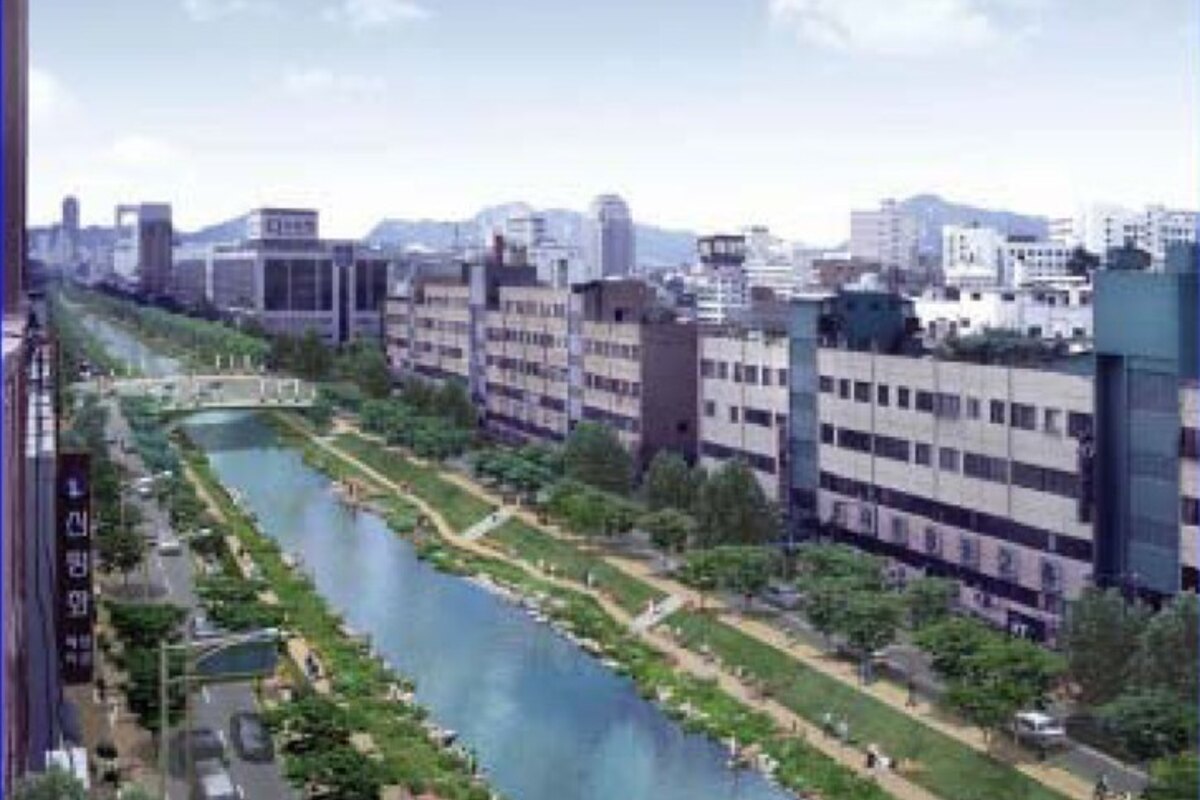
Seoul buried the historic Cheonggyecheon stream under a culvert from 1958 and built a 5.6km elevated expressway over it in 1976 to serve a rapidly motorising city. Between July 2003 and September 2005 the Seoul Metropolitan Government demolished the expressway and daylighted the stream, creating a linear park along the former road corridor.
Because the original watershed had been irreversibly urbanised, the restored stream is sustained artificially: roughly 120,000 tonnes of water are pumped daily from the Han River and groundwater into a concrete-lined streambed, which limits natural self-purification. The project cost approximately $380 million (about $120 million for landscape and stream works), and pumping/maintenance now costs an estimated 7.1 billion KRW per year, rising as algae-control needs grow.
Documented outcomes include a 3.3–5.9°C temperature reduction along the corridor versus a parallel road 4–7 blocks away, a 35% cut in fine-particulate air pollution (74 to 48 µg/m³), and flood protection engineered for up to a 200-year event. Between 2003 and 2008 recorded species richness rose 639% (plants 62→308, fish 4→25, birds 6→36, invertebrates 5→53). Nearby property values rose 30–50% within 50 metres, business growth outpaced the citywide rate (3.5% vs 1.75%, 2002–2003), and the corridor now draws roughly 64,000 visitors daily.
The project is widely cited internationally as a transferable model for urban daylighting, though its reliance on pumped water and a concrete bed, rather than a self-sustaining natural hydrology, is a recognised limitation for cities considering replication.
National / regional programmes Own resources / municipal budget
Indicative funding routes for practices of this type — always check each programme's current calls and eligibility rules.
Do you run this practice? Claim it — verified implementers get a public contact pathway and can propose corrections.
Where this practice's information was retrieved from, and when.
Sri Lanka
Sri Lanka's capital combines wetland conservation, restored public wetland parks and Ramsar Wetland City status to avoid flood damage valued …
Portugal
An EU LIFE-funded programme (2019-2025) converting irrigated Lisbon parkland into rain-fed meadows and planting over 107,000 trees and shrubs, cutting …
Micronesia
Since 2002 the Micronesia Conservation Trust has mobilised USD 100 million, including a USD 50 million endowment, funding 150+ protected …
South Africa
A US$3.5m GEF project (2012–2018) trained over 5,000 people in integrated fire management across four Western Cape communities in South …
Open full copilot Grounded in cited practices — always check the sources.