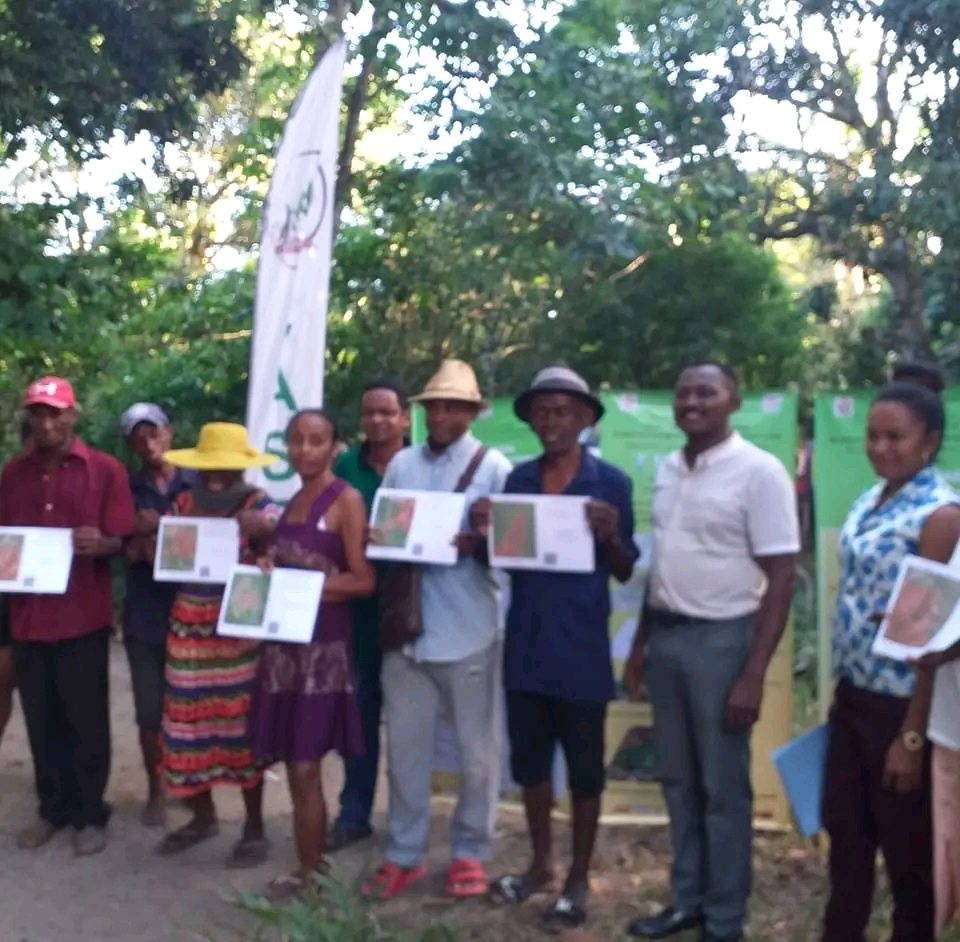
Le programme CASEF de Madagascar (47 M$, 2016–2024) a réduit le coût d'un certificat foncier d'environ 600 à 25 dollars et délivré plus de 570 000 certificats, dont 28 % à des femmes — en deçà de l'objectif de 40 %.
47 USD million
Budget du programme
~600 USD
Coût d'un certificat foncier, avant
~25 USD
Coût d'un certificat foncier, après
>570,000
Certificats fonciers délivrés (by late 2023)
~660,000
Demandes supplémentaires en cours (by late 2023)
~300,000
Ménages touchés (estimation)
28 %
Certificats délivrés à des femmes ou en titularité conjointe (vs. 40% target)
90 %
Titulaires de certificats déclarant des droits désormais reconnus
80 %
Titulaires signalant une augmentation de la valeur perçue de leur propriété
56 %
Titulaires signalant un investissement dans une production à plus long terme
Détails
Maturité
Abandonnée
Promoteur
World Bank (IDA), with Madagascar's Ministry of Agriculture and Livestock and Ministry of Land Management and Land Services
Période
2016–2024
Mots-clés
land rights, women's economic empowerment, property rights, agriculture
Contexte
CASEF (Croissance Agricole et Sécurisation Foncière) était un programme de certification foncière financé par la Banque mondiale (IDA) à hauteur de 47 millions de dollars (2016-2024), mis en œuvre avec le ministère de l'Agriculture et de l'Élevage et le ministère de l'Aménagement du Territoire et des Services Fonciers de Madagascar, dans 14 des 23 régions du pays.
Objectifs
Le programme visait à formaliser les droits fonciers des petits exploitants en numérisant et en décentralisant la délivrance des certificats via des guichets fonciers locaux, en réduisant le coût d'obtention d'un document foncier, et fixait un objectif explicite selon lequel 40 % des certificats devaient être délivrés à des femmes, à titre individuel ou conjoint, afin de réduire l'écart entre les genres en matière de droits fonciers.
Activités
Les guichets fonciers locaux ont été décentralisés et numérisés afin de délivrer des certificats à un coût bien inférieur à celui pratiqué auparavant.
Résultats
À l'approche de sa clôture, fin 2023, le programme avait délivré plus de 570 000 certificats fonciers (avec environ 660 000 demandes supplémentaires en cours de traitement), touchant environ 300 000 ménages ; le coût moyen d'un document foncier est passé d'environ 600 à environ 25 dollars. 28 % des certificats ont été délivrés à des femmes ou en tant que titularité conjointe, n'atteignant pas l'objectif de 40 %. Des enquêtes menées par la Banque mondiale auprès des bénéficiaires ont montré que 90 % des titulaires de certificats estimaient que leurs droits étaient désormais reconnus, 80 % ont signalé une augmentation de la valeur perçue de leur propriété, et 56 % ont déclaré avoir investi dans une production à plus long terme (par exemple des arbres fruitiers) en conséquence. Des enquêtes indépendantes (Témoignages, Helvetas) ont corroboré le nombre de certificats délivrés, mais ont constaté que de nombreuses communes n'avaient jamais bénéficié d'un guichet foncier opérationnel, et que les chefs de Fokontany locaux favorisaient souvent les hommes au détriment des femmes, même lorsque la certification existait.
Conclusions
Le projet s'est achevé en juin 2024 sans qu'aucun financement de suivi confirmé n'ait été identifié, illustrant le fait que les avancées juridiques formelles sur le papier ne se sont pas uniformément traduites en un accès pratique équitable pour les femmes.
Mise en œuvre
Les détails de mise en œuvre (coût, calendrier, personnel, conditions de réussite) ne sont pas encore disponibles pour cette pratique.
Habituellement financé par
National / regional programmes
Pistes de financement indicatives pour des pratiques de ce type — vérifiez toujours les appels en cours et les règles d'éligibilité de chaque programme.
Vous portez cette pratique ?
Revendiquez-la —
les porteurs vérifiés obtiennent un contact public sur la page et peuvent proposer des corrections.
Sources de données
D'où proviennent les informations de cette pratique, et quand.
L'Éthiopie (1998-2021) a délivré des certificats fonciers conjoints (noms/photos des deux conjoints) à des millions de ménages. Sécurité foncière perçue …