Hydropower expansion and improved management in response to increased glacier melt in Iceland
Islande
None
France · Voir le profil de France
Preuves: Descriptif / auto-déclaré · Demandez à Evidence Copilot à propos de cette pratique
None
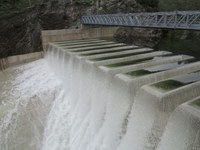
Releasing water safely from dams during floods or heavy precipitation presents a critical operational challenge. Past trends show an increase in extreme daily rainfall in southern France, which can lead to flash floods. This trend is expected to continue in the future. Snow and glacier melt are also expected to impact on dam inflow and outflow in the longer term. Glacier mass loss already shows a consistent acceleration across the Alps. The challenge for flood management at hydropower facilities is to prevent or minimise the impacts of dam-overtopping on downstream communities, property, agriculture and ecosystems, while also protecting the dams themselves against operational failure and other damage. Each hydropower dam presents different risk levels and the effectiveness of PKW systems must be evaluated separately in each case.
The PKW system was developed in response to updated hydrological studies by EDF, which showed that extreme floods affecting hydropower dams were becoming more frequent and intense. PKWs help to adapt dam capacity to cope with climate change impacts such as increased precipitation and flooding. The objective of PKW systems is to provide an increased surface area for the (over)flow of water. This increases the discharge capacity of the dam without changing the maximum reservoir level. The primary benefit of such technology is to protect hydropower assets from damage, while also reducing operational costs compared to alternative gate systems. Other benefits include reducing downstream impacts during heavy precipitation events, as well as ensuring security of energy supply during such events through reduced operational failures.
The valley of Chassezac in the department of Ardèche in the Auvergne-Rhône-Alpes region of France was identified as a high potential hydrological basin in the 1950s. This led to the development of five hydropower dams and four hydropower plants, which were all built between 1961 and 1970. One of these, the Malarce dam, has a height of 28.4 m, a length of 111 m and a withholding capacity of 2.3 hm 3 (i.e. 2.3 million m 3 ). It became operational in 1968 and has a power capacity of 16MW. The PKW for the Malarce dam was commissioned to increase its maximum discharge capacity by around 600 m 3 /s to a total of 4600 m 3 /s. When dam water levels exceed the level in the inlet tanks, water automatically flows over the PKW into outlet tanks that run straight into the spillway channel and downstream. This technology provides a means of adapting dams to increasing flood risks expected under climate change. The PKW in the Malarce dam helps to reduce the risk of costly damage to dam infrastructure and to downstream communities. There are several engineering options available for managing dam spill over. Labyrinth spillways can only be installed in certain types of dams and must usually must be installed at the earliest dam design stage. Gated systems are in place in many existing dams for flow management. However, gated systems can fail in cases of saturation due to excessive flooding. PKWs often present the most effective option for flood risk management at existing dams. PKWs do not have a maximum capacity but instead provide a free flow spillway. PKWs can therefore manage much higher flow levels and provide a safer solution than gated systems, with minimal risk of malfunction and easier evacuation of floating debris. In contrast to other flow management techniques, PKWs also avoid human error, since they do not require human operators. This is helpful in emergency situations including flash flooding and landslides, during which workers cannot access the site. The principal European players in PKW technology are France, Switzerland and Belgium. EDF did not patent the PKW system. Instead it has been working collaboratively to share the PKW technology and insights with other players in the international hydropower community. Indeed, indicating international recognition of the innovative technology, several developers around the world (e.g. in Algeria, the USA and South Africa) are also installing PKWs. In 2015, EDF received a Climate Solutions Award from the United Nations Framework Convention on Climate Change on the theme of adaptation.
The cost of the PKW depends on the existing dam structure, location and also on the extent of water flow. Accessibility of the dam structure and associated equipment needs also impact on the cost. Depending on the dam, it may be more or less costly to install modifications such as PKW. Installation of PKW can cost between 200,000 and a few million Euros. In any case, the PKW can be cost-efficient, representing a relatively small component of the overall cost of the dam. Examples of PKW installation are routinely quoted as taking up to 30% of the total cost. While current gated system technology must be operated manually and requires expensive regular maintenance, PKWs do not require operating manpower and only low to no maintenance is needed.
The PKW has been implemented in various hydropower facilities globally. This wide spread was facilitated by EDF’s decision not to patent this technology. The collaborative approach of the original developers, who shared the technology with stakeholders throughout the hydropower community, is one of the most important success factors of the technology. PKW is a cheap and easily installed solution compared to other overflow management technologies, such as gated systems. Furthermore, PKW technology is reliable and resilient since there is no need for manned operations or large scale maintenance. Finally, the fact that the first PKW was built by EDF, a well-known company that is well-respected in the hydropower sector, helped to convince other dam owners to install PKWs. Challenges relating to PKWs include the suitability and accessibility of certain dam sites, particularly in mountainous regions. Furthermore, the long lifetime of hydropower infrastructure and the duration of the product cycles means that the spread of new ideas and technological solutions takes time in this industry. Finally, construction at dam sites usually takes place only in the summer months, which adds further constraints to the installation of PKWs.
Les détails de mise en œuvre (coût, calendrier, personnel, conditions de réussite) ne sont pas encore disponibles pour cette pratique.
Own resources / municipal budget
Pistes de financement indicatives pour des pratiques de ce type — vérifiez toujours les appels en cours et les règles d'éligibilité de chaque programme.
Vous portez cette pratique ? Revendiquez-la — les porteurs vérifiés obtiennent un contact public sur la page et peuvent proposer des corrections.
D'où proviennent les informations de cette pratique, et quand.
Islande
None
Finlande
None
Japon
À Mashike, Hokkaido, Nippon Steel et la coopérative de pêche locale ont transformé des scories d'aciérie en substrat de croissance …
Ouganda
Des charançons Neochetina lâchés dès 1995 ont réduit le tapis de 20 000 hectares de jacinthe d'eau du lac Victoria …
Ouvrir le copilote complet Fondé sur des pratiques citées — vérifiez toujours les sources.