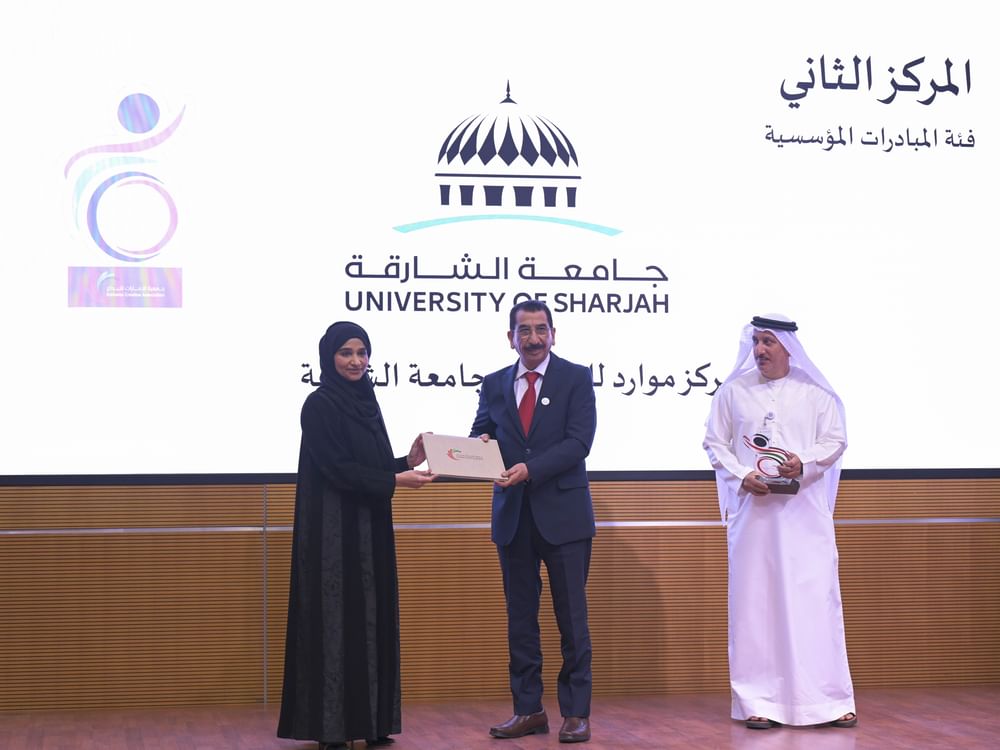
A University of Sharjah case study of 12 media students 'of Determination' found generative AI — ChatGPT, Canva, Runway ML, Otter.ai — cut task time by an estimated 40% as informal accommodations; its Disability Resource Centre won a 2026 national inclusion award.
12
Focus-group participants
~40 %
Estimated reduction in task-completion time
Details
Maturity
Pilot
Promoter
University of Sharjah — Disability Resource Centre / College of Communication
Period
2025–2026
Keywords
higher education, disability inclusion, generative AI
Context
The University of Sharjah's College of Communication and its Disability Resource Centre support 'Students of Determination,' the UAE's official term for students with disabilities, studying broadcast and media production -- a field with heavy practical, visual and time-pressured coursework.
Activities
Researchers ran two 75-minute focus groups with 12 media students of determination to understand how they were already using mainstream generative-AI tools -- ChatGPT for ideation and scripting, Canva and Runway ML for visual prototyping, and Otter.ai for lecture transcription -- as informal academic accommodations, publishing the findings as a peer-reviewed case study.
Results
Participants estimated the tools cut task-completion time by around 40% and reported gains in creative independence, but also cited a steep learning curve and the cost of premium AI features as barriers.
Conclusions
Separately, the University of Sharjah's Disability Resource Centre took 2nd place in the 'Institutional Initiatives' category of the UAE's inaugural Award for Creativity for Determination in 2026, corroborating that inclusive-AI support is an active institutional priority rather than a one-off study. The evidence is a small (n=12) self-report study, not a controlled or longitudinal trial, and the AI tools studied are general-purpose consumer products adopted informally rather than a university-built or -procured system.
Implementation
Indicative cost
Low (< €50k) — Informal use of consumer AI tools (ChatGPT, Canva, Runway ML, Otter.ai); premium-tier costs cited as a barrier for some students.
Time to results
Short (< 1 year) — Two 75-minute focus groups; institutional recognition in 2026.
Staffing & skills
University of Sharjah Disability Resource Centre, College of Communication faculty
Conditions for success
Students self-adopting low-cost, mainstream consumer AI tools rather than needing custom institutional systems
Common failure modes
Steep learning curve and cost of premium AI features cited as barriers
Small (n=12) self-report study, not a controlled or longitudinal trial
Where it fits
Governance type
university disability-resource centre
Scale
single institution (University of Sharjah)
Income level
high-income
Do you run this practice?
Claim it —
verified implementers get a public contact pathway and can propose corrections.
Data sources
Where this practice's information was retrieved from, and when.
Transilvania University of Brasov researchers built AccessiLearnAI, a proof-of-concept platform combining AI alt-text, summarisation and text-to-speech with WCAG-compliant design; early …
UNICEF Bhutan and the Ministry of Education trained curriculum experts, teachers and special-educators to produce accessible digital textbooks with PubCoder, …
Jamaica's 2022 pilot developed accessible digital storybooks tested in five schools—four for deaf, blind and intellectually disabled students. UNICEF's 10-country …