Thailand 'AI for Teachers' — Upskilling 160,000 Educators Nationwide
Thailand
Government programme that trained and certified 160,507 Thai educators in ethical AI use, saving 4 hrs/week per teacher, and reaching …
France · Paris · See the France profile · See the Paris profile
Evidence: Quasi-experimental Top 14% 67/100 · Ask Evidence Copilot about this practice
Erasmus+ project (2021–2024) training 1,005 secondary teachers in France, Slovenia, Italy, Ireland and Luxembourg to integrate AI into Maths, Languages and Science; MOOC, open textbook and test/control evaluation; resources freely licensed and adopted globally.
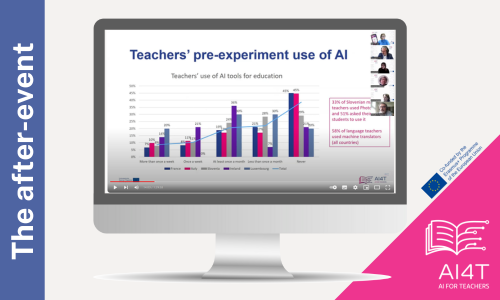
AI4T (Artificial Intelligence for and by Teachers) was a three-year Erasmus+ Key Action 3 project (2021-2024) led by France Éducation international, partnering with education ministries, research institutes and schools across France, Slovenia, Italy, Ireland and Luxembourg. Its central aim was to build secondary school teachers' understanding and pedagogical use of AI-based tools in Maths, Modern Languages and Science/Technology for students aged 14-17.
To equip secondary teachers with the understanding and pedagogical skills to integrate AI-based tools into Maths, Languages and Science teaching, and to produce freely reusable open resources (MOOC, open textbook) that could be adopted beyond the original five-country consortium.
During the pilot phase (November 2022-June 2023), 1,005 educators from 302 schools across the five countries completed a structured professional learning pathway: a free MOOC, an open textbook and hybrid webinar/face-to-face sessions.
The impact evaluation used a test group and a control group, collecting survey responses from 738 teachers and 204 headteachers, semi-structured interviews with 88 teachers and 18 headteachers, and questionnaires from 7,551 pupils. Results showed significant gains in teachers' AI understanding, confidence and pedagogical attitudes.
The project's MOOC and open textbook have since been translated and adopted by countries outside the original consortium; the project was incorporated into UNESCO's AI Competency Framework for Teachers and recognised as an Inspiring Practice by the European Digital Education Hub.
Indicative funding routes for practices of this type — always check each programme's current calls and eligibility rules.
Do you run this practice? Claim it — verified implementers get a public contact pathway and can propose corrections.
Where this practice's information was retrieved from, and when.
Thailand
Government programme that trained and certified 160,507 Thai educators in ethical AI use, saving 4 hrs/week per teacher, and reaching …
Taiwan
Taiwan's MoE integrates AI into its free national Adaptive Learning Platform (TALP) for K-12. A quasi-experiment (n=4,442 sixth-graders) showed significant …
Sierra Leone
EducAid and FabData deploy theTeacher.ai, a WhatsApp AI assistant for 529 teachers in 300 Sierra Leonean schools. A World Bank …
Croatia
Croatia's BrAIn (ESF+, EUR 16 M) piloted an AI elective in 53 VET schools in 2024/25: 68 trained teachers, 1,018 …
Open full copilot Grounded in cited practices — always check the sources.