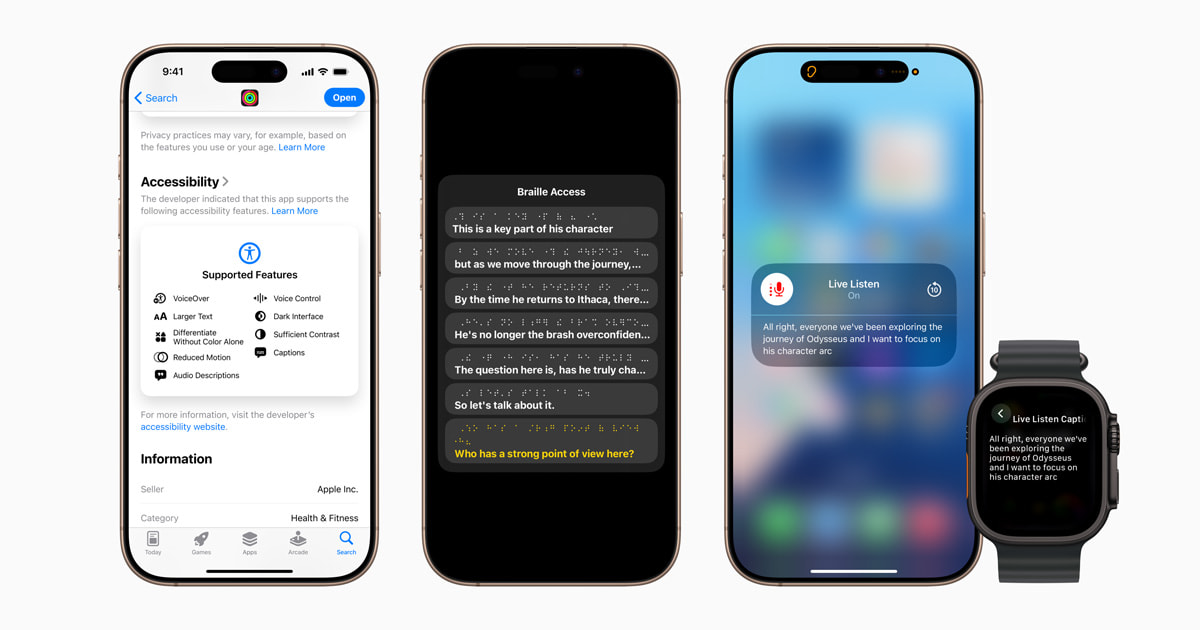
Apple introduced Accessibility Nutrition Labels for the App Store in 2025, letting developers disclose upfront which accessibility features — VoiceOver, Voice Control, captions, larger text — an app supports before users download it, worldwide.
over 1 billion active devices
Active devices reached (2025)
~10 pages
Evaluation-criteria document length (2025)
Details
Maturity
Scaling
Promoter
Apple Inc.
Period
2025–ongoing
Keywords
technology, digital accessibility, app store policy, disability inclusion
Context
Users who rely on assistive technology — screen readers, switch control, captions or larger text — have historically had no way to know whether an app would actually work for them before downloading it, often discovering incompatibilities only after installation.
Objectives
Apple's Accessibility Nutrition Labels aim to let developers disclose upfront which accessibility features an app supports before users download it.
Activities
Announced in May 2025 around Global Accessibility Awareness Day and detailed at WWDC 2025, the labels appear on App Store product pages and disclose whether an app supports features including VoiceOver, Voice Control, larger text, sufficient contrast, reduced motion, captions and audio descriptions; developers submit this information against a published evaluation-criteria document of roughly ten pages as part of App Store Connect.
Results
As of the 2025 rollout the labels are optional, but Apple has said they will become a required part of future app submissions, and they are already live worldwide on the App Store, reaching Apple's reported base of over a billion active devices.
Conclusions
Adoption remains voluntary at launch, and no independent third-party data yet quantifies what share of App Store titles have added labels or whether they measurably reduce accessibility complaints — the feature is too new for outcome evaluation.
Implementation
Indicative cost
Low (< €50k) — The feature was built into Apple's existing App Store Connect submission workflow, so marginal platform cost is low; developer-side cost is the time to self-assess and disclose against the roughly ten-page evaluation criteria.
Time to results
Short (< 1 year) — Announced in May 2025 around Global Accessibility Awareness Day, detailed at WWDC 2025, and live worldwide the same year, with mandatory adoption planned for a future date not yet specified.
Staffing & skills
Apple Inc. (App Store Connect / accessibility engineering teams)
Conditions for success
Integration into the existing App Store Connect submission pipeline used by all developers
A published, standardised evaluation-criteria document (roughly ten pages) developers submit against
A stated plan to make labels mandatory in future submissions rather than leaving them permanently voluntary
Common failure modes
Voluntary adoption at launch means coverage across the App Store catalogue is unmeasured
No independent data yet on whether labels reduce accessibility complaints or improve user outcomes
Radboudumc co-designed a simplified, text-to-speech health survey with co-researchers who have mild intellectual disabilities or low literacy. Three rounds reached …