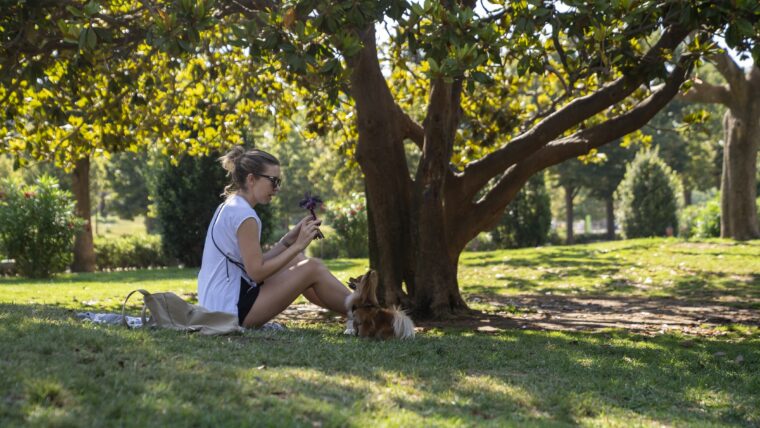
Since 2020 Barcelona's city council has run a network of 'climate shelters': existing public and some private spaces that are signposted as places to rest, drink water and cool down during heat waves. Indoor sites include libraries, civic centres and museums; outdoor sites include parks, gardens, school and nursery playgrounds and inner courtyards.
The network grew quickly. The city's own announcement of 17 June 2024 reported 353 shelters, 120 more than the previous year, with 98% of residents within 10 minutes' walk of one and 68% within 5 minutes. Admission is free except at municipal swimming pools that act as shelters. A retrospective by El Salto Diario cites council data of 200 facilities in 2022 and about 400 signposted sites in August 2025, dominated by 128 neighbourhood facilities, 55 pools, 50 libraries, 47 parks and 19 markets. A Greenpeace-linked report counts 401 sites in Barcelona against 131 in Bilbao, 94 in Murcia, 31 in Madrid and 5 in Seville, and notes that only 16 of 52 Spanish provincial capitals have any network.
The shelters are linked to the city's heat-wave protocol: the preventive alert starts when daytime maxima exceed 33.7 °C or night minima exceed 25.9 °C, and the emergency stage above 35.7 °C / 27.9 °C. At that point the municipal social-emergency centre (CUESB) offers a cool waiting room, water and overnight stays for frail people.
Evidence caveats: neither source reports visitor numbers, who uses the shelters, or any effect on heat-related illness or mortality. Critics quoted by El Salto Diario say some listed sites are only shaded, lack air conditioning, close at midday, evenings or weekends, or (markets, shopping centres) may expect a purchase, and that pools charge. Ciutat Vella, the lowest-income district, has 41 shelters against 28 in the highest-income Sarrià-Sant Gervasi, which suggests some pro-poor distribution. The model is cheap because it reuses existing buildings, and it is replicable in other cities, but its health benefit remains unmeasured.
Read the full analysis: https://barcelona.cat/barcelona-pel-clima/en/news/over-350-climate-shelters-open-to-help-beat-the-heat-1410886
Where this practice's information was retrieved from, and when.