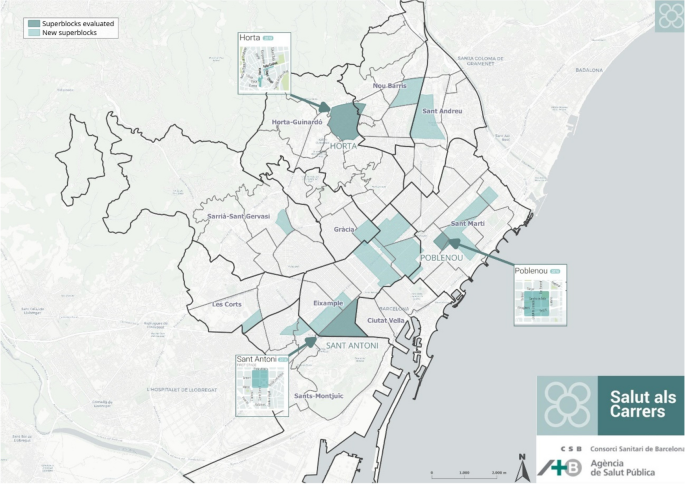
Barcelona closed street grids to through-traffic in pilot 'superblocks'; evaluated zones saw NO2 fall 24% and noise fall 5.4%. A 2019 health-impact model put the city-wide potential at 667 fewer premature deaths a year, but the scheme has also been linked to rising local rents.
~500 intersections
Intersections targeted city-wide
~667 deaths/year
Estimated premature deaths preventable per year (full implementation)
~200 days
Estimated added life expectancy per resident
~1.7 EUR billion
Estimated annual economic savings
24 %
Drop in street-level NO2
47 to 36 µg/m³
Street-level NO2, before vs after
5.4 %
Drop in street-level noise
54 to 51 dB
Street-level noise, before vs after
86 %
Rise in local housing prices (related Poblenou 22@ rezoning) (1997-2002)
Details
Maturity
Scaling
Promoter
Barcelona City Council / BCNecologia / ISGlobal / Public Health Agency of Barcelona (ASPB)
Period
2016-present
Region (NUTS)
ES51
Keywords
urban planning, public health, mobility, air quality
Context
Starting with Poblenou in 2016, Barcelona began converting sections of its Eixample grid into 'superilles' (superblocks): 3x3 clusters of city blocks where through-traffic is excluded from interior streets, freeing the reclaimed space for pedestrians, cycling and green infrastructure. The city's official plan envisions extending the model across roughly 500 intersections of the grid, though rollout since 2016 has been incremental and politically contested, with several planned superblocks delayed or scaled back after resident and business pushback.
Activities
Barcelona City Council, BCNecologia, ISGlobal and the Public Health Agency of Barcelona (ASPB) have jointly implemented and evaluated the model, converting interior streets in successive superblocks and monitoring environmental and health outcomes.
Results
A health-impact assessment led by ISGlobal with ASPB and BCNecologia, published in Environment International (2019), modelled five exposure pathways (air pollution, noise, heat, green space and physical activity) against mortality data and estimated that full implementation of the original plan could prevent about 667 premature deaths a year across Barcelona, add close to 200 days of life expectancy per resident on average, and save roughly EUR 1.7 billion annually. A follow-up mixed-methods evaluation ('Salut als Carrers') across the three earliest superblocks (Poblenou, Sant Antoni and Horta), published in BMC Public Health in February 2025, measured a 24% drop in street-level NO2 (from about 47 to 36 micrograms per cubic metre) and a 5.4% drop in noise (54 to 51 dB) in the converted streets, alongside resident-reported gains in perceived wellbeing, sleep quality and social interaction, and higher observed walkability and outdoor activity.
Conclusions
The model is not without documented downsides. Academic case studies of Barcelona's related Poblenou industrial-to-innovation rezoning (22@) found an 86% rise in local housing prices between 1997 and 2002 and displacement of small firms and residents, and critics have raised similar gentrification concerns about superblock streets becoming more desirable. The city's own pace of rollout — well short of the original scale ambition a decade on — is itself evidence that political and commercial resistance is a real constraint on scaling this kind of intervention, not just a communications problem.
Implementation
Indicative cost
High (€500k–€5M) — City-wide infrastructure retrofit envisioned across roughly 500 intersections; no single published capital figure, but modelled annual economic savings of ~EUR 1.7 billion if fully implemented.
Time to results
Long (> 3 years) — Poblenou pilot from 2016; incremental, politically contested rollout continuing over a decade; full city-wide plan not yet complete.
Staffing & skills
Barcelona City Council — planning and implementation, BCNecologia — urban ecology design, Barcelona Institute for Global Health (ISGlobal) — health-impact modelling and evaluation, Public Health Agency of Barcelona (ASPB) — public health evaluation
Conditions for success
Political will to sustain rollout against resident and business pushback
Health-impact modelling and field evaluation to build the evidence case for further expansion
Integrated design combining traffic exclusion with green infrastructure
Common failure modes
Several planned superblocks delayed or scaled back after resident and business pushback
Related area rezoning (22@) associated with an 86% rise in housing prices and displacement, raising gentrification concerns for superblock streets
Rollout well short of the original ~500-intersection ambition a decade on
Do you run this practice?
Claim it —
verified implementers get a public contact pathway and can propose corrections.
Data sources
Where this practice's information was retrieved from, and when.