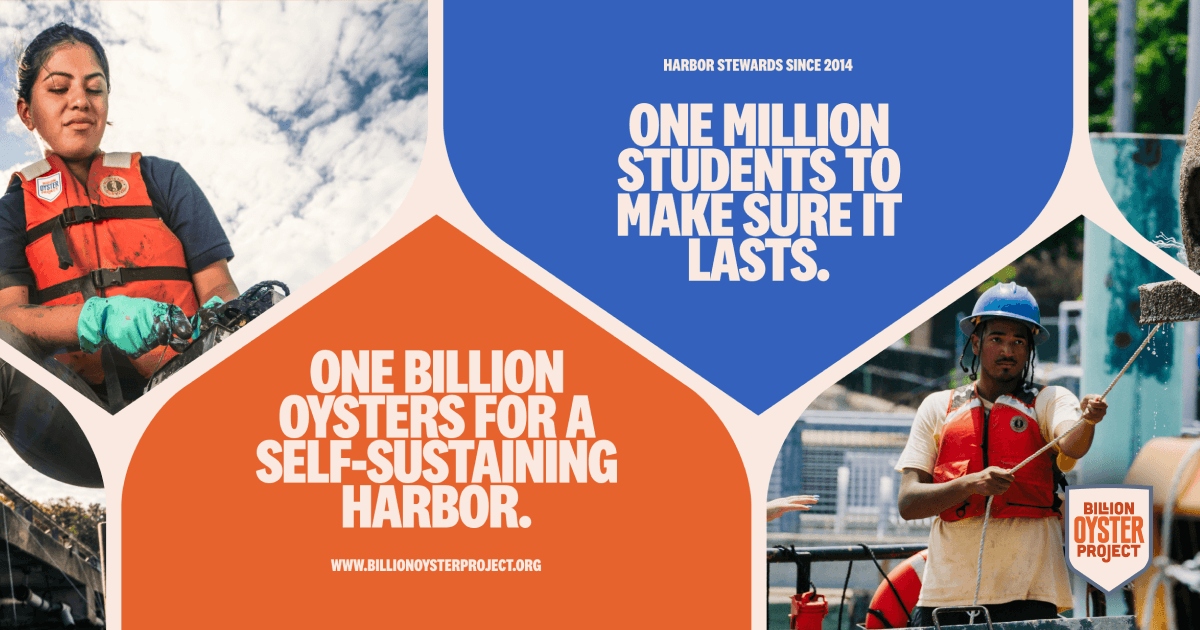
Founded in 2008 by a public high school, Billion Oyster Project has restored 150–200+ million native oysters over 17–19 acres of reef across New York Harbor, recycling millions of pounds of restaurant shell and training thousands of students.
150-200 million+ oysters
Oysters restored (2008-2025)
17-19 acres
Reef area restored (2008-2025)
2-3 million pounds
Shell recycled (2008-2025)
11,000+ public school students
Students engaged
16,000+ volunteers
Volunteers engaged
5 US$ million
NSF grant for schools programme (2015)
Details
Maturity
Scaling
Promoter
Billion Oyster Project (founded by New York Harbor School)
Period
2008–present
Keywords
marine conservation, water quality, reef restoration, environmental education
Context
Billion Oyster Project was founded in 2008 by the New York Harbor School, a New York City public high school, with the goal of restoring one billion native oysters to New York Harbor by 2035 while engaging one million people in the effort, after oysters had become functionally extinct in the harbor following over a century of dredging, pollution and overharvesting.
Activities
The project's mechanism combines shell recycling and reef engineering with education: used oyster shells are collected from more than 75 partner NYC restaurants, cured, and used as cultch for hatchery-raised oyster larvae, then deployed as reef structures at 8-plus monitored sites across the harbor, with more than 11,000 public school students and over 16,000 volunteers taking part in restoration and monitoring work.
Results
The organisation's own site cites over 150-200 million oysters restored across roughly 17-19 acres of reef and around 2-3 million pounds of shell recycled as of late 2025, a 2015 National Science Foundation grant of $5 million funded expansion of the schools programme, and the project is a named partner in New York State's $107 million Living Breakwaters coastal-resilience project in Staten Island.
Conclusions
Long-term monitoring has confirmed oysters can survive and reproduce in the harbor, but the specific oyster-count and acreage figures come from the organisation's own reporting, and no independently published, peer-reviewed population survey or water-quality-improvement measurement at these reef sites was found, so ecosystem-service claims like filtration should be read as biologically plausible rather than locally measured.
Implementation
Indicative cost
High (€500k–€5M) — Funded through a mix of grants and partnerships, including a $5 million National Science Foundation grant (2015) for the schools programme and a role in New York State's $107 million Living Breakwaters project.
Time to results
Long (> 3 years) — Founded 2008, operating continuously with a 2035 target for one billion oysters restored.
Staffing & skills
New York Harbor School staff and students, Billion Oyster Project restoration and education team, Restaurant shell-recycling partners, Community volunteers
Conditions for success
A reliable shell-recycling supply chain from partner restaurants to provide settlement substrate
Sustained multi-year public and philanthropic funding, including national grants
Integration with a public high school's curriculum to build a lasting volunteer and student base
Common failure modes
No independently published, peer-reviewed population survey or water-quality measurement exists at the reef sites, so ecosystem-service claims rely on the organisation's own reporting
Restoring one billion oysters by 2035 requires reef survival at a much larger scale than the 150-200 million restored to date
Where it fits
Governance type
nonprofit led by a public school, with city/state and federal partners
Scale
harbor-wide (8+ monitored sites)
Income level
high-income
Commonly funded by
Philanthropic / foundation fundingNational / regional programmes
Indicative funding routes for practices of this type — always check each programme's current calls and eligibility rules.
Do you run this practice?
Claim it —
verified implementers get a public contact pathway and can propose corrections.
Data sources
Where this practice's information was retrieved from, and when.