HANS — Estonia's AI Speech-Recognition System for Parliamentary Verbatim Records
Estonia
Since 2020, Estonia's Riigikogu has used HANS, an AI speech-recognition tool built with Tallinn University of Technology, to auto-transcribe plenary …
Chile · Valparaíso · See the Chile profile
Chile's Chamber of Deputies built CAMINAR, a four-part generative-AI suite for bill drafting, transcription and regulatory-impact review, using closed authorised legal databases with mandatory human validation — deployed for the 2024 Budget Law, but unevaluated.
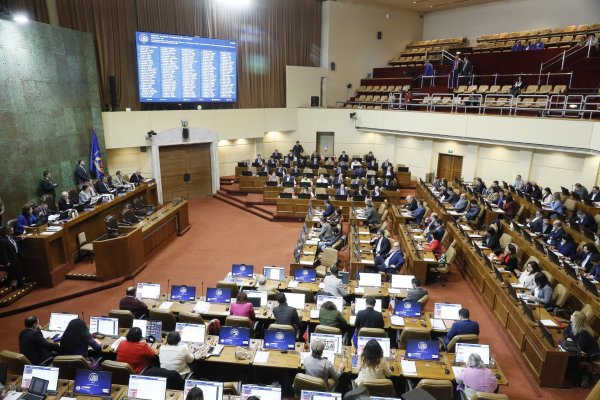
In June 2024, the Information and Communications Technologies Directorate of Chile's Chamber of Deputies (Cámara de Diputadas y Diputados) presented CAMINAR ("Cámara Inteligencia Artificial"), a proprietary generative-AI suite built in a closed environment. It comprises four components: Caminar-L for legislative work (transcription, semantic search, automated summaries and comparisons of bills, and regulatory impact assessments), Caminar-A for administrative support, Caminar-T for public information access, and Caminar-M, mobile apps for members of parliament and citizens.
The Chamber's Secretary General, Miguel Landeros, presented the suite as running on authorised, vectorised legal databases with mandatory human validation before any output is released, alongside stated bias-mitigation and legal-hierarchy safeguards; CAMINAR was deployed for the Chamber's November 2024 Budget Law proceedings and is registered in Chile's public-algorithm registry (algoritmospublicos.cl). Landeros described Chile's parliament as, in his words, "the most advanced in the world" in this area, and the project was presented to the U.S. House of Representatives.
No quantitative performance data — bills processed, staff time saved, transcription accuracy, usage volume — has been published in any available source; all evidence found is descriptive, from launch coverage and conference presentations. Deputy Érika Olivera publicly questioned whether parliamentary staff would be adequately trained to use the tools, an unresolved concern as of the latest reporting found, and the "most advanced in the world" framing is a self-assessment by Chamber leadership rather than an independent benchmark.
Read the full analysis: https://www.df.cl/df-lab/transformacion-digital/diputadogpt-camara-se-sube-a-la-ola-de-la-ia-generativa-y-crea
Implementation detail (cost, timeline, staffing, conditions for success) is not yet available for this practice.
Where this practice's information was retrieved from, and when.
Estonia
Since 2020, Estonia's Riigikogu has used HANS, an AI speech-recognition tool built with Tallinn University of Technology, to auto-transcribe plenary …
New Zealand
New Zealand's Parliamentary Counsel Office ran a six-month, five-partner R&D programme fine-tuning an 8-billion-parameter model on 200 examples of NZ …
South Korea
South Korea's National Assembly deployed an on-premises generative-AI platform built by Samsung SDS — combining a custom LLM, retrieval-augmented generation …
Estonia
After a one-word drafting slip left Estonia's online casinos untaxed for 2026 — an estimated €2m/month loss — a former …
Open full copilot Grounded in cited practices — always check the sources.