Kariba REDD+ Project — Carbon Credit Over-Issuance and Correction (Zimbabwe)
Zimbabwe
One of the world's largest community REDD+ projects, run by four Zimbabwean Rural District Councils across ~1.3 million hectares of …
Nepal · Bharatpur · See the Nepal profile · See the Bharatpur profile
Evidence: Observational / pre–post Top 58% 40/100 · Ask Evidence Copilot about this practice
Nepal's first REDD+ pilot paid 112 community forest user groups across three watersheds (Dolakha, Chitwan, Gorkha) via new Forest Carbon Trust Funds — $285,000 distributed 2010-2013 to 16,000+ households, 60% of it weighted toward social-equity criteria.
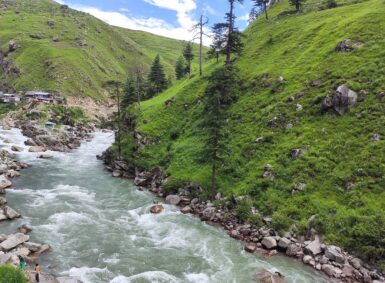
Between 2009 and 2013, ANSAB, ICIMOD and FECOFUN piloted Nepal's first sub-national REDD+ payment scheme with 112 community forest user groups across three watersheds — Charnawati (Dolakha district), Kayarkhola (Chitwan district) and Ludikhola (Gorkha district) — covering over 10,000 hectares and reaching more than 16,000 households and roughly 89,000 forest-dependent people. A $100,000 seed grant from Norway's development agency (Norad) established Nepal's first Forest Carbon Trust Funds, with nested district monitoring committees and a central advisory committee overseeing disbursement.
Test whether Nepal's community forestry system — which already manages roughly a third of the country's forests — could administer performance- and equity-based carbon payments transparently down to the household level, informing Nepal's national REDD+ readiness process.
Local forest user groups were trained to run annual carbon inventories across 570 permanent plots, following IPCC 2006 methodology and covering above- and below-ground biomass, litter and soil carbon. Trust funds disbursed payments using a formula weighting only 40% to measured carbon performance (24% stock, 16% enhancement) and 60% to social-equity criteria: indigenous populations (10%), Dalit households (15%), women (15%) and poor households (20%).
Between 2010 and 2013 the three watersheds registered a combined carbon dioxide saving of 343,339 tonnes, with annual increments averaging 2.62-3.53 tonnes per hectare. The trust funds disbursed $285,000 in total over the three years, including $95,000 in the final year alone (Dolakha $45,535, Gorkha $27,560, Chitwan $21,905).
A 2014 peer-reviewed case study in the journal Forests flagged an unresolved "additionality" question — the community forests were already gaining carbon before the project began — and cautioned that payment-based incentives of this kind work only where payments exceed communities' additional management costs. A separate 2020 Environmental Research Letters assessment characterised the pilot's measured impact as incremental rather than transformative. The pilot nonetheless demonstrated that Nepal's community forestry system can administer performance- and equity-based carbon payments transparently, a model since referenced in Nepal's national REDD+ readiness process.
National / regional programmes
Indicative funding routes for practices of this type — always check each programme's current calls and eligibility rules.
Do you run this practice? Claim it — verified implementers get a public contact pathway and can propose corrections.
Where this practice's information was retrieved from, and when.
Zimbabwe
One of the world's largest community REDD+ projects, run by four Zimbabwean Rural District Councils across ~1.3 million hectares of …
Guatemala
VCS/CCB-certified REDD+ project covering 660,000 ha in Petén's Maya Biosphere Reserve; 12 community concessions managed by ACOFOP and CONAP project …
Nepal
Nepal received its first-ever REDD+ results-based payment - US$9.4 million from the World Bank's FCPF - in November 2025, after …
Tanzania
Plan Vivo-verified REDD+ project protecting 110,500 ha of Hadza and Datoga community land in northern Tanzania, avoiding a cumulative 652,082 …
Open full copilot Grounded in cited practices — always check the sources.