Program H — Promundo's Gender-Transformative Curriculum for Young Men
Brazil
Program H is Promundo's gender-transformative group curriculum for young men, developed in Rio de Janeiro and now adapted in 30+ …
United States of America · San Francisco · See the United States of America profile · See the San Francisco profile
Evidence: Randomised controlled trial Top 9% 96/100 · Ask Evidence Copilot about this practice
Futures Without Violence trains US high-school athletic coaches to deliver brief weekly discussions on healthy relationships and bystander intervention. Two cluster-RCTs (2012, 2013) found reduced dating-violence perpetration at 12 months, with modelled savings of ~$2.4m per 1,00
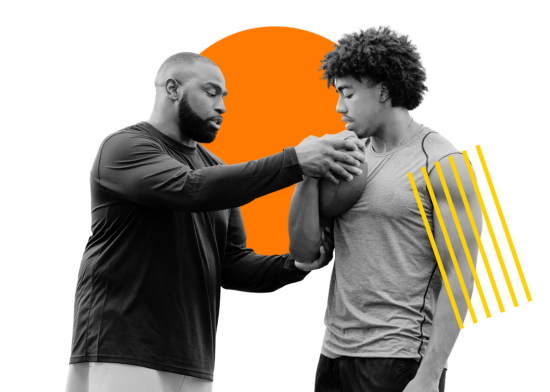
Coaching Boys Into Men (CBIM), developed by the US organisation Futures Without Violence, trains high-school athletic coaches to lead brief, scripted weekly conversations with male student athletes on respect, healthy relationships, recognising abusive behaviour and bystander intervention. Piloted as a media campaign from 2001 and developed into a structured curriculum from around 2004, it has since been disseminated internationally, including in India, South Africa, Australia, New Zealand and Canada.
The programme aims to prevent dating violence and sexual harassment by engaging male athletes through trusted coach relationships, using sport as an entry point for norms-change conversations rather than a stand-alone classroom lesson.
Coaches deliver a scripted sequence of short weekly discussions throughout a sports season, covering respectful behaviour, recognising abuse and how to intervene safely as a bystander.
A cluster-randomised controlled trial across 16 US high schools (N=2,006 athletes) found that at three months, intervention athletes showed significantly greater gains in intentions to intervene as bystanders and in positive bystander behaviour, with larger effects where the curriculum was delivered at full intensity — but no significant difference yet in gender-equitable attitudes or actual dating-violence perpetration (Miller et al., 2012, Journal of Adolescent Health). A 12-month follow-up of the same schools (N=1,513) found significantly lower self-reported dating-violence perpetration and negative bystander behaviour among intervention athletes, although the earlier three-month gains in attitudes and positive bystander intentions were no longer statistically significant (Miller et al., 2013, American Journal of Preventive Medicine). A secondary analysis of both trials (Jones et al., 2021, Prevention Science) estimated that, per 1,000 high-school athletes, CBIM prevented approximately 85 dating-abuse incidents, 48 sexual-harassment incidents and 20 sexual-assault incidents, associated with roughly $2.4 million in averted costs from the sexual-assault reduction alone.
The evidence base comes predominantly from one research team working with the same original school sample and its follow-ups, and all outcomes rely on self-report; independent replication by unaffiliated researchers has not been located.
Implementation detail (cost, timeline, staffing, conditions for success) is not yet available for this practice.
Philanthropic / foundation funding
Indicative funding routes for practices of this type — always check each programme's current calls and eligibility rules.
Do you run this practice? Claim it — verified implementers get a public contact pathway and can propose corrections.
Where this practice's information was retrieved from, and when.
Brazil
Program H is Promundo's gender-transformative group curriculum for young men, developed in Rio de Janeiro and now adapted in 30+ …
Vietnam
A randomised trial of 793 university men in Hanoi found GlobalConsent, a six-module web-based programme with a local drama series, …
United States of America
Six-session classroom curriculum plus building measures (hot-spot mapping, staff presence, posters, school restraining orders). Two NYC randomised trials found the …
India
Cricket coaches in Mumbai held brief weekly talks on respect and gender equity with adolescent athletes. A controlled evaluation of …
Open full copilot Grounded in cited practices — always check the sources.