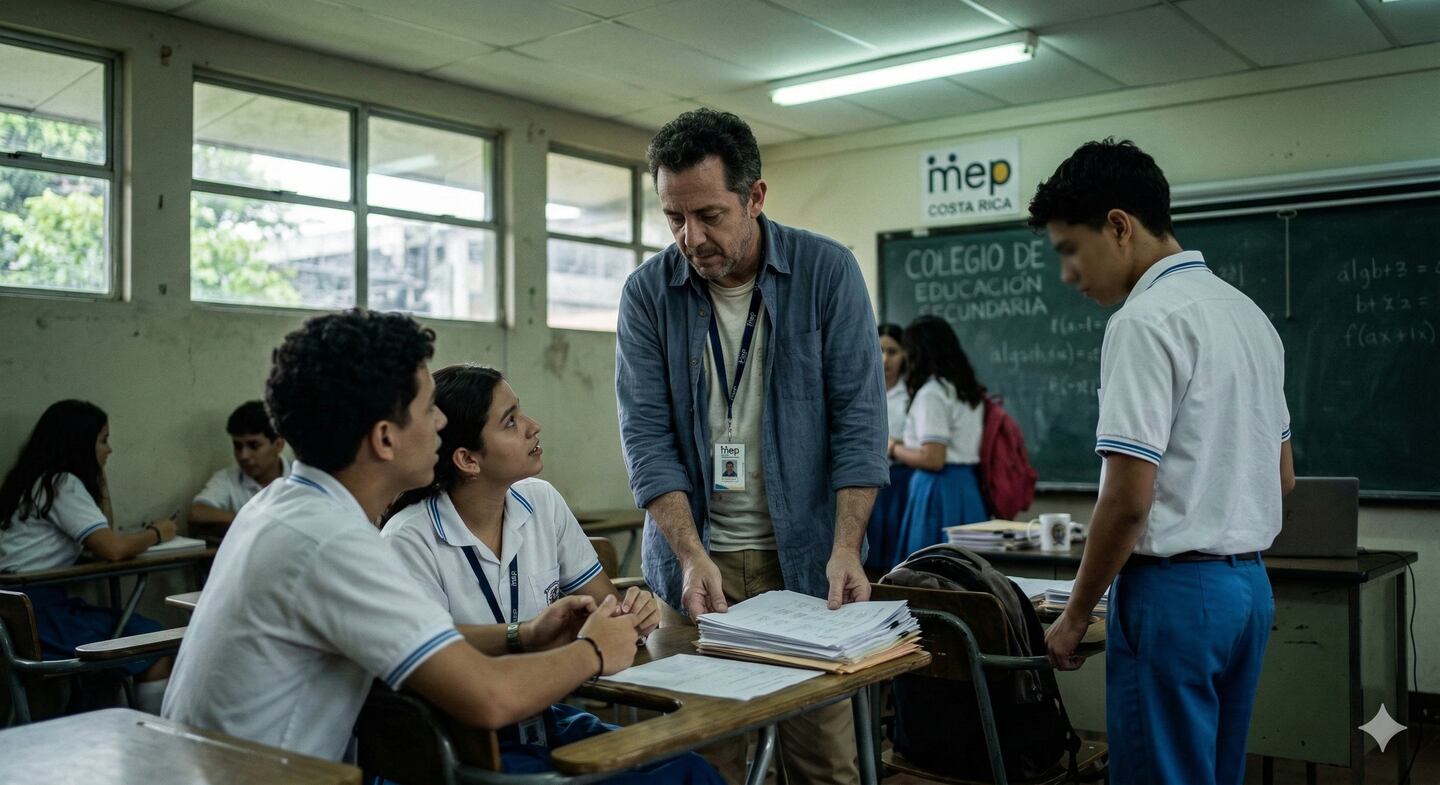
Costa Rica's Ministry of Education, with UNESCO, the UN system and ULACIT, launched a seven-chapter national guide in February 2026 setting ethical-use principles — student data protection, bias reduction, responsible prompting — for AI use by the country's 65,000 public teachers
65,000
Public teachers targeted by the national guide
1,000,000
Students reached nationally (estimated)
7
Chapters in the national guide
Details
Promoter
Ministerio de Educación Pública (MEP), UNESCO, United Nations System in Costa Rica, ULACIT
Period
Launched February 2026
Keywords
AI governance, teacher guidance, data protection, education policy
Context
Costa Rica's Ministerio de Educación Pública (MEP), in a public-private partnership with the university ULACIT and backed by UNESCO and the United Nations System in Costa Rica, launched the "Guía para el uso ético y responsable de la Inteligencia Artificial" on 22 February 2026.
Objectives
The seven-chapter guide sets ethical-use principles for student data, criteria to reduce bias, discrimination and inappropriate AI-generated content, and practical classroom guidance on prompt-writing and project design — explicitly framed as supporting, not replacing, teacher professional judgment.
Activities
The guide targets Costa Rica's full public teaching corps of roughly 65,000 teachers, reaching an estimated one million students nationally. It was corroborated by the UN Costa Rica office, MEP's own announcement, ULACIT's account of the partnership, and independent coverage from the Costa Rican newspaper La Teja; the primary document is publicly available as a PDF.
Conclusions
As a governance document launched only in February 2026, no usage or outcome data exists yet. One claim repeated in Costa Rican press coverage — that AI can improve learning outcomes by up to 30% in maths and science — could not be traced to a specific study and is treated here as an unverified promotional claim, not a fact; it was not used to justify this practice's evidence score.
Implementation
Indicative cost
Low (< €50k)
Time to results
Short (< 1 year)
Staffing & skills
Ministerio de Educación Pública (MEP) policy team, ULACIT university partner (public-private partnership), UNESCO and United Nations System in Costa Rica technical backing
Conditions for success
National ministerial mandate reaching the full public teaching corps
Explicit framing as supporting, not replacing, teacher professional judgment
Publicly available primary document (PDF) for transparency
Common failure modes
No usage or outcome data exists yet, since the guide only launched in February 2026
A widely repeated '30% improvement' claim in press coverage could not be traced to a specific study
Where it fits
Governance type
national ministry of education, public-private partnership
Scale
national (65,000 teachers, ~1M students)
Income level
Costa Rica, upper-middle income
Commonly funded by
National / regional programmes
Indicative funding routes for practices of this type — always check each programme's current calls and eligibility rules.
Replication kit
Reusable artefacts from this practice — as published by their sources.
Finland's education ministry and Opetushallitus published national AI recommendations (31 March 2025) after consulting 172 organisations and youth 'Digiraati' councils, …
Argentina's national PaideIA programme and a Federal Council-approved AI-in-Education Observatory are rolling out alongside Buenos Aires City's new mandatory K-12 …
Switzerland's joint federal-cantonal agency educa.ch published a legal assessment (Aug 2024) and data-reuse guidance (Jan 2025) governing AI in schools …