Ley 20.422 & Decreto No. 1 — Chile's State-Sector Web Accessibility Standard
Chile
Chile's Ley 20.422 and its 2015 implementing decree require state websites to meet WCAG 2.0 AA under disability agency SENADIS …
Philippines · Quezon City · See the Philippines profile · See the Quezon City profile
Evidence: Observational / pre–post Top 31% 84/100 · Ask Evidence Copilot about this practice
The Philippines' DICT mandated WCAG 2.0 for all government websites in 2017; a 2025 peer-reviewed audit of national agencies found average accessibility compliance of only 53%, real but incomplete progress eight years on.
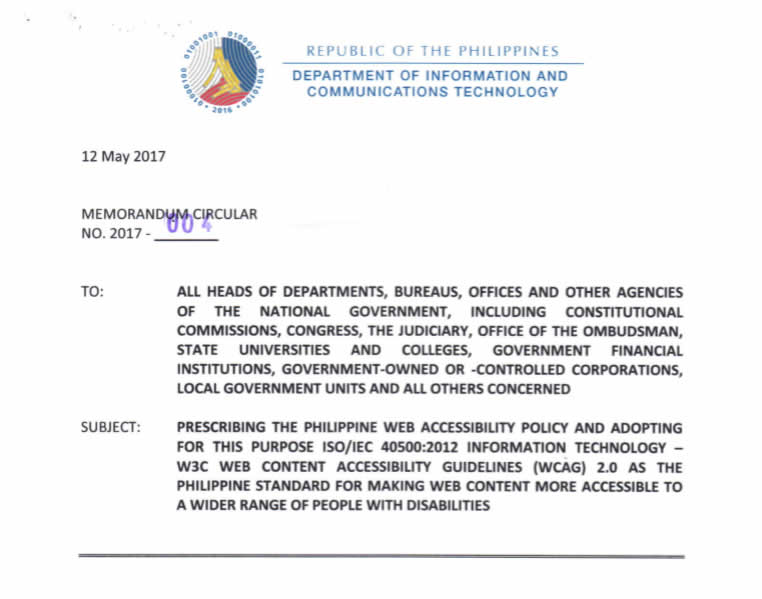
Signed 9 June 2017 by DICT Secretary Rodolfo Salalima, Memorandum Circular No. 2017-004 adopts ISO/IEC 40500:2012 (W3C's WCAG 2.0) as the Philippine Web Accessibility Policy, rooted in the 1992 Magna Carta for Persons with Disabilities.
The circular binds national departments, Congress, the judiciary, state universities and colleges, government financial institutions, GOCCs and local government units, requiring accessible e-forms, alt-text, accessible PDFs, and captioning or sign-language interpretation, with a two-year transition period and a DICT/NCDA technical working group to monitor conformance.
A 2025 peer-reviewed study (Bokingkito et al., MDPI Informatics) combining automated and manual testing across national agency websites found web-accessibility compliance ranging from 28.00% to 82.67% (average 53.43%), notably lower than general-usability compliance (62.32%-97.10%, average 82.50%). Better-performing agencies included the Department of Trade and Industry, the Commission on Higher Education, the Department of Justice, the Department of Labor and Employment, and the Department of Environment and Natural Resources.
Accessibility specifically lags behind general usability eight years after the mandate took effect. A commonly cited 2018 baseline of 0% WCAG compliance could not be traced to a primary report and should be treated as weakly sourced.
Do you run this practice? Claim it — verified implementers get a public contact pathway and can propose corrections.
Where this practice's information was retrieved from, and when.
Chile
Chile's Ley 20.422 and its 2015 implementing decree require state websites to meet WCAG 2.0 AA under disability agency SENADIS …
Israel
Israel's binding IS 5568 standard requires nearly all public and private websites and apps to meet WCAG 2.0 AA, enforced …
Belgium
Since 2001, Belgian nonprofit AnySurfer has audited websites against WCAG and awarded a public accessibility label; as of Sept 2026 …
Slovakia
In its first EU-mandated monitoring cycle, Slovakia's MIRRI SR tested 195 public-sector sites, finding average WCAG scores of just 30% …
Open full copilot Grounded in cited practices — always check the sources.