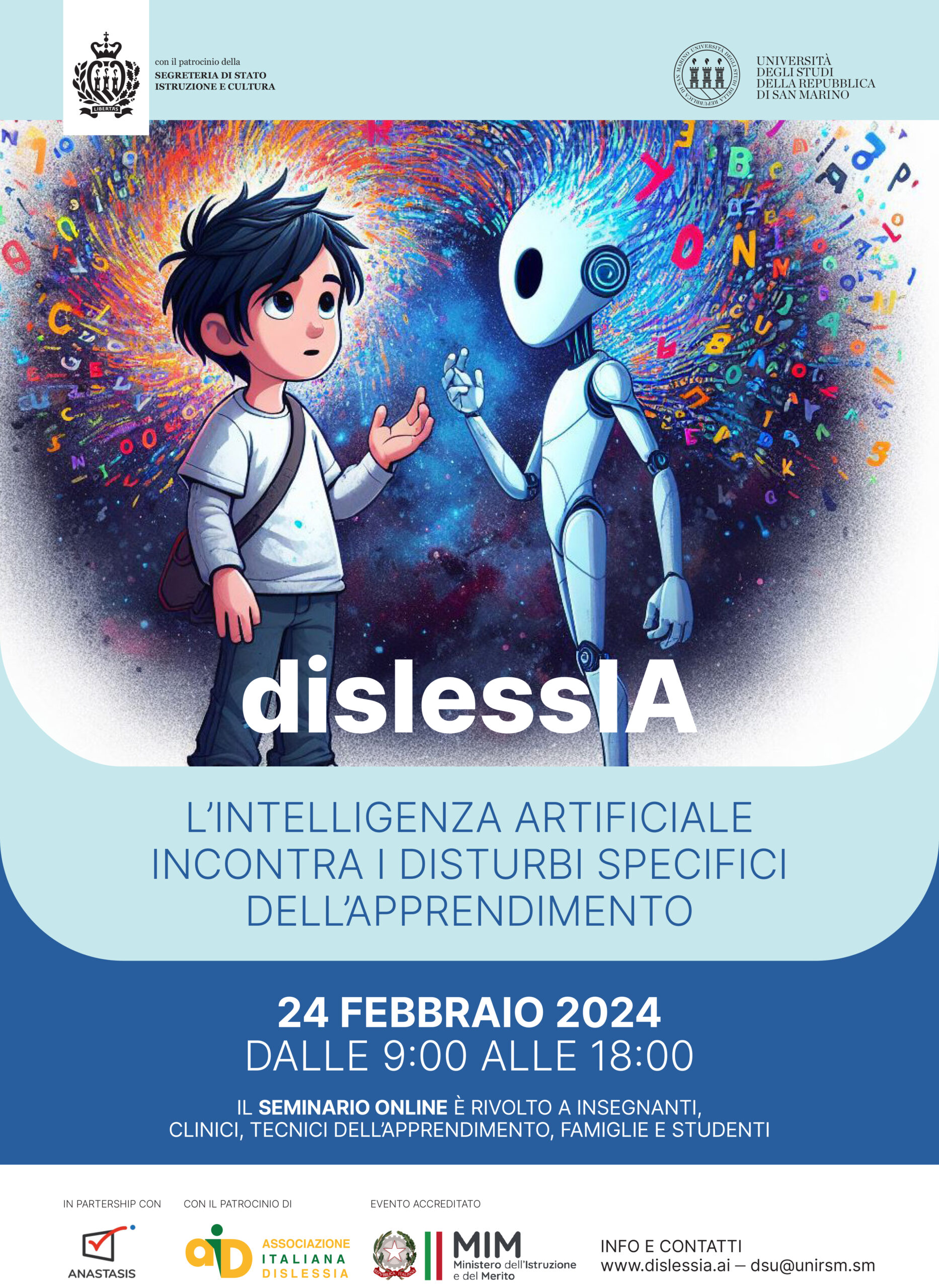
On 24 February 2024, the University of San Marino ran a ministry-accredited seminar training teachers and clinicians to use generative AI as a compensatory tool for students with dyslexia and other learning disorders, with Italy's national dyslexia association and AI researchers.
Details
Maturity
Pilot
Promoter
Università degli Studi della Repubblica di San Marino (UNIRSM), with Anastasis and Associazione Italiana Dislessia (AID)
Period
24 February 2024
Keywords
special education, teacher training, dyslexia/SLD, generative AI, accessibility
Context
On 24 February 2024, the University of San Marino (UNIRSM) ran 'dislessIA', a full-day ministry-accredited seminar exploring how generative AI can support students with dyslexia and other Specific Learning Disorders, reaching teachers across the San Marino–Italy cross-border school system.
Results
The seminar was accredited for continuing professional development by Italy's Ministry of Education and is embedded in UNIRSM's ongoing postgraduate DSA programme, but no attendance figures, pre/post competency measures or student-outcome data have been published — the evidence here is institutional, not a measured improvement in teaching practice.
Implementation
Indicative cost
Low (< €50k)
Time to results
Short (< 1 year)
Staffing & skills
UNIRSM Center for Dyslexia Studies, Anastasis (edtech co-organiser)
Conditions for success
Ministry accreditation extending reach across the San Marino–Italy cross-border school system
Do you run this practice?
Claim it —
verified implementers get a public contact pathway and can propose corrections.
Data sources
Where this practice's information was retrieved from, and when.
Puerto Rico's Department of Education rolled out Microsoft Copilot to 20,000+ teachers and 220,000+ students, cutting assessment-writing time from an …
Ascendia's Timlogo platform uses AI to analyse Romanian schoolchildren's pronunciation, diagnose speech-sound errors and generate personalised exercises. Backed by a …
OLE Nepal's 'intelligent OCR' (iOCR) converts scanned Nepali/English documents into screen-reader-compatible e-books, filling a gap in Nepali-script OCR. Built with …