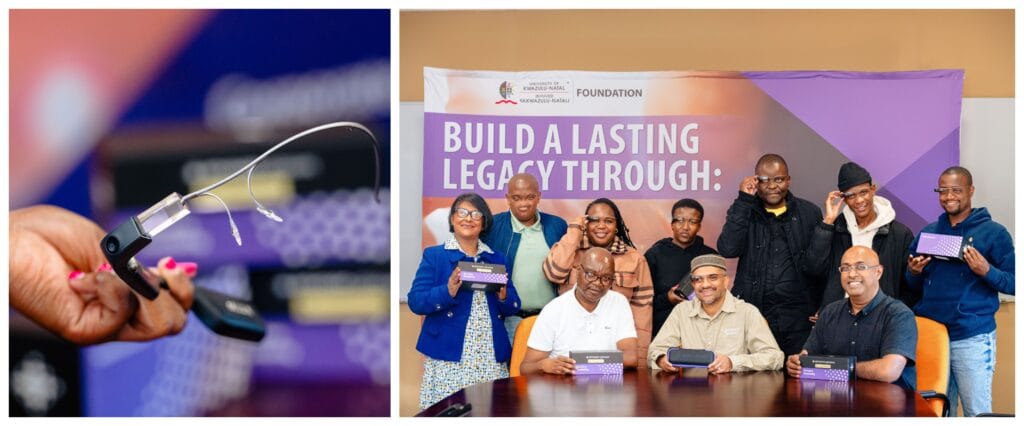
UKZN's Disability Support Unit gave five visually impaired students Envision AI smart glasses — donated at R75,000 (~$4,100) a pair by Sensory Solutions — that read text aloud, recognise faces and describe surroundings in 60+ languages, a South African university first.
5
Students equipped
75,000 ZAR (~USD4,100)
Cost per pair of glasses
Details
Maturity
Pilot
Promoter
University of KwaZulu-Natal Foundation / UKZN Disability Support Unit
Period
2025
Keywords
higher education, assistive technology, disability support
Context
UKZN's Disability Support Unit, with the UKZN Foundation and Sensory Solutions (Pty) Ltd, trialled wearable AI vision aids for visually impaired students in mid-2025.
Activities
A DSU selection panel identified 5 visually impaired students to receive Envision AI smart glasses (Google-Glass-based, reading text aloud, recognising faces, describing surroundings in 60+ languages), each pair valued at ~R75,000 (~USD4,100), donated by Sensory Solutions.
Results
UKZN says this is the first South African university to equip students with this technology; independent press corroborated the donor, cost and 'first' claim.
Implementation
Indicative cost
Low (< €50k)
Time to results
Short (< 1 year)
Staffing & skills
UKZN Disability Support Unit selection panel
Conditions for success
extending the programme beyond the initial 5 recipients
Commonly funded by
Philanthropic / foundation funding
Indicative funding routes for practices of this type — always check each programme's current calls and eligibility rules.
Do you run this practice?
Claim it —
verified implementers get a public contact pathway and can propose corrections.
Data sources
Where this practice's information was retrieved from, and when.
STMicroelectronics Foundation, ITU and a blind Milan professor run train-the-trainer digital-literacy classes for blind and visually-impaired adults in Dakar. An …