Cantareira Water Producer Programme — Payments for Watershed Restoration (São Paulo, Brazil)
Brazil
Brazil's pioneering Water Producer scheme, piloted 2008–2015 in São Paulo's Cantareira system, signed 41 PES contracts covering 342 hectares of …
Tanzania · Morogoro · See the Tanzania profile
Evidence: Quasi-experimental Top 89% 27/100 · Ask Evidence Copilot about this practice
A 2008–2012 CARE/WWF pilot paid upstream farmers in Tanzania's Uluguru Mountains — source of 90% of Dar es Salaam's water — to adopt terracing and agroforestry on 2,240 hectares, funded by $300,000 from the city water utility and Coca-Cola Kwanza.
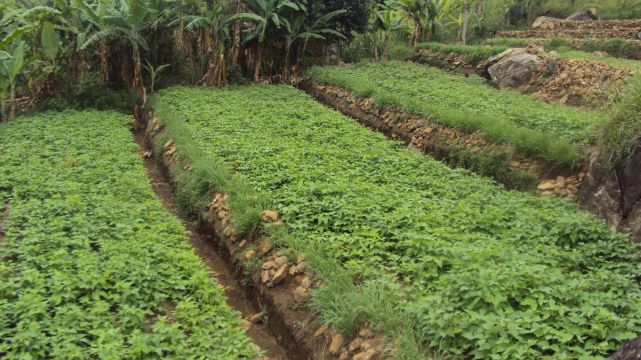
The Uluguru Mountains in Tanzania's Morogoro region are the source of the Ruvu River, which supplies roughly 90% of Dar es Salaam's water.
Reduce soil erosion and nutrient loss into the river by paying upstream farmers to adopt sustainable land-management practices.
Between 2008 and 2012, CARE and WWF piloted an Equitable Payments for Watershed Services (EPWS) scheme in the Kibungo Juu ward, paying farmers in five villages to adopt agroforestry, fanya juu and bench terracing across roughly 2,240 hectares of farmland. The Dar es Salaam Water and Sewerage Corporation (DAWASCO) and Coca-Cola Kwanza Ltd acted as service buyers, committing US$100,000 and US$200,000 respectively over four years.
A peer-reviewed quasi-experimental evaluation (propensity-score matching across 116 participants and 117 non-participants) found EPWS payments contributed about 20% of participating households' cash income (averaging US$11 per farmer), alongside significant indirect gains in crop yields, livestock ownership and land values; 77% of participants received training versus 16% of non-participants.
The same study found that rising land values after terracing made land less accessible to the landless poor. A post-pilot governance handover to a multi-stakeholder steering committee for scale-up was documented as an intention, but independently-verified evidence that this expansion or continuation actually occurred beyond the original pilot was not found.
National / regional programmes Philanthropic / foundation funding Own resources / municipal budget
Indicative funding routes for practices of this type — always check each programme's current calls and eligibility rules.
Reusable artefacts from this practice — as published by their sources.
Do you run this practice? Claim it — verified implementers get a public contact pathway and can propose corrections.
Where this practice's information was retrieved from, and when.
Brazil
Brazil's pioneering Water Producer scheme, piloted 2008–2015 in São Paulo's Cantareira system, signed 41 PES contracts covering 342 hectares of …
United States of America
After 1996 and 2002 wildfires choked Denver's reservoirs with sediment, Denver Water and the US Forest Service treated 120,000+ acres …
Australia
Melbourne has kept the public and farming out of its mountain-ash forest catchments since 1879, so over 65% of its …
Peru
Since 2008, a one-sol water-tariff surcharge in Moyobamba has funded reforesting 400 ha across three microwatersheds feeding the city's supply, …
Open full copilot Grounded in cited practices — always check the sources.