IT Fitness Test — Slovakia's National Digital and AI-Skills Certification for Schools
Slovakia
Slovakia's annual IT Fitness Test, run since 2010, now embeds AI-literacy questions and issued personal digital-skills certificates to over 66,000 …
Uzbekistan · Tashkent · See the Uzbekistan profile · See the Tashkent profile
Evidence: Descriptive / self-reported Top 70% 40/100 · Ask Evidence Copilot about this practice
UNICEF, Arm, the Raspberry Pi Foundation and Micro:bit Educational Foundation brought the Experience AI curriculum to Uzbekistan's 50 government STEM Labs from January 2026, extending a 2024 Honduras-Maldives-Montenegro-Vietnam pilot with a stronger AI-literacy focus.
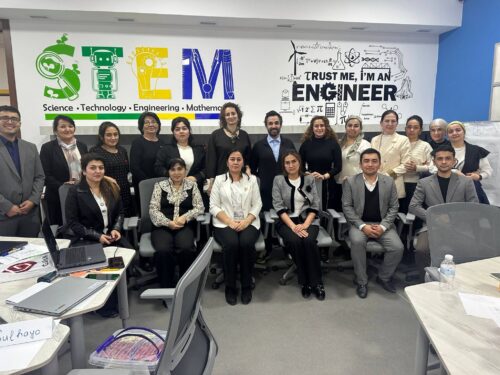
Tinkering with Tech launched in 2024 as a UNICEF Global Learning and Innovation Hub initiative with Arm and Finland's Ministry for Foreign Affairs, piloted in Honduras, the Maldives, Montenegro and Viet Nam. At a partnership workshop in Helsinki on 28-29 January 2026, UNICEF and Arm, together with the Micro:bit Educational Foundation and the Raspberry Pi Foundation, announced 'Tinkering with Tech and AI,' expanding the programme to Lao PDR, Ukraine and Uzbekistan with the Raspberry Pi Foundation's Experience AI curriculum added to build AI literacy. In Uzbekistan, under the government's Ishonch 2030 education project, UNICEF and the Ministry of Preschool and School Education have equipped Innovative STEM Labs in 50 schools nationwide with smartboards, laptops, 3D printers, Arduino kits and micro:bits; the national NGO Tech4Impact supports local delivery.
Published material to date describes programme design, infrastructure investment and a single trainer's qualitative reflection ('I have changed my mind about AI and now I have a better understanding of it') rather than measured student learning outcomes. The Raspberry Pi Foundation's own account is candid about the challenge ahead: some Uzbekistani classrooms have laptops and interactive whiteboards, while others operate with limited electricity, lower digital literacy and devices shared among many students — an acknowledged, unresolved gap rather than a solved problem.
Philanthropic / foundation funding
Indicative funding routes for practices of this type — always check each programme's current calls and eligibility rules.
Do you run this practice? Claim it — verified implementers get a public contact pathway and can propose corrections.
Where this practice's information was retrieved from, and when.
Slovakia
Slovakia's annual IT Fitness Test, run since 2010, now embeds AI-literacy questions and issued personal digital-skills certificates to over 66,000 …
Bosnia and Herzegovina
Under the EU-funded EU4Education and Employment project, the ILO trained 170+ vocational teachers across Bosnia and Herzegovina in a five-month …
Kenya
Young Scientists Kenya trained 170 secondary-school teachers in Nakuru, Mandera, Tana River and Wajir counties to deliver the Raspberry Pi …
Canada
Ontario's eCampusOntario portal lists free, bilingual, accessible AI-literacy modules from Durham College and a teaching-focused AI credential from Conestoga, backed …
Open full copilot Grounded in cited practices — always check the sources.