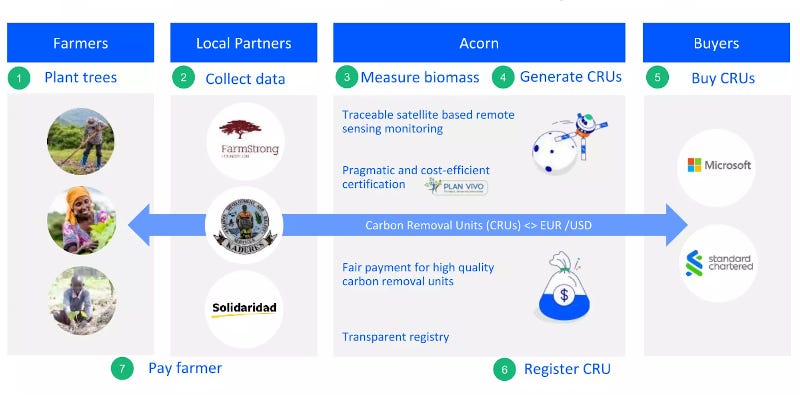
Since 2021, Swiss NGO FarmStrong has interplanted cocoa farms in Côte d'Ivoire's Nawa Region with timber and fruit trees across 50,942 ha, generating 122,457 Rabobank Acorn carbon credits — but a 2022 Preferred by Nature audit found removals overestimated by roughly 600%.
50,942 ha
Area under agroforestry (2021-present)
122,457 CRUs
Carbon Removal Units issued (2021-present)
~600%
Audit-found overestimation of removals (2022 audit)
34,989 CRUs (~€1m)
Credits purchased by Microsoft (2023) (2023)
Details
Maturity
Established
Promoter
FarmStrong Foundation / Rabobank Acorn
Period
2021-present
Keywords
cocoa agroforestry, carbon removal units, Plan Vivo certification, smallholder finance
Context
Swiss NGO FarmStrong Foundation (founded 2016) has, since 2021, worked with cocoa-growing communities in Côte d'Ivoire's Nawa Region (around Soubré and Abengourou) to interplant existing cocoa farms with timber and fruit trees under Rabobank's Acorn agroforestry carbon programme. The scheme uses a Plan Vivo-certified methodology and satellite-based monitoring to convert measured carbon sequestration into tradeable Carbon Removal Units (CRUs), and has become the single largest source of credits sold through the Acorn platform.
Results
The programme has covered 50,942 hectares and generated 122,457 CRUs since 2021 — over a third of all credits sold through Acorn — including 34,989 credits purchased by Microsoft in 2023 for roughly €1 million. However, a June 2022 audit by certification body Preferred by Nature, commissioned under Plan Vivo's own certification process, found that the credits issued overestimated actual greenhouse-gas removals by roughly 600%, and that no third party had verified the credits corresponded to tree planting beyond what was already occurring under Côte d'Ivoire's broader Cocoa & Forests Initiative. In November 2023, Côte d'Ivoire's environment minister asked Rabobank to suspend activities in the Nawa Region because the project area overlapped with government forest-carbon credits already sold to the World Bank's Forest Carbon Partnership Facility, an unresolved double-counting risk.
Implementation
Indicative cost
High (€500k–€5M)
Time to results
Long (> 3 years)
Staffing & skills
FarmStrong Foundation field teams working with cocoa-growing communities, Rabobank Acorn platform / Plan Vivo certification staff
Conditions for success
independent third-party verification of carbon-removal claims
avoiding double-counting with overlapping government forest-carbon credit programmes
Common failure modes
carbon removals overestimated without independent verification (~600% per 2022 audit)
double-counting risk with government credits sold to the World Bank's Forest Carbon Partnership Facility
Commonly funded by
Philanthropic / foundation funding
Indicative funding routes for practices of this type — always check each programme's current calls and eligibility rules.
Do you run this practice?
Claim it —
verified implementers get a public contact pathway and can propose corrections.
Data sources
Where this practice's information was retrieved from, and when.