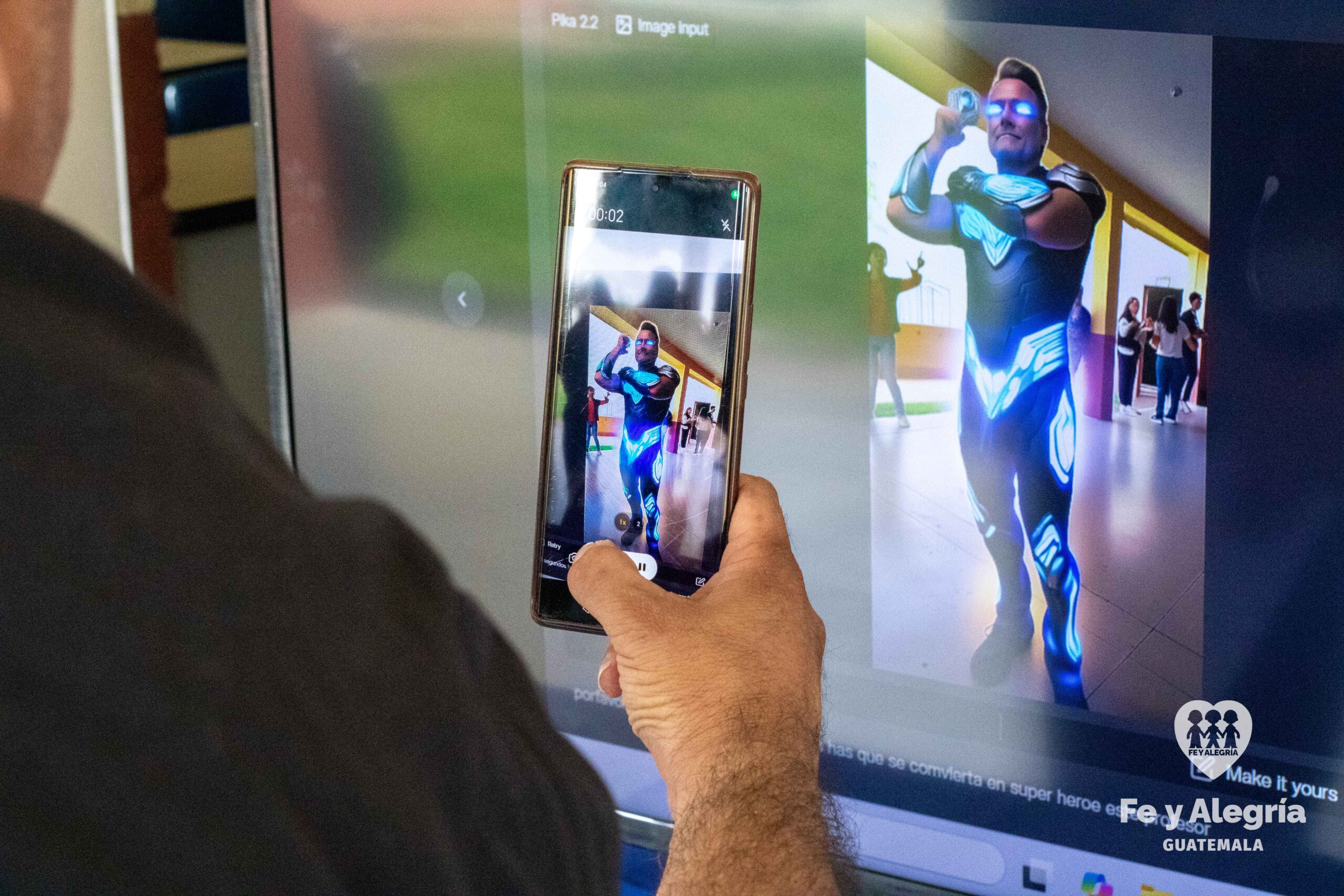
Fe y Alegría Guatemala has run a multi-year AI-literacy effort in some of the country's poorest and most violence-affected neighbourhoods: a 2021 pilot in La Limonada and Zone 18, a 2025 immersion week reaching 1,600+ students, and teacher-training days across 59 centres.
1,600+
Students reached (2025 AI immersion week) (2025)
85
Educators reached (2025 AI immersion week) (2025)
59
Educational centres reached in teacher-training round (November 2025)
Details
Maturity
Scaling
Promoter
Fe y Alegría Guatemala; Proyecto Educativo Puente Belice
Period
2021-2025
Keywords
K-12 education, faith-based NGO schooling, digital & AI literacy
Context
In 2021, two Fe y Alegría Guatemala educators travelled to Pamplona, Spain to study an AI-in-schools methodology developed by das-Nano and Fundación Luz-IA with the NGO Alboan, then piloted it at Centro Educativo No. 1 in La Limonada — a high-poverty periurban settlement — and Centro Educativo No. 5 in Zone 18, a gang-violence-affected Guatemala City neighbourhood.
Objectives
The pilot aimed to bring AI literacy to some of Guatemala's poorest and most violence-affected school communities, framing AI tools around practical uses such as helping with students' families' small household enterprises.
Activities
The pilot grew into 'Expo... sueños, ideas, innovación', a 2025 week-long AI immersion across three Fe y Alegría centres and the Proyecto Educativo Puente Belice, delivering three modules — an introduction to AI's uses and limits, responsible/ethical AI use, and hands-on application — and in November 2025 the network ran teacher-training workshops across the Metropolitan, Southwest and Northeast regions.
Results
The 2025 immersion week reached more than 1,600 students and 85 educators, and the subsequent teacher-training round reached administrators and teachers from 59 educational centres in total.
Conclusions
No formal evaluation of learning gains accompanies either phase; the evidence available is participation counts and organisational self-reporting from Fe y Alegría and its partner Alboan, not an independent study.
Implementation
Indicative cost
Medium (€50k–€500k)
Time to results
Long (> 3 years)
Staffing & skills
Fe y Alegría classroom educators (trained via the Pamplona methodology exchange), Alboan/das-Nano/Fundación Luz-IA methodology partners, regional teacher-trainers across the Metropolitan, Southwest and Northeast regions
Conditions for success
direct educator exchange with the Spanish methodology's originators (das-Nano/Fundación Luz-IA via Alboan)
framing AI content around students' everyday context (household micro-enterprises)
phased rollout from two pilot schools to a multi-centre expo and then a 59-centre teacher-training round
Common failure modes
no formal evaluation of learning gains accompanies either phase
evidence remains organisational self-reporting rather than an independent study
Where it fits
Governance type
faith-based NGO school network
Scale
multi-centre NGO network (59 centres by November 2025)