Lord Howe Island Rodent Eradication Project
Australia
An AUD 15.5m operation cleared ship rats and house mice from Lord Howe Island's 1,455 ha in 2019; official surveys …
Brazil · Fernando de Noronha · See the Brazil profile
Evidence: Observational / pre–post Top 99% 13/100 · Ask Evidence Copilot about this practice
Two decades of cat sterilisation on Brazil's Fernando de Noronha archipelago have not curbed the feral population, estimated at 1,287 animals in 2015. Peer-reviewed monitoring documents ongoing predation on endemic skinks and seabirds, and a state law blocking lethal control.
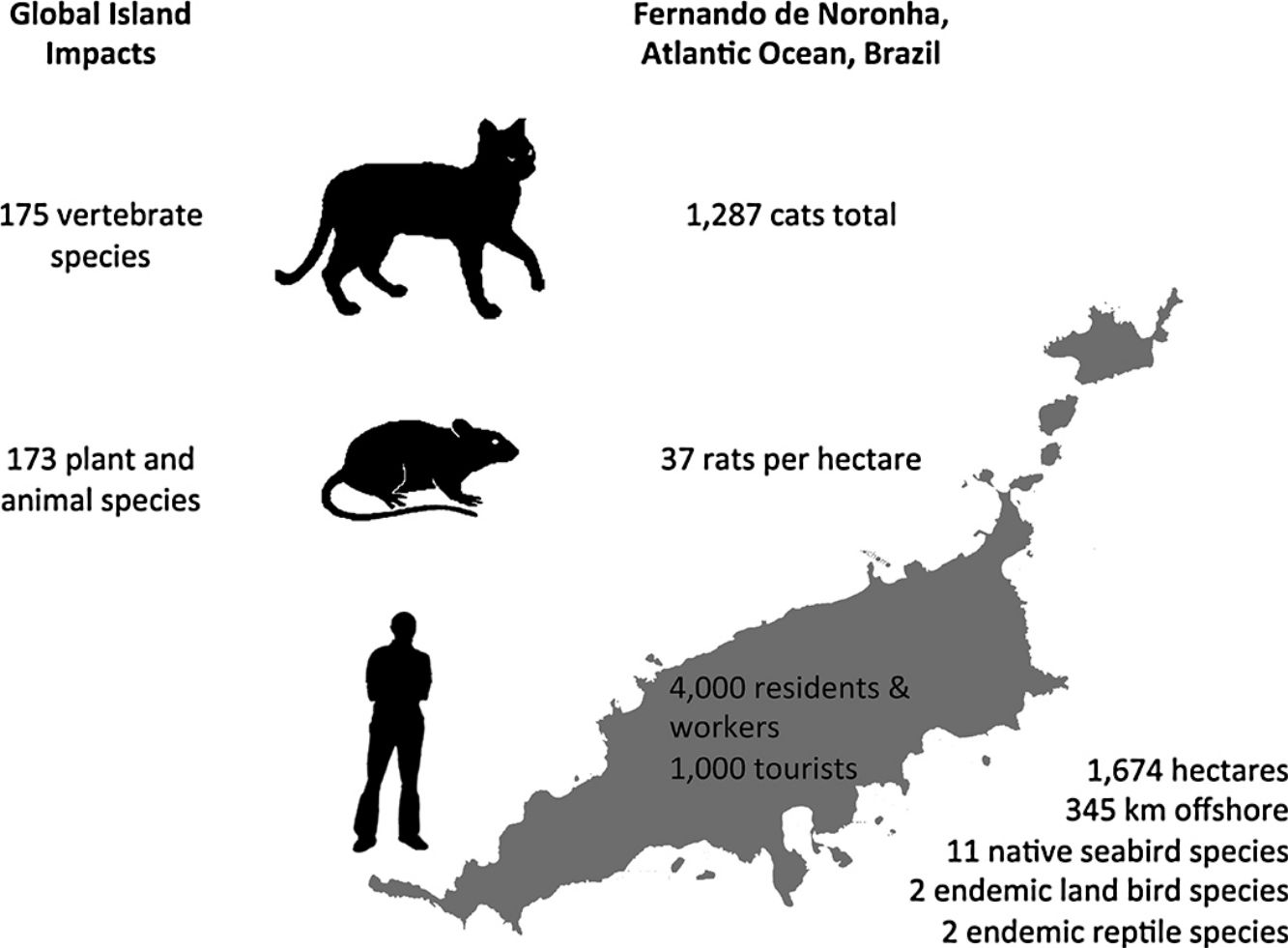
Fernando de Noronha, a UNESCO World Heritage marine national park off Brazil's north-east coast, hosts the endemic Noronha skink and remnant seabird colonies now largely restricted to small offshore islets free of cats and rats, after historical predation collapsed breeding on the main island.
ICMBio's cat-management programme aims to reduce feral cat predation on native and endemic wildlife through sterilisation and relocation, operating under a formal action plan and constrained by a Pernambuco state law that prohibits lethal cat control.
Between 2004 and 2010, ICMBio sterilised roughly 450 feral cats on the main island. A 2019 campaign sterilised 605 cats in 20 days. A parallel adoption scheme relocated cats to mainland Brazil, though a published case study reports this achieved only 10-20 cats relocated.
Despite these efforts, a 2015 distance-sampling survey estimated the resident cat population at 1,287 animals, and 2015-2017 live-trapping recorded black rat densities of around 37 per hectare in forested habitat. Researchers documented continuing cat predation on the Noronha skink, worm lizard and seabirds — including at least 11 predated red-billed tropicbird carcasses found in 2014-2015 alone — with a masked booby colony reduced to fewer than 20 pairs and red-billed tropicbirds to fewer than 10 individuals at one monitored site.
The published case study identifies Pernambuco's state law against lethal control as the central structural barrier: management has followed a mainland urban sterilisation model rather than an island-eradication approach, and researchers conclude this has not delivered measurable conservation outcomes. ICMBio researchers have called for an integrated, revised strategy, noting that sterilisation-only control has not matched results achieved elsewhere (e.g. Seychelles, French Polynesia) through lethal eradication combined with biosecurity.
National / regional programmes
Indicative funding routes for practices of this type — always check each programme's current calls and eligibility rules.
Do you run this practice? Claim it — verified implementers get a public contact pathway and can propose corrections.
Where this practice's information was retrieved from, and when.
Australia
An AUD 15.5m operation cleared ship rats and house mice from Lord Howe Island's 1,455 ha in 2019; official surveys …
Seychelles
Since 1990, BirdLife International and Nature Seychelles eradicated rats and cats and moved the Seychelles magpie-robin to four more islands, …
Bermuda
Bermuda government biologists have run continuous rat biosecurity and habitat restoration on the Bermuda petrel nesting islets since 1960, growing …
Falkland Islands (Malvinas)
Since 2001, Falklands Conservation and partners have cleared invasive Norway rats from 65 islands (~6,500 ha) for under £250,000; a …
Open full copilot Grounded in cited practices — always check the sources.