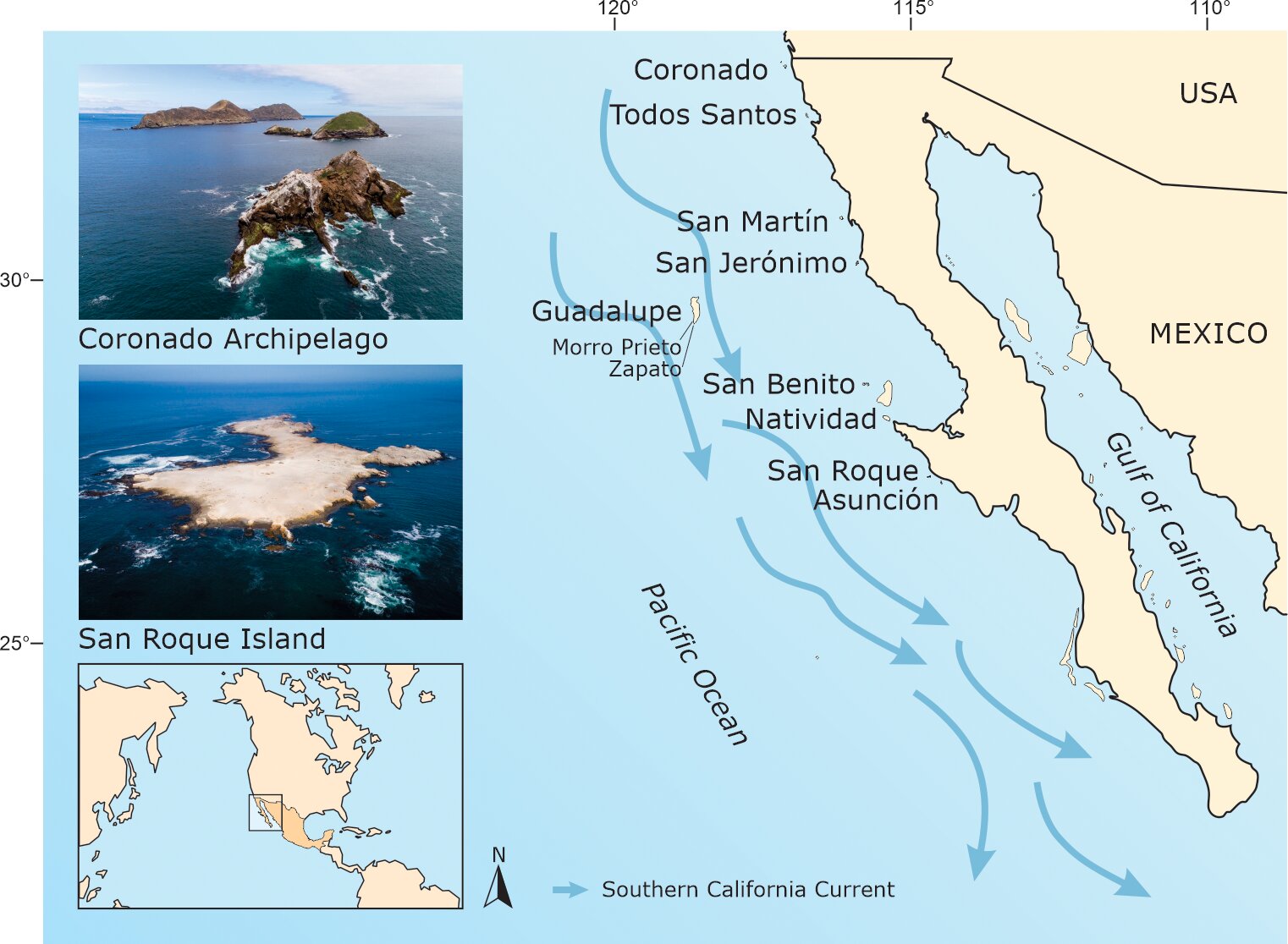
Since the late 1990s, Mexican NGO GECI has removed 60 populations of 13 invasive mammal species from 39 Pacific islands, restoring 85% of historically lost seabird colonies and protecting 147+ endemic island species, per 20+ years of peer-reviewed monitoring.
Grupo de Ecología y Conservación de Islas (GECI) / CONANP
Period
1998–present
Keywords
island restoration, invasive species eradication, seabird conservation, biodiversity
Context
Grupo de Ecologia y Conservacion de Islas (GECI), a Mexican NGO founded in 1998 and based in Ensenada, Baja California, works with Mexico's National Commission of Natural Protected Areas (CONANP) and the global Island Conservation network to remove invasive mammals from Pacific and Gulf of California islands, most of which sit within federally protected areas.
Activities
Over more than two decades, GECI-led operations have eradicated 60 populations of 13 invasive mammal species — including rats, cats, mice, goats, rabbits, dogs and donkeys — from 39 priority islands. On Guadalupe Island, removal of feral goats (completed around 2007) was followed by a native-plant nursery programme that has planted more than a quarter of a million seedlings, tripling the island's forest cover to over 900 hectares.
Results
A 2022 peer-reviewed study tracking 61 breeding colonies of 19 seabird species over more than 20 years found that 23 of 27 (85%) seabird colonies historically extirpated from the Baja California Pacific Islands have returned, with 12 entirely new colonies recorded and 31 of 61 monitored populations showing significant increases. Islands in the programme now support an estimated 400,000-1,400,000 breeding seabirds annually and safeguard more than 147 endemic terrestrial species.
Conclusions
Gains depend on continuous biosecurity — quarantine protocols and rodent-detection networks — to prevent re-invasion, and the long-term seabird dataset, while independently published, draws primarily on GECI's own monitoring network rather than a fully external verifier.
Implementation
Indicative cost
Medium (€50k–€500k) — No aggregate budget disclosed in source; scale is 39 islands over 25+ years of NGO-led operations.
Time to results
Long (> 3 years) — Founded 1998; Guadalupe Island goat eradication completed ~2007; monitoring dataset spans 20+ years to the 2022 study.
Staffing & skills
Grupo de Ecologia y Conservacion de Islas (GECI), lead NGO, Mexico's National Commission of Natural Protected Areas (CONANP), partner, Island Conservation network, global partner
Conditions for success
Continuous biosecurity — quarantine protocols and rodent-detection networks — required to prevent re-invasion
Long-term partnership between an established NGO and the federal protected-areas agency
Peer-reviewed, internationally replicated eradication methodology via the Island Conservation network
Common failure modes
Gains depend on continuous biosecurity; re-invasion risk remains if quarantine/detection lapses
Long-term seabird dataset draws primarily on GECI's own monitoring network rather than a fully external verifier
From 1976, Durrell, Mauritius's National Parks Service and the Mauritian Wildlife Foundation eradicated invasive goats (1979) and rabbits (1986) from …
A three-phase cat eradication (2002–2006) let seabirds recolonize Ascension Island's mainland after roughly 180 years of absence: Ascension frigatebirds grew …