University of Sydney 'two-lane' assessment for the AI era
Australia
Instead of an unwinnable AI-detection arms race, Sydney redesigned assessment into two lanes — secure in-person assessment of core capability, …
United States of America · Berkeley · See the United States of America profile
AI platform grouping similar student responses for batch grading; 3.2M students at 2,600+ universities. A peer-reviewed ACM 2017 study found 67% of instructors save ≥30% grading time; a 2024 Indiana University case study linked adoption to lower DFW rates and higher grades.
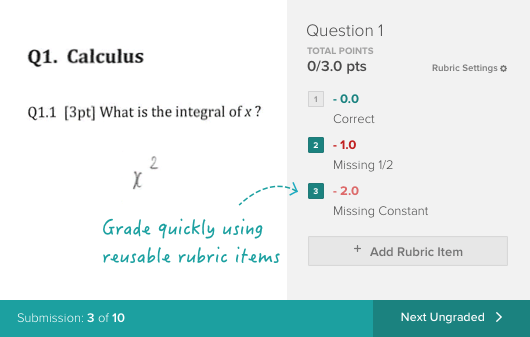
Gradescope, launched commercially in 2014 from a UC Berkeley prototype, clusters visually similar handwritten student responses so instructors can apply one rubric decision to an entire group. Turnitin acquired it in 2018; it now covers typed, code and bubble-sheet assignments.
A peer-reviewed ACM Learning @ Scale 2017 paper found 67% of surveyed instructors saved at least 30% of grading time, and 79.7% of users agreed anonymous grading reduced assessor bias. A 2024 Indiana University case study (Journal of Teaching and Learning with Technology) documented lower DFW rates and higher average grades in a large lecture course after adoption, though the authors note concurrent instructional changes also contributed.
As of 2025 the platform serves 3.2 million students at 2,600+ institutions across 100+ countries. Data-privacy conditions changed under Turnitin ownership, drawing scrutiny from European data-protection advocates.
Implementation detail (cost, timeline, staffing, conditions for success) is not yet available for this practice.
Where this practice's information was retrieved from, and when.
Australia
Instead of an unwinnable AI-detection arms race, Sydney redesigned assessment into two lanes — secure in-person assessment of core capability, …
Hong Kong
In June 2023 HKU's Senate named GenAI a "fifth literacy" and gave every student and staff member free ChatGPT-class access. …
United Kingdom
Bedfordshire ran a published evaluation comparing its human-tutor Studiosity writing service with a new AI-augmented version. The 2024 AI trial …
Mexico
Tec de Monterrey AI ecosystem (33 campuses, 2023): CogBooks adaptive learning (Springer 2024, +15% A-grades), Adaptive Leveling Modules (10,350 students, …
Open full copilot Grounded in cited practices — always check the sources.