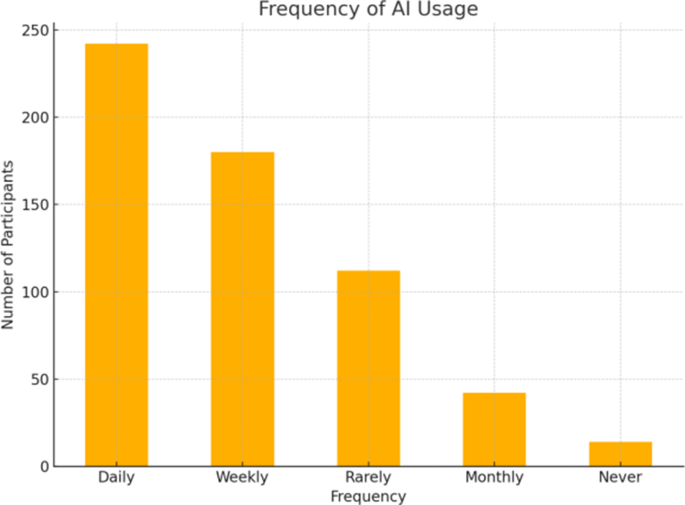
Two peer-reviewed 2022-2025 surveys - 550 Al-Quds medical students, 264 Gaza teachers - document fast grassroots ChatGPT/AI adoption (87% of students use AI regularly) despite 91% lacking formal training, patchy access, and unresolved integrity concerns.
550 students
Medical students surveyed (Al-Quds) (2025)
87 %
Students reporting frequent AI use (2025)
50 %
Students reporting daily AI use (2025)
76 %
Students using ChatGPT
38 %
Students using Copilot
26 %
Students using virtual simulators
4.6 0-5 scale
Self-rated time-management gain
4.5 0-5 scale
Self-rated research-productivity gain
4.2 0-5 scale
Self-rated academic-performance gain
3.6 0-5 scale
Self-rated clinical-competence gain
91 %
Students with no formal AI training
51.05 %
Students flagging inadequate ethical oversight
264 teachers
Gaza teachers surveyed (Nov 2022 - Jun 2023)
15 teachers
Gaza teachers in follow-up focus groups
Details
Promoter
Al-Quds University Faculty of Medicine; independent Gaza Strip schoolteacher study
Period
Nov 2022 - May 2025
Keywords
higher education, medical education, K-12, teacher training
Context
Amid blockade, war and restricted mobility, Palestinian students and teachers have turned to generative AI tools largely on their own, without institutional programmes or training. Two independently conducted, peer-reviewed studies published in 2025-2026 quantify this grassroots adoption: a 550-student survey at Al-Quds University's Faculty of Medicine, and a 264-teacher mixed-methods survey (plus 15-teacher focus groups) in the Gaza Strip.
Results
87% of Al-Quds medical students reported frequent AI use (50% daily), led by ChatGPT (76%), Copilot (38%) and virtual simulators (26%); students self-rated gains on 0-5 scales in time management (4.6), research productivity (4.5) and academic performance (4.2), with lower gains in clinical competence (3.6). Despite this, 91% had received no formal AI training and 51.05% flagged inadequate ethical oversight. Gaza teachers surveyed (264, plus 15 in follow-up focus groups) were broadly open to AI integration but voiced persistent concerns about trust, accessibility and effectiveness.
Conclusions
Both studies are self-reported, cross-sectional surveys with no control group and no independently measured learning outcomes; they document adoption patterns and attitudes under crisis conditions rather than the results of a deliberate, evaluated programme, and academic-integrity and equitable-access questions remain explicitly unresolved in both.
Implementation
Indicative cost
Low (< €50k)
Time to results
Short (< 1 year)
Do you run this practice?
Claim it —
verified implementers get a public contact pathway and can propose corrections.
Data sources
Where this practice's information was retrieved from, and when.
A 5-week AI-literacy module for pre-service physics teachers across nine Kazakhstani universities, led by Zhetysu University, raised literacy scores far …
MUST, Mongolia's IIOE National Centre, runs a train-the-trainer micro-certification scheme with UNESCO-ICHEI, giving AI and digital-competency micro-credentials to 1,800+ teachers …