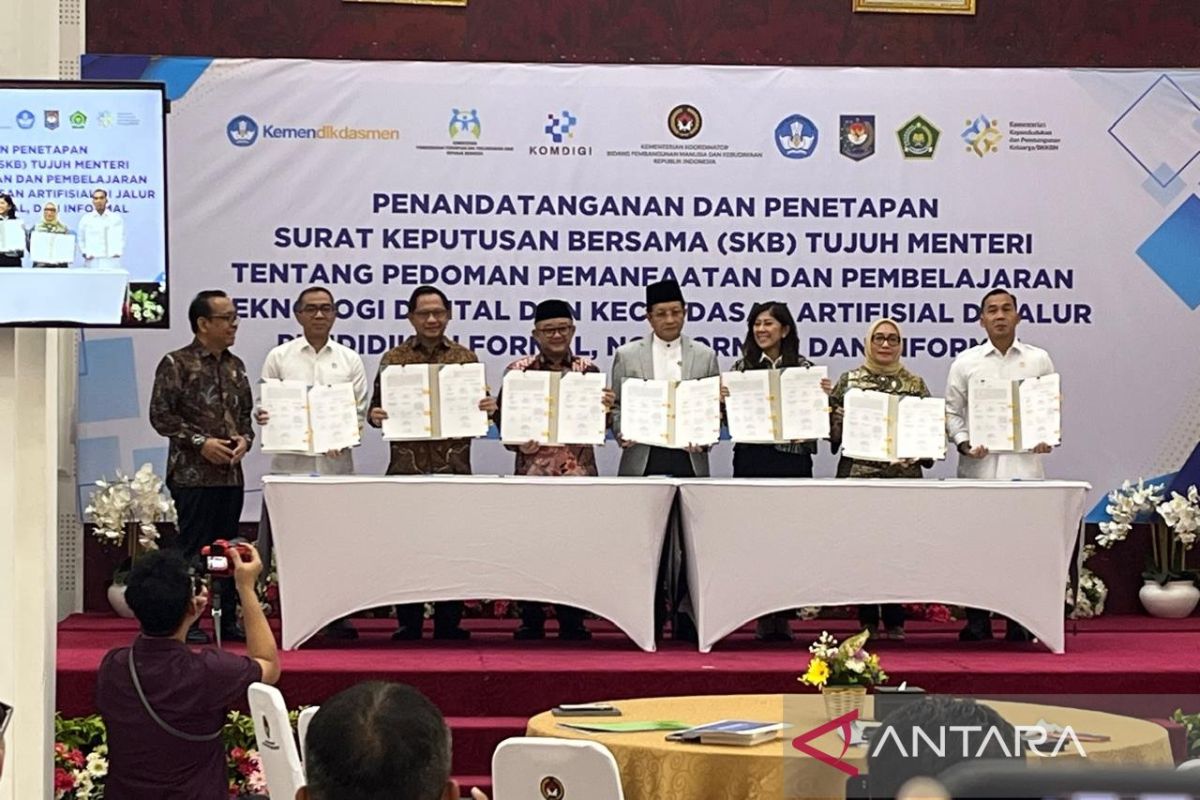
On 12 March 2026, seven Indonesian cabinet ministers jointly signed a decree setting age-based limits on AI and digital-technology use in education, barring elementary and secondary students from instant-answer AI tools while easing restrictions at higher levels.
7 ministries
Ministries co-signing the decree (March 2026)
Details
Promoter
Coordinating Ministry for Human Development and Cultural Affairs (Indonesia), with six co-signing ministries
Period
March 2026
Keywords
AI governance, education policy, child online safety
Context
On 12 March 2026, seven Indonesian cabinet ministers — spanning home affairs, religious affairs, primary and secondary education, higher education, communications and digital affairs, population and family development, and women's empowerment and child protection — jointly signed a decree regulating the use of digital technology and AI in education, covering early childhood through higher education.
Objectives
Set a minimum age, permitted use types and a recommended duration of use for digital and AI tools at each education level, protecting younger students most, before AI tools become widespread in Indonesian classrooms.
Activities
Elementary and secondary students are explicitly barred from using 'instant-answer' AI tools that generate direct solutions to questions, while higher-education students are given more flexibility; the decree is a joint governance instrument spanning multiple ministries rather than a single ministry's guideline.
Conclusions
As a newly signed decree, there is not yet public evidence on enforcement mechanisms, school-level compliance, or measured effects on learning or academic integrity; its significance for now lies in being an unusually coordinated, explicit national governance framework rather than a demonstrated outcome.
Implementation
Indicative cost
Low (< €50k) — No programme budget; a regulatory decree with no direct implementation spend described in available sources.
Time to results
Short (< 1 year) — Signed 12 March 2026; enforcement and compliance status not yet reported.
Staffing & skills
Coordinating Ministry for Human Development and Cultural Affairs (Indonesia), Six co-signing ministries (home affairs, religious affairs, primary/secondary education, higher education, communications and digital affairs, population and family development, women's empowerment and child protection)
Conditions for success
A joint governance instrument spanning child-protection, curriculum and digital-policy authorities together, rather than a single ministry acting alone
Age-tiered rules matched to developmental stage, tightest for younger students
Common failure modes
No public evidence yet on enforcement mechanisms or school-level compliance
No measured effects on learning or academic integrity reported
Commonly funded by
National / regional programmes
Indicative funding routes for practices of this type — always check each programme's current calls and eligibility rules.
Do you run this practice?
Claim it —
verified implementers get a public contact pathway and can propose corrections.
Data sources
Where this practice's information was retrieved from, and when.
Finland's education ministry and Opetushallitus published national AI recommendations (31 March 2025) after consulting 172 organisations and youth 'Digiraati' councils, …
Argentina's national PaideIA programme and a Federal Council-approved AI-in-Education Observatory are rolling out alongside Buenos Aires City's new mandatory K-12 …