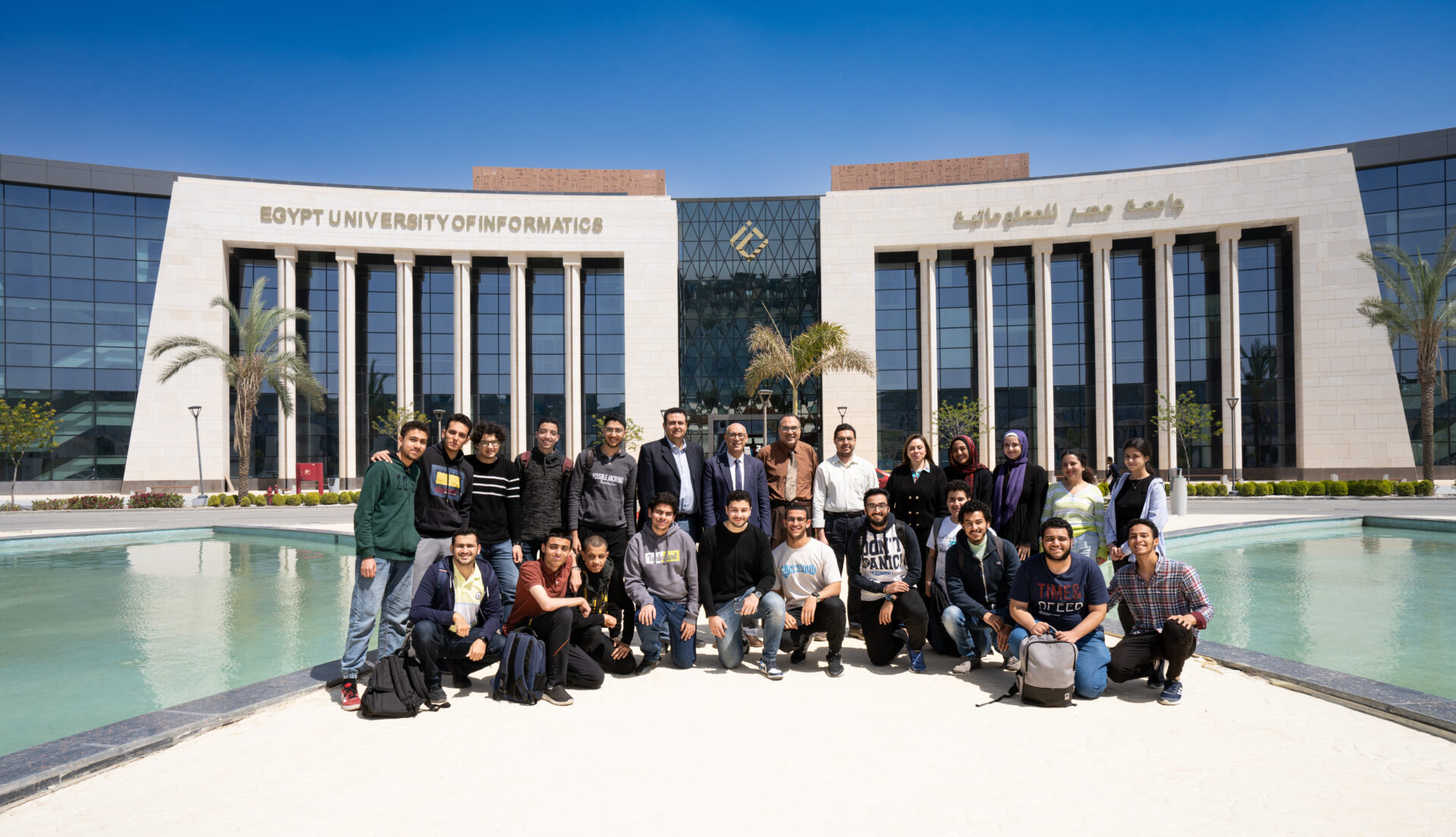
In October 2025, Egypt University of Informatics (Cairo) hosted an ITU–EY 'AI Skills Accelerator for Girls' workshop on AI, machine learning and ethics for female students — part of a two-year programme that has already trained 470+ girls across 13 workshops in seven countries.
13
Workshops delivered (first cohort) (2024–2025)
470+
Participants reached (first cohort) (2024–2025)
24
Two-year workshop target (2024–2026)
1,000+
Two-year participant target (2024–2026)
12
Countries covered by two-year target (2024–2026)
Details
Maturity
Scaling
Promoter
ITU Telecommunication Development Bureau & EY, hosted by Egypt University of Informatics
Period
2025
Keywords
AI literacy, gender digital divide, higher education
Context
The ITU Telecommunication Development Bureau (ITU-D) and EY run the AI Skills Accelerator for Girls, a two-year (2024-2026) programme pairing EY volunteer trainers with local host institutions to teach AI fundamentals to girls and young women, including from marginalised and underserved communities. In October 2025, Egypt University of Informatics (EUI) in Cairo hosted a workshop, "Introduction to Artificial Intelligence", for its first- and second-year female students.
Objectives
The programme aims to build practical AI skills among girls and young women worldwide, with a two-year target of at least 24 workshops and 1,000 participants across 12 countries.
Activities
The Cairo workshop curriculum covered AI foundations, big data, machine learning and programming, closing with a dedicated session on AI ethics, bias and risk. It followed the same model used in earlier 2024-2025 workshops hosted in Asunción (Paraguay), Malta, Nairobi (Kenya), Hyderabad and Bangalore (India), Astana (Kazakhstan) and Amman (Jordan).
Results
By the end of the first cohort (2024-2025) the programme had delivered 13 workshops reaching more than 470 participants overall, with self-reported survey gains in confidence and technical knowledge reported at the programme level; the Cairo cohort's own participant numbers and outcomes are not separately published.
Conclusions
There is no independent, longer-term follow-up yet on whether workshop participants go on to study or work in AI-related fields, and outcome evidence is strongest at the whole-programme level rather than for the Cairo cohort specifically.
Implementation
Indicative cost
Medium (€50k–€500k) — No budget figures published; delivered via EY volunteer trainers and in-kind host-institution support.
Time to results
Medium (1–3 years) — Two-year programme, 2024-2026; the Cairo workshop was held in October 2025 during the first cohort.
Staffing & skills
ITU Telecommunication Development Bureau (ITU-D) (programme lead), EY (Ernst & Young) volunteer trainers (deliverers), Egypt University of Informatics, Cairo (host institution for this cohort)
Conditions for success
Pairing EY volunteer trainers with local host institutions to adapt delivery to each context
Consistent curriculum model (AI foundations, big data, machine learning, ethics) replicated across host countries
Targeting girls and young women including from marginalised and underserved communities
Common failure modes
No independent, longer-term follow-up yet on whether participants go on to study or work in AI-related fields
Outcome evidence is strongest at the whole-programme level; individual host-cohort outcomes (including Cairo) are not separately published
Where it fits
Governance type
UN specialised agency (ITU) and corporate partner (EY) collaboration with local university hosts
Scale
multi-country (12 countries targeted)
Income level
mixed (spans low, middle and high-income host countries)
Commonly funded by
Philanthropic / foundation funding
Indicative funding routes for practices of this type — always check each programme's current calls and eligibility rules.
Do you run this practice?
Claim it —
verified implementers get a public contact pathway and can propose corrections.
Data sources
Where this practice's information was retrieved from, and when.
A 5-week AI-literacy module for pre-service physics teachers across nine Kazakhstani universities, led by Zhetysu University, raised literacy scores far …
MUST, Mongolia's IIOE National Centre, runs a train-the-trainer micro-certification scheme with UNESCO-ICHEI, giving AI and digital-competency micro-credentials to 1,800+ teachers …
A professional-development programme for 37 pre-service teachers at Palestine Technical University Kadoorie and Hebron University used a validated AI-literacy scale …