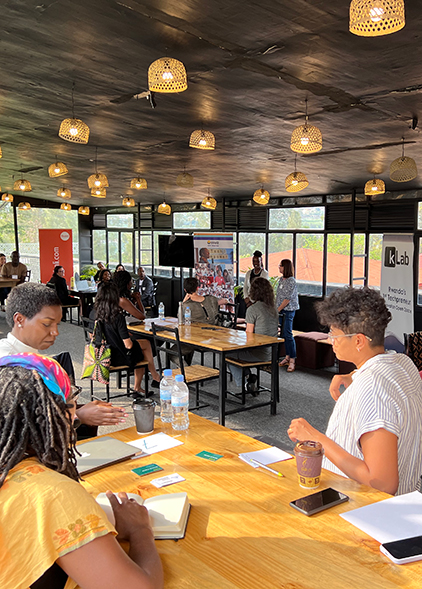
Rwanda's first open tech innovation hub, inaugurated March 2012 by a six-organisation public-private consortium with JICA support. 150,000+ students trained in coding; 200+ companies founded by 2016; 1,400+ active community members — a catalyst for Rwanda's emergence as a top Afr
>50,000
People who passed through the hub (by 2016) (by 2016)
>200
Companies founded by kLab members (by 2016) (by 2016)
~60
Companies reaching commercial maturity (by 2016)
>1,400
Community members (2023)
>150,000
Students trained in coding/digital entrepreneurship (as of 2023)
Details
Maturity
Established
Promoter
kLab Rwanda / Rwandan Development Board (RDB)
Period
2012–present
Keywords
innovation hub, technology, skills training, digital entrepreneurship, Africa
Context
kLab (Knowledge Lab) was inaugurated in March 2012 as Rwanda's first open technology innovation hub, co-founded by the Rwandan Development Board (RDB), Rwanda Private Sector Federation, the Rwandan Software Association, iHills, CODEPAC and Nyaruka, with JICA (Japan International Cooperation Agency) funding the renovation of the hub's physical space.
Activities
Operating from Kigali, kLab offers free co-working space, mentorship, hackathons, coding bootcamps and a startup incubation track.
Results
By 2016, more than 50,000 people had passed through the hub and over 200 companies had been founded by kLab members, of which around 60 reached commercial maturity. As of 2023, kLab counts over 1,400 community members and has trained more than 150,000 students in coding and digital entrepreneurship skills. Notable companies with kLab roots include AC Group and Khenz. kLab's model has been cited by GSMA, UNCTAD and the African Union as a reference for community-driven tech hubs in low-income countries.
Conclusions
kLab operates on a mixed-funding model (government, JICA, membership fees), creating sustainability risk as donor programmes cycle. No formal replication in other Rwandan cities has been documented.
Implementation
Indicative cost
Low (< €50k)
Time to results
Long (> 3 years)
Staffing & skills
Hub management and operations team, Mentors and coaches for hackathons and bootcamps
Conditions for success
Multi-stakeholder founding coalition combining government, private-sector and international donor support
Free access to space and training to lower barriers to entry
Sustained hub operation over many years to build community scale
Common failure modes
Mixed government/donor/membership funding model creates sustainability risk as donor programmes cycle
No formal replication documented in other Rwandan cities, limiting geographic scale-up
Commonly funded by
National / regional programmes
Indicative funding routes for practices of this type — always check each programme's current calls and eligibility rules.
Do you run this practice?
Claim it —
verified implementers get a public contact pathway and can propose corrections.
Data sources
Where this practice's information was retrieved from, and when.
Guernsey's States-funded Digital Greenhouse reported 250+ entrepreneurs supported and 1,000+ event attendees in 2024, plus an AI course delivered with …
A 35-year industry-academia tri-partnership in Penang's semiconductor cluster. Founded 1989 by the state government, Universiti Sains Malaysia, Intel, HP and …