Văcărești Natural Park — Bucharest's Abandoned Reservoir Reclaimed as an Urban Wetland Reserve (Romania)
Romania
A ~183 ha reservoir basin abandoned in 1989 rewilded on its own into Bucharest's richest habitat (reports of 140–175 bird …
United Kingdom · West Grinstead, West Sussex · See the United Kingdom profile
Top 27% 53/100 · Ask Evidence Copilot about this practice
Since 2000 the Knepp Estate has replaced intensive farming on 1,400 ha with free-roaming grazers and natural regeneration; surveys report breeding birds up from 55 to 559 individuals (2007–2025) and soil carbon doubling, with caveats on carbon methods.
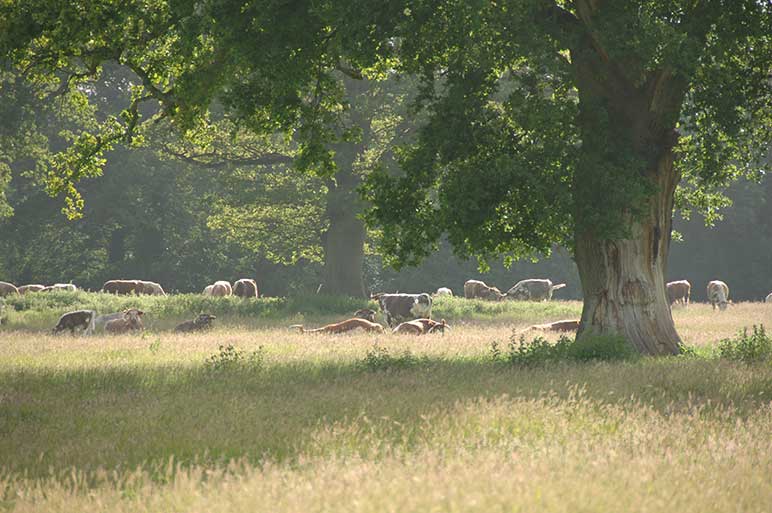
Knepp Estate (West Sussex, c. 1,400 ha / 3,500 acres) ended intensive arable and dairy farming in 2000 and turned to free-roaming grazing by old English longhorn cattle, Exmoor ponies, Tamworth pigs and deer, letting scrub and wood-pasture regenerate. Early funding came from Countryside Stewardship (2001) and later Higher Level Environmental Stewardship (2010); the estate now also earns income from c. 75 tonnes a year of pasture-fed meat and wildlife tourism.
Reported outcomes: a breeding-bird survey of the southern block counted 55 individuals of 22 species in 2007 and 559 individuals of 51 species in 2025 (+916%); singing nightingales reached 62 in 2025 (9 in 1999); turtle doves rose from 2 singing males (2008) to 22 (2024); dragonflies and damselflies rose c. 870% (2005–2025); and the estate hosts one of the UK's largest purple emperor populations. A 2018 Cranfield University study reported soil organic carbon had doubled since rewilding.
Caveats: an Oxford-led 2024 study found that standard tree-carbon models (i-Tree Eco) are unsuitable for rewilded scrub, whose root:shoot ratio (1.07) far exceeds the model assumption (0.26), so carbon figures remain uncertain. A 2025 comparison with an agricultural baseline (Boothby Wildland) is a space-for-time study, not a controlled experiment, and some scholars question whether the commercial 'safari' model amounts to true rewilding. Much of the biodiversity data are estate-reported.
Read the full analysis: https://knepp.co.uk/rewilding/
Implementation detail (cost, timeline, staffing, conditions for success) is not yet available for this practice.
Do you run this practice? Claim it — verified implementers get a public contact pathway and can propose corrections.
Where this practice's information was retrieved from, and when.
Romania
A ~183 ha reservoir basin abandoned in 1989 rewilded on its own into Bucharest's richest habitat (reports of 140–175 bird …
Australia
Australia's AU$20m Reef Builder programme rebuilt over 60 hectares of near-extinct shellfish reefs at 13 sites nationwide; a 2025 survey …
Iran
A decade-long Iran–UNDP programme cutting agricultural water use 25% and raising irrigation efficiency ~42% around Ramsar-listed Lake Urmia; independent monitoring …
United Kingdom
Scotland's Nature Restoration Fund has put £65 million into nearly 800 projects since 2021, restoring over 15,400 hectares of habitat, …
Open full copilot Grounded in cited practices — always check the sources.