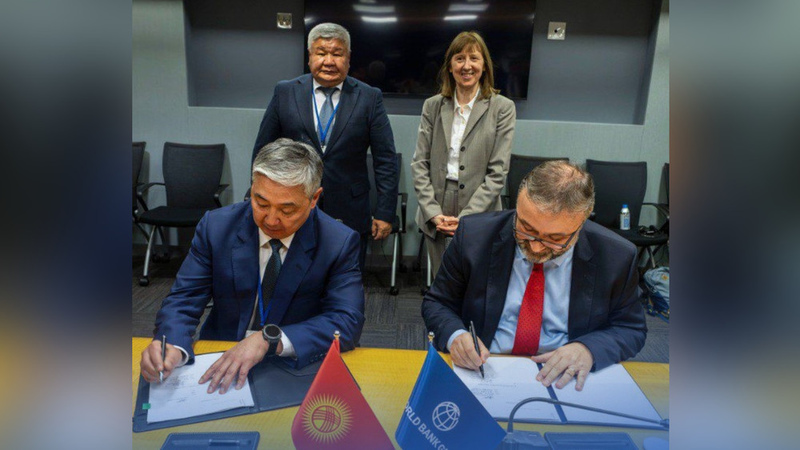
World Bank and Korea-World Bank Group Partnership Facility funding has trained 36,000 Kyrgyz teachers (80% women), equipped 1,200 schools with IT platforms, and piloted the country's first digital-skills assessment framework in 141 schools since 2020.
36000 people
Teachers trained (2020-2025)
80 %
Share of trained teachers who are women (2020-2025)
1200 schools
Schools equipped with IT platforms (2020-2025)
900 people
Deputy principals trained in instructional leadership (2020-2025)
141 schools
Schools piloting the digital-skills assessment framework (2025)
6.36 USD million
Additional financing approved (June 2025) (2025)
Details
Maturity
Scaling
Promoter
World Bank Group & Ministry of Education and Science of the Kyrgyz Republic (Korea-World Bank Group Partnership Facility)
Period
2020–2028
Keywords
education, digital skills, teacher training, public sector
Context
Since 2020, the World Bank's $50 million 'Learning for the Future' project has partnered with Kyrgyzstan's Ministry of Education and Science, drawing on the Korea-World Bank Group Partnership Facility to design the country's first digital-skills assessment framework and first training course purpose-built for informatics teachers.
Activities
By 2025 the initiative had trained 36,000 teachers (80% women), equipped 1,200 schools with IT platforms, run a 32-week pedagogical mentoring programme, trained 900 deputy principals in instructional leadership, and piloted the new digital-skills assessment framework in 141 schools.
Results
In June 2025 the World Bank approved $6.36 million in additional financing ($4.36 million zero-interest IDA credit plus $2 million Early Learning Partnership grant) to extend the project through 2028, explicitly framed as building toward 'an AI-ready education and workforce.'
Conclusions
The scale of activity is verified through World Bank programme documentation and independently corroborated by AKIpress; neither source yet reports independent measurement of student learning gains, the main evidence gap for the project's next phase.
Implementation
Indicative cost
High (€500k–€5M) — $50 million original World Bank project (2020) plus $6.36 million additional financing approved June 2025 ($4.36m zero-interest IDA credit + $2m Early Learning Partnership grant).
Time to results
Long (> 3 years) — Running 2020-2028, extended from the original closing date via the June 2025 additional financing.
Staffing & skills
World Bank Group financed and structured the project, Ministry of Education and Science of the Kyrgyz Republic implemented it nationally, Korea-World Bank Group Partnership Facility supplied Korean digital-education expertise for framework/course design
Conditions for success
Long-term, large-scale concessional financing enabling a multi-year national rollout
Dedicated informatics-teacher training course paired with a 32-week mentoring pipeline
Deputy-principal leadership training to support instructional change at school level
Common failure modes
Reported metrics are reach/process (teachers trained, schools equipped), not independent measures of student learning gains
The 'AI-ready' framing is a stated ambition of the 2025 extension, not yet substantiated by AI-specific outcome data
Where it fits
Governance type
national ministry with multilateral (World Bank) financing and bilateral (Korea) technical partnership
Scale
national (36,000 teachers, 1,200 schools)
Income level
lower-middle-income
Do you run this practice?
Claim it —
verified implementers get a public contact pathway and can propose corrections.
Data sources
Where this practice's information was retrieved from, and when.
South Africa's higher-education department and Google signed a two-year deal for 10,000 AI, cybersecurity and data-analytics Career Certificate scholarships across …