Guernsey's WCAG 2.1 AA Standard for Government and Disability-Sector Digital Services
Guernsey
The States of Guernsey and the Guernsey Disability Alliance both adopted WCAG 2.1 AA as their accessibility benchmark; the government's …
Armenia · Yerevan · See the Armenia profile · See the Yerevan profile
Evidence: Descriptive / self-reported Top 61% 68/100 · Ask Evidence Copilot about this practice
Since 2016, UNDP Armenia's Kolba Lab has incubated Matcheli, an open, crowdsourced map of wheelchair-accessible places built through public mapathons where wheelchair users, parents with prams and cyclists jointly tag accessible sites across Yerevan and beyond.
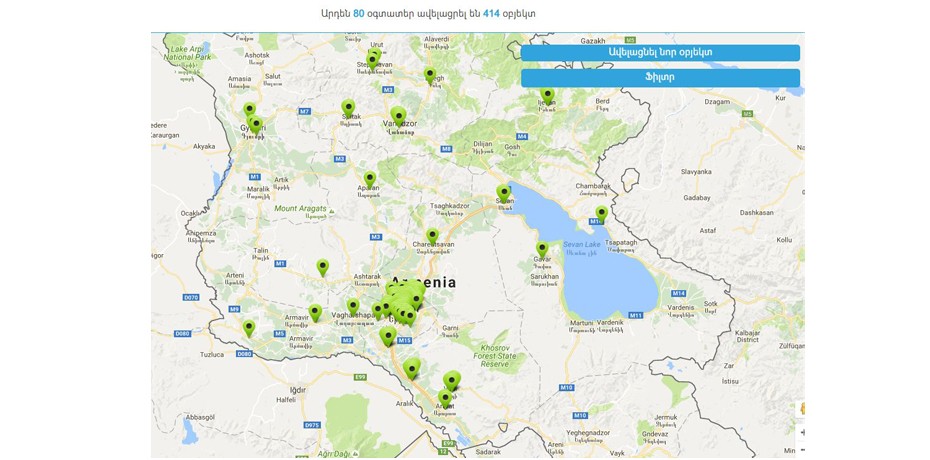
UNDP Armenia's Kolba Lab incubated Matcheli ('accessible' in Armenian), an open platform letting anyone mark a location's wheelchair accessibility, built through public mapathons in central Yerevan that co-designed the tool with wheelchair users, parents with prams and cyclists.
Coverage grew steadily since the 2016 launch: itel.am reported roughly 400 mapped places and about 80 active users, while UNDP separately reports over 500 locations in Yerevan alone, with outreach extended to other Armenian cities.
No independent impact evaluation was found and the user base remains modest for a national platform; its main evidenced strengths are longevity and a genuinely participatory data-collection method rather than measured outcomes.
Do you run this practice? Claim it — verified implementers get a public contact pathway and can propose corrections.
Where this practice's information was retrieved from, and when.
Guernsey
The States of Guernsey and the Guernsey Disability Alliance both adopted WCAG 2.1 AA as their accessibility benchmark; the government's …
South Africa
A 2014 community-based co-design study led by Delft University of Technology and the University of the Western Cape with Cape …
Nepal
Prayatna Nepal, an organisation led by visually impaired women, audited 20 government and private websites and 10 mobile apps against …
Kyrgyzstan
Giga (UNICEF-ITU) helped Kyrgyzstan build a real-time map of internet connectivity at all 2,137 public schools. The transparent data let …
Open full copilot Grounded in cited practices — always check the sources.