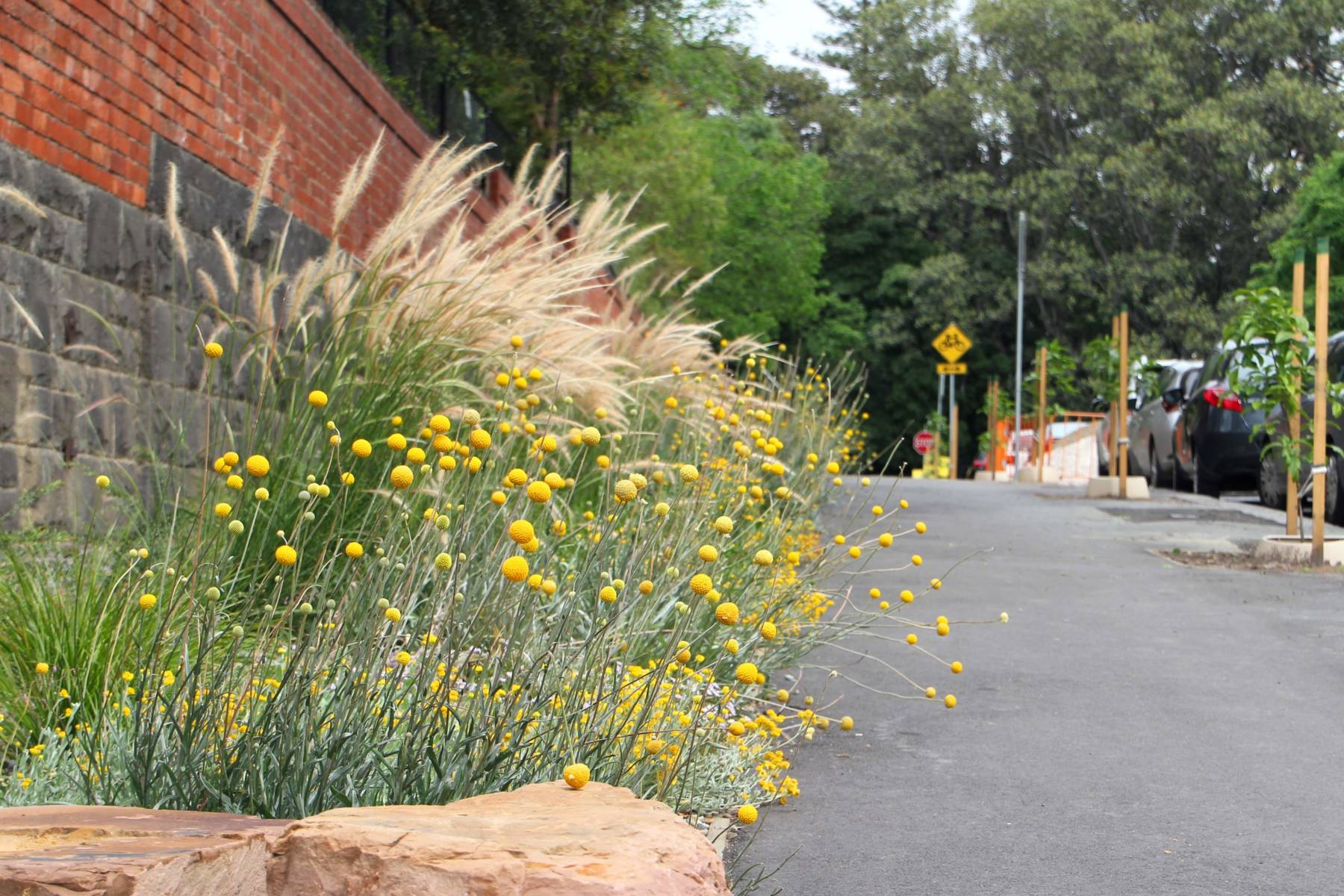
Launched in 2012 after the 1997–2009 Millennium Drought, the Urban Forest Strategy aims to raise public-realm canopy cover to 40% by 2040 (sources give the 2012 baseline as 20–22%) and to make 90% of the municipality's trees healthy. It was prompted by an ageing tree stock, with a projected 23% of trees at end of useful life within 10 years and 39% within 20, and by urban heat-island exposure. The strategy implies planting at least 3,000 trees a year; a figure of 42,000 trees over its life is also cited.
Delivery runs through Precinct Plans that coordinate street tree planting with other streetworks. Nearly 12,000 trees had been planted by 2015, and the municipality now has over 80,000 trees. In the CBD, 32 major street tree-planting projects and 1,304 trees were reported by July 2024, when a new Central City plan went to consultation. It caps single species at 5%, genus at 10% and family at 20% to limit pest risk, and it responds to a CBD with the highest share of exotic trees and the lowest share of Indigenous trees in the municipality.
The evidence is mostly about delivery, not outcomes. Reports note that public-realm canopy has held stable despite the loss of many mature trees in decline after repeated heatwaves, so the 40% target is not yet shown to be on track. A projected summer cooling of about 4°C is a modelled expectation, not a measured result. Biodiversity pilots on streets recorded more bees but no significant change in birds.
The transferable lessons are to set a quantified canopy target, plan species diversity and tree replacement from the start, and report canopy honestly against the target.
Read the full analysis: https://aiph.org/green-city-case-studies/melbourne-australia-urban-forestry/
Where this practice's information was retrieved from, and when.