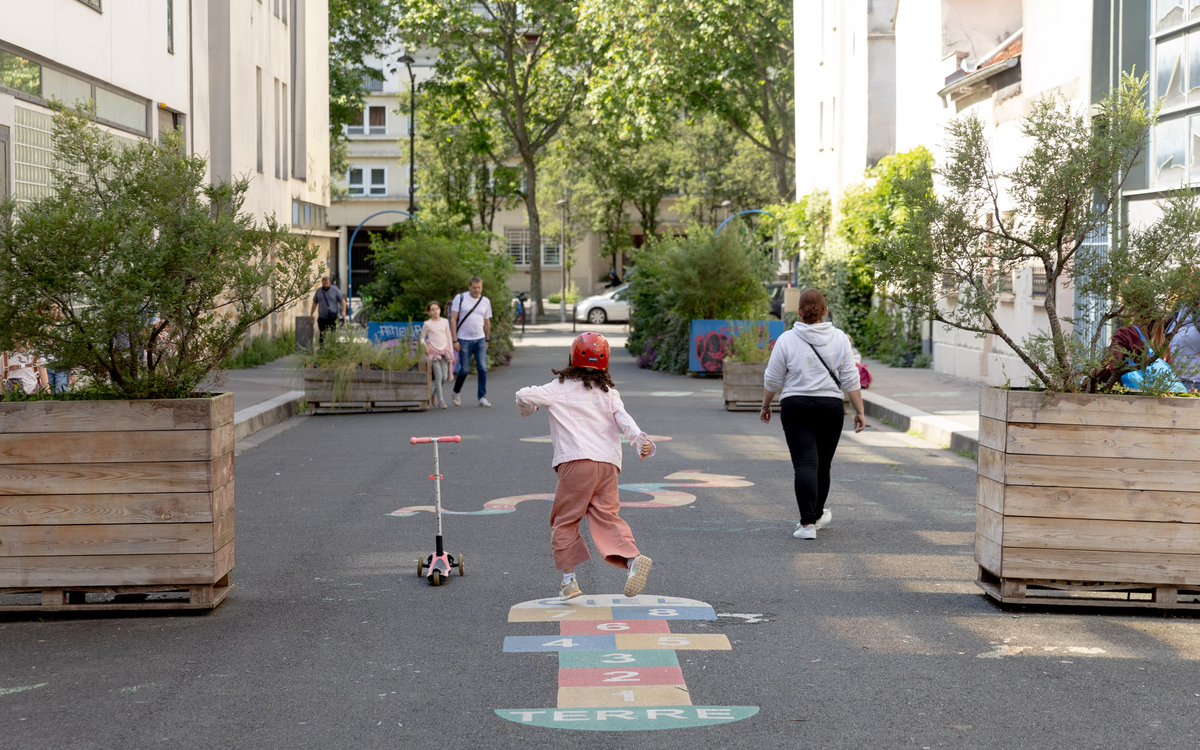
Paris has calmed 300+ streets in front of schools, about half of nursery and primary schools; early studies report 10–30% lower NO2 and cooler greened pavements, but independent long-term evidence is still thin.
Details
Promoter
City of Paris (Ville de Paris)
Period
2020–2026 mandate (ongoing)
Keywords
school streets, pedestrianisation, urban greening, child safety, heat adaptation
Description
Paris's 'rues aux écoles' close or pedestrianise the street in front of nursery and primary schools, with around 100 redesigned with depaved surfaces and planting. The City reports more than 300 such streets as of September 2025, covering about half of nursery and primary schools; the 2020–2026 works budget was reported at about €110 million. A spring 2024 study by the associations Respire and AirGones, as reported in secondary summaries, found NO2 decreases of 10–30% depending on site. A 2026 peer-reviewed analysis (Marcel Moran, Journal of the American Planning Association/SAGE) visited 272 active sites and used remote sensing, reporting an average surface-temperature difference of about 5.0°C between cooling-pavement school streets and adjacent control streets. Caveats: the air-quality study came from advocacy associations; city pages state objectives more than measured outcomes; and evidence on traffic displacement, child safety outcomes and equity across arrondissements remains limited.
Read the full analysis: https://www.paris.fr/pages/57-nouvelles-rues-aux-ecoles-dans-paris-8197
Implementation
Implementation detail (cost, timeline, staffing, conditions for success) is not yet available for this practice.
Do you run this practice?
Claim it —
verified implementers get a public contact pathway and can propose corrections.
Data sources
Where this practice's information was retrieved from, and when.
Freetown City Council piloted a smartphone-verified, micropayment-incentivised tree-planting model that has geotagged and tracked over 950,000 trees, won a $1M …