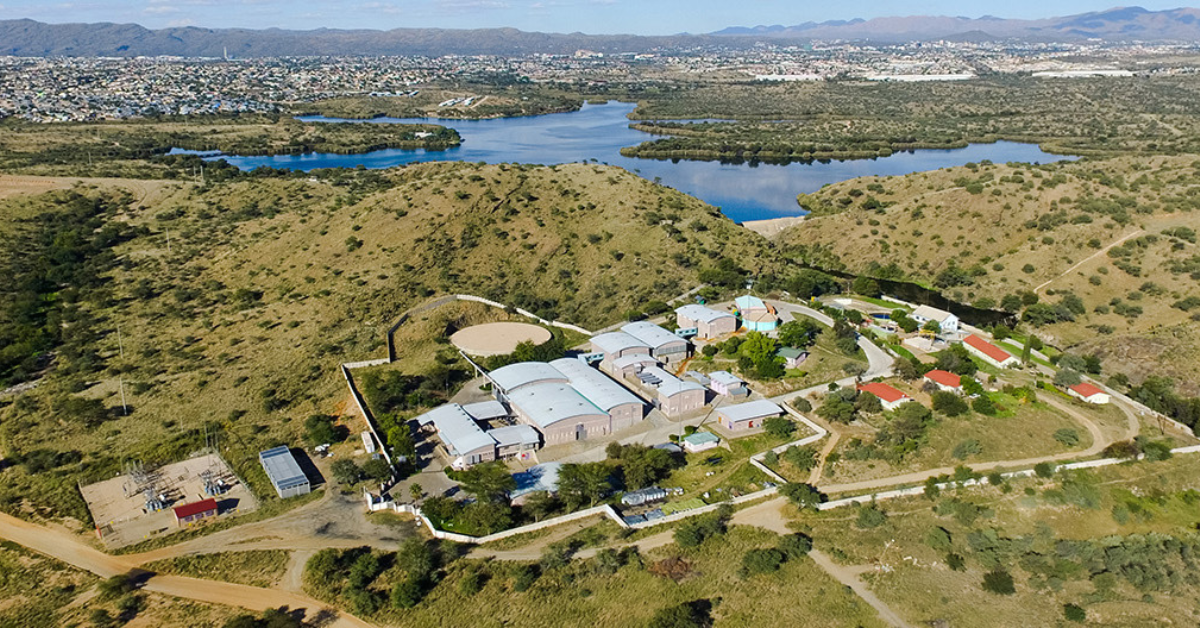
Windhoek has turned reclaimed sewage into drinking water since 1968. The New Goreangab plant (2002) now supplies 21,000 m³/day — a quarter of the capital's water — with a second facility planned to reach 50% amid prolonged drought.
~21,000 m3/day
Drinking water produced
~25%
Share of Windhoek's water demand met
US$43 million+
DPR2 financing (KfW)
~50%
Target share of consumption after DPR2
Details
Maturity
Established
Promoter
City of Windhoek / Windhoek Goreangab Operating Company (WINGOC)
Period
1968–present (New Goreangab plant since 2002)
Keywords
water reuse, drinking water, drought resilience, circular economy
Context
Windhoek pioneered direct potable reuse (DPR) in 1968, when the original Goreangab Water Reclamation Plant became the world's first facility purifying sewage effluent into drinking water without an environmental buffer. The New Goreangab Water Reclamation Plant, commissioned in September 2002, uses a multi-barrier treatment train to produce roughly 21,000 m3 of drinking water per day, meeting about a quarter of Windhoek's demand.
Results
Namibia's capital sits in one of the driest countries south of the Sahara and has faced more than seven years of persistent drought, making reclaimed water a structural part of the city's supply. A second direct-potable-reuse facility (DPR2) is now planned with financing of more than US$43 million from Germany's KfW development bank, intended to lift reclaimed water's share of consumption to about 50%.
Conclusions
Windhoek's decades-long safety record has made it a reference case cited by utilities elsewhere, including in the United States, exploring their own direct-reuse programmes.
Implementation
Indicative cost
High (€500k–€5M)
Time to results
Long (> 3 years)
Staffing & skills
City of Windhoek water utility, KfW development bank (DPR2 financing)
Conditions for success
multi-barrier treatment train
decades-long operational safety record supporting public trust
Commonly funded by
National / regional programmes
Indicative funding routes for practices of this type — always check each programme's current calls and eligibility rules.
Do you run this practice?
Claim it —
verified implementers get a public contact pathway and can propose corrections.
Data sources
Where this practice's information was retrieved from, and when.
Arcata (California) completes conventional wastewater treatment with 307 acres of constructed wetlands that double as a wildlife sanctuary; 300+ bird …