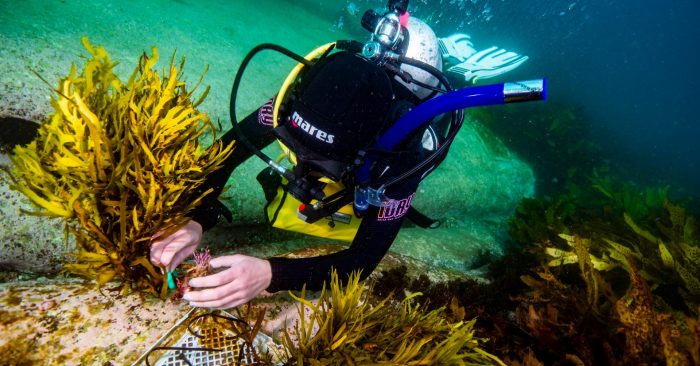
Since 2012, Operation Crayweed has hand-transplanted golden crayweed onto barren reefs at nine sites across 70km of Sydney's coastline; UNSW-led peer-reviewed monitoring found survival and reproduction rates matching natural populations, reviving a foundation species lost since t
~70 km
Coastline restored (2012-present)
9
Restoration sites
Details
Maturity
Established
Promoter
UNSW Sydney Centre for Marine Science and Innovation, with the NSW Department of Primary Industries
Crayweed (Phyllospora comosa), a golden seaweed that once formed dense underwater forests along Sydney's coastline, vanished from the city's reefs in the 1980s — likely due to poor water quality — and did not recover naturally even after water quality improved.
Activities
Since 2012, Operation Crayweed, led by UNSW Sydney's Centre for Marine Science and Innovation, has fixed fertile adult plants from healthy populations onto barren reefs with biodegradable mats; transplant stress triggers spawning and offspring attach permanently to the reef. Transplanting has taken place at nine locations spanning roughly 70 km of coastline.
Results
Peer-reviewed monitoring found transplanted crayweed achieves survival and reproduction rates comparable to natural populations, restoring habitat that supports abalone, rock lobsters and other reef species.
Conclusions
The programme is funded by a durable, multi-funder model — NSW government trusts, the Australian Research Council, private foundations and UNSW's own research centre — now over a decade old.
Implementation
Indicative cost
Low (< €50k)
Time to results
Long (> 3 years)
Staffing & skills
UNSW Sydney Centre for Marine Science and Innovation researchers
Conditions for success
Source of fertile adult plants from healthy nearby populations
Conservation International and Colombian partners' Vida Manglar project protects and restores mangroves across Cispatá Bay, scaling from 7,500 to 11,000 …