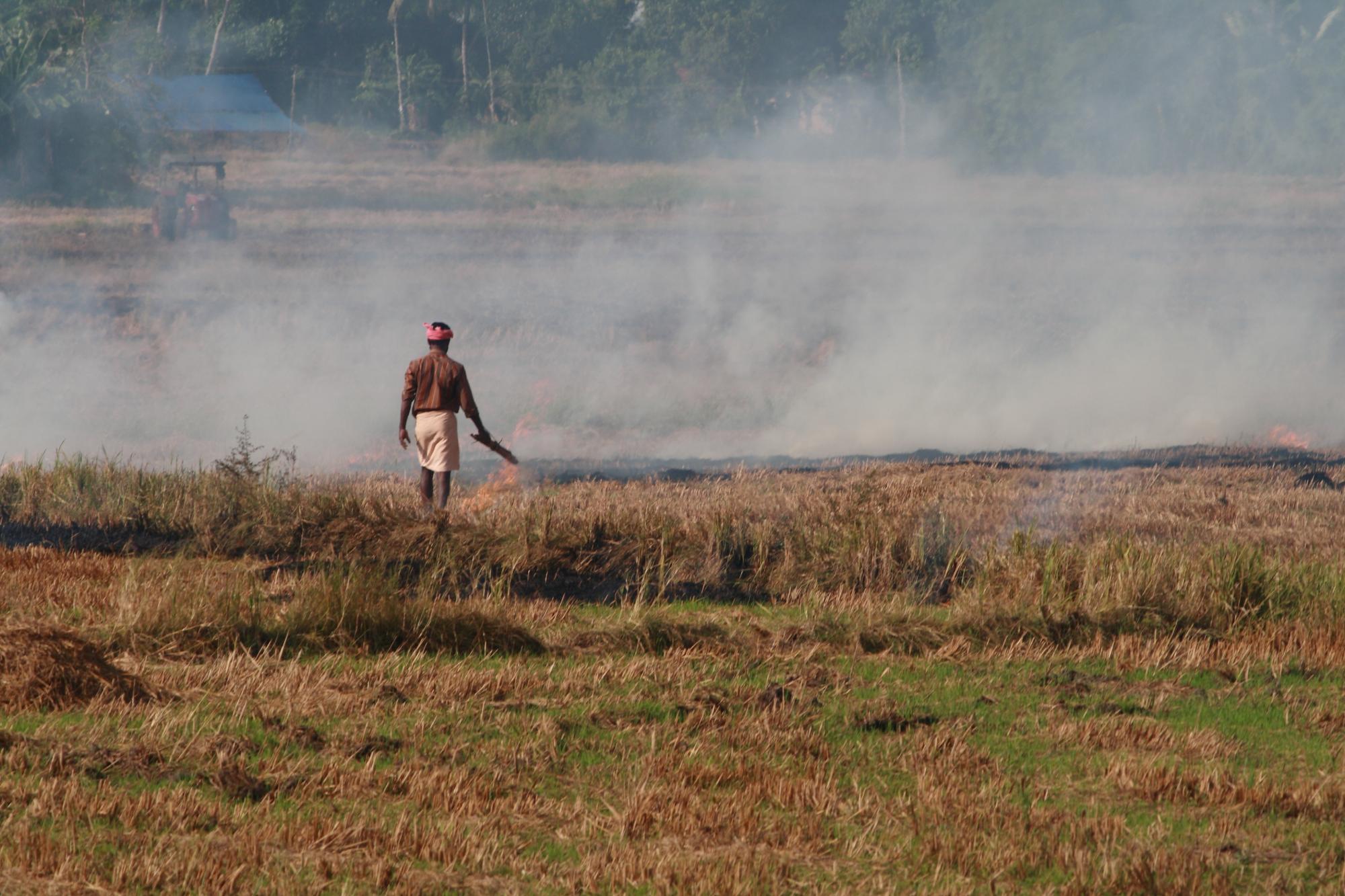
A randomised trial across 171 Punjab villages found that paying farmers a share of their no-burn payment upfront cut satellite-detected crop-residue burning by roughly 8-11 percentage points versus a standard pay-on-compliance contract.
1700 farmers, 171 villages
Farmers covered (2019 kharif season)
72 %
Contract signup rate (both arms)
18.5 %
Compliance, upfront-payment contracts
8.5 %
Compliance, standard contracts
8-11 percentage points
Reduction in satellite-detected burning (upfront vs standard)
125-190 x
Benefit-to-cost ratio
3600-5400 USD
Cost per life saved (avoided health damages)
800-1600 INR/acre
Payment range
Details
Maturity
Pilot
Promoter
J-PAL South Asia, with UC Santa Barbara, Princeton University, MIT and Yale University
Period
2019–2020 rice season (RCT); results published 2025
Keywords
agriculture, air quality, payments for ecosystem services, behavioural design
Context
Farmers in Punjab commonly burn rice stubble to clear fields cheaply, estimated to drive 30-40% of winter air pollution in New Delhi. Researchers tested whether payments for ecosystem services (PES), and the timing of payment, could change that behaviour.
Objectives
Determine whether standard (pay-on-compliance) versus partly-upfront PES contracts reduce crop-residue burning, measured via satellite detection.
Activities
A randomised controlled trial covered roughly 1,700 farmers in 171 villages during the 2019 kharif season. Some farmers were offered a standard PES contract (₹800-1,600/acre, paid only after verified compliance); others received the same contract with 25-50% paid upfront and unconditionally.
Results
About 72% of farmers in both arms signed contracts. Standard PES produced no significant reduction in burning versus control. Upfront-component contracts performed very differently: compliance rose to ~18.5% versus 8.5% for standard contracts, and satellite-based measures showed an 8-11 percentage-point reduction in burning. The team estimated a benefit-to-cost ratio of 125-190x from avoided health damages, translating to roughly $3,600-5,400 per life saved.
Conclusions
The trial's key governance finding is that contract design — specifically payment timing, not just size — determines whether agricultural PES changes behaviour among liquidity-constrained farmers; standard delayed-payment PES showed no significant effect.
Implementation
Indicative cost
Low (< €50k) — ₹800-1,600/acre PES payments, 25-50% disbursed upfront in the treatment arm; trial-scale, not yet a funded standing programme.
Time to results
Short (< 1 year) — Single-season (2019 kharif) randomised trial; results published in 2025.
Staffing & skills
J-PAL South Asia field/enumeration team, academic research team (UC Santa Barbara, Princeton, MIT, Yale), satellite burning-detection analysts
Conditions for success
upfront (unconditional) partial payment component to overcome farmer liquidity constraints and payment-trust concerns
satellite verification of compliance
randomised assignment enabling causal attribution
Common failure modes
standard pay-on-compliance PES contracts showed no significant reduction in burning relative to control
Where it fits
Governance type
research-trial PES contract with state/researcher administration
Scale
sub-regional (171 villages, Punjab)
Income level
lower-middle-income smallholder farmers (India)
Replication kit
Reusable artefacts from this practice — as published by their sources.