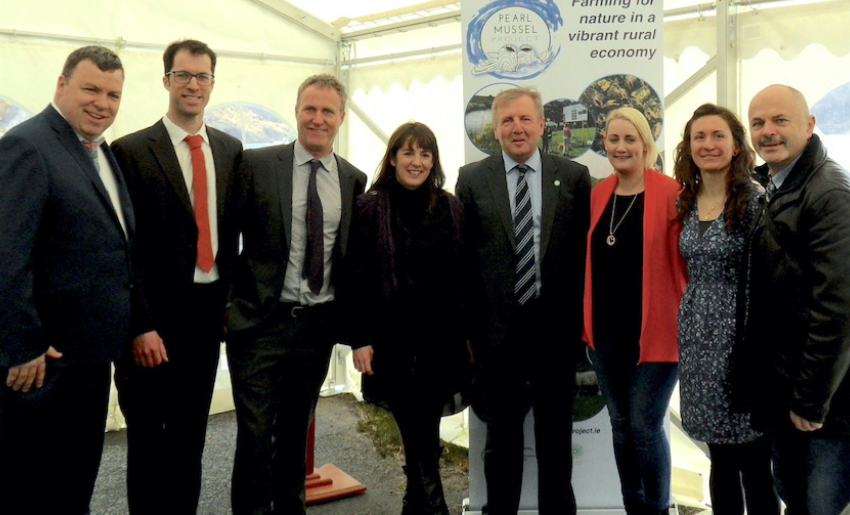
A six-year, €10m EIP-AGRI results-based scheme paid roughly 450 farmers across Ireland's 'Top 8' freshwater pearl mussel catchments for measured habitat and water-quality scores, aiming to slow the decline of one of Europe's most endangered freshwater molluscs.
450 farmers
Farmers participating (2018–2023)
10 € million
Total scheme funding (2018–2023)
Details
Maturity
Pilot
Promoter
Pearl Mussel Project (Ireland Department of Agriculture, Food and the Marine — EIP-AGRI)
Period
2018–2023
Keywords
agri-environment, freshwater biodiversity, results-based payments, water quality
Context
The Pearl Mussel Project (2018–2023) was a €10 million pilot agri-environment scheme funded through Ireland's EIP-AGRI programme, run by the Department of Agriculture, Food and the Marine with roughly 450 farmers across the country's 'Top 8' freshwater pearl mussel catchments, which hold around 80% of Ireland's national population of the critically endangered freshwater pearl mussel.
Activities
Independent farm advisors scored each participating farm annually against habitat and whole-farm scorecards (peatland, grassland, woodland, watercourse quality), paying farmers according to score achieved rather than for prescribed actions — funding measures such as blocking drains, fencing watercourses and installing off-stream drinking troughs.
Results
Over 450 farmers participated across the eight catchments. Independent reporting from Teagasc, Ireland's state agriculture research and advisory body, notes that pearl mussel populations in the Top 8 catchments were still undergoing a slow decline even with the scheme in place.
Conclusions
The scheme shows results-based payments can improve on-farm practice without yet reversing decades of accumulated water-quality pressure on pearl mussel populations.
Implementation
Indicative cost
Medium (€50k–€500k) — €10 million over six years (2018–2023), funded via Ireland's EIP-AGRI programme.
Time to results
Medium (1–3 years) — Six-year pilot, 2018–2023, with annual on-farm scoring visits.
Staffing & skills
Independent farm advisors who scored each participating farm annually, Ireland's Department of Agriculture, Food and the Marine (EIP-AGRI programme)
Conditions for success
Results-based scoring that rewarded outcomes rather than prescribed actions
Sustained farmer engagement across all eight priority catchments
Annual independent scoring to keep payments credible
Common failure modes
Even with the scheme in place, pearl mussel populations in the Top 8 catchments were still undergoing a slow decline, per Teagasc — results-based payments improved on-farm practice without yet reversing decades of accumulated water-quality pressure
Where it fits
Governance type
national government agri-environment pilot scheme
Scale
sub-national — eight priority river catchments
Income level
high-income
Commonly funded by
National / regional programmes
Indicative funding routes for practices of this type — always check each programme's current calls and eligibility rules.
Do you run this practice?
Claim it —
verified implementers get a public contact pathway and can propose corrections.
Data sources
Where this practice's information was retrieved from, and when.
France's 2021–2024 national PES pilot paid nearly 3,500 farmers across 130 territories for water-quality, soil and biodiversity outcomes, contracting up …
Colombia's Decreto-Ley 870/2017 created a national legal framework paying landowners to conserve páramos, forests and wetlands; by 2024 government figures …