Copenhagen Business Hub (Erhvervshus Hovedstaden)
Denmark
Erhvervshus Hovedstaden is one of six regional business houses in Denmark. At Erhvervshus Hovedstaden, they help more than 5,000 companies …
South Africa · Pretoria · See the South Africa profile · See the Pretoria profile
Top 39% 71/100 · Ask Evidence Copilot about this practice
Technovera's Pelebox smart lockers, backed by South Africa's Technology Innovation Agency, let clinic patients collect chronic medication via SMS one-time password in under a minute versus an average 3-hour queue, reaching 3,000+ patients in multiple provinces.
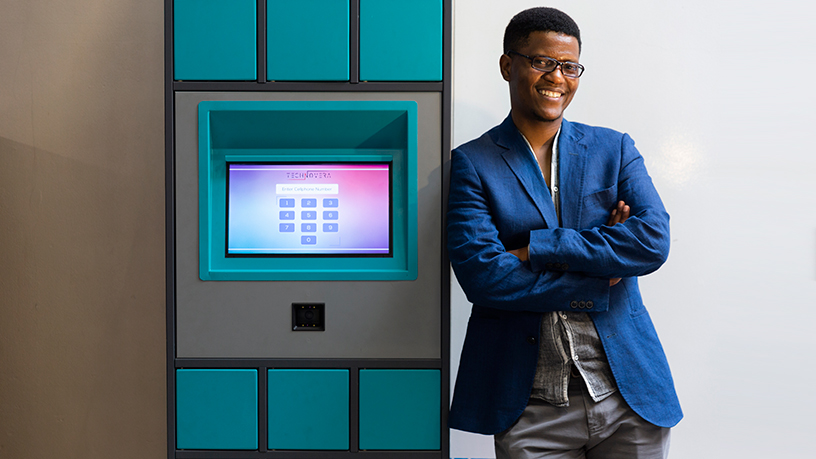
Neo Hutiri, diagnosed with tuberculosis in 2014, endured queues of more than three hours to collect his chronic medication at a public clinic in Gauteng. He founded Technovera and built Pelebox, IoT-enabled smart lockers that let registered chronic-care patients open a cubicle holding their pre-packed medication by entering their phone number and a one-time SMS password, skipping the pharmacy queue entirely.
Pelebox is integrated with South Africa's national Central Chronic Medicine Dispensing and Distribution (CCMDD) programme and has been piloted with the City of Tshwane and the National Department of Health. Independent reporting by Daily Maverick, Bhekisisa and News24 documents patients collecting medication in as little as 30–36 seconds against a national average wait of roughly three hours, with more than 3,000 patients served. KwaZulu-Natal's provincial health department also runs Pelebox sites under CCMDD.
The Technology Innovation Agency (TIA), South Africa's national public commercialisation agency, backs Pelebox as a flagship example of publicly supported health tech scaling from prototype to multi-province deployment. TIA has not published independently audited nationwide uptake or cost-effectiveness figures, so the evidence here is strongest at the site/queue-time level rather than as a verified national health-system outcome.
Read the full analysis: https://www.itweb.co.za/content/wbrpO7gPQZjMDLZn
Implementation detail (cost, timeline, staffing, conditions for success) is not yet available for this practice.
Do you run this practice? Claim it — verified implementers get a public contact pathway and can propose corrections.
Where this practice's information was retrieved from, and when.
Denmark
Erhvervshus Hovedstaden is one of six regional business houses in Denmark. At Erhvervshus Hovedstaden, they help more than 5,000 companies …
Kazakhstan
Kazakhstan's Damu Fund tested three SME finance instruments; a 2026 World Bank study found market-aligned partial guarantees raised employment ~24% …
United States of America
In July 2017, 15 volunteer teams in Richmond, Virginia logged 60,000+ car-mounted temperature readings, finding 15–20°F intra-city gaps that helped …
Uganda
Makerere University engineers built AirQo in 2015 to fill Africa's air-quality data gap with low-cost, solar-powered sensors. It now runs …
Open full copilot Grounded in cited practices — always check the sources.