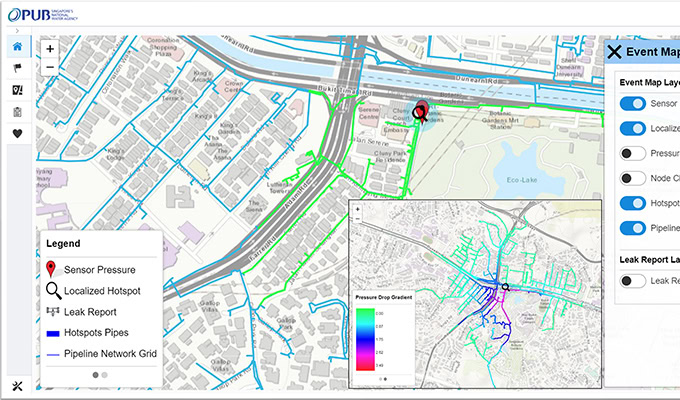
PUB's Anomaly Leak Finder uses AI, machine learning and a daily-recalibrated hydraulic digital twin to detect and localise hidden pipe leaks across four major water networks. Live since January 2024, it has confirmed two leaks, each localised to under 1km.
90+ sensors
Smart sensors feeding the digital twin
1,000+ km
Pipeline network modelled
4
Major distribution networks covered
2
Leaks detected and localised by ALF (since Jan 2024)
<1 km
Leak localisation accuracy
330+ km
Pipes renewed (since 2016)
267
Pipe leaks repaired (2024)
1500 sensors
Permanent leak-detection sensors network-wide
Details
Maturity
Scaling
Promoter
PUB, Singapore's National Water Agency
Period
2024-2026
Keywords
water utilities, digital twin, predictive maintenance, public infrastructure
Context
PUB, Singapore's national water agency, needed better tools to detect hidden underground pipe leaks across its distribution network, since earlier acoustic-only sensor deployments could not reliably distinguish genuine leaks from other anomalies like sensor failures or pressure shifts.
Objectives
To build a cloud-hosted AI system combining data-driven prediction with physics-based hydraulic simulation, recalibrated daily against live sensor data, to detect and localise leaks before they become disruptive.
Activities
PUB built the Anomaly Leak Finder (ALF) on Bentley Systems' iTwin and OpenFlows software, combining a data-driven prediction (DDP) model with a physics-based simulation (PBS) model. Hydraulic models are recalibrated daily using data from over 90 smart sensors, creating a digital twin of more than 1,000km of pipelines across four major distribution networks, run 24/7. ALF sits within PUB's longer-running leak-management programme (330km of pipes renewed since 2016; 267 pipe leaks repaired in 2024).
Results
Since going live in January 2024, ALF has detected and localised two significant underground leaks to within roughly one kilometre, alerting leak-detection crews before they became disruptive, and also flags related anomalies such as sensor failures and demand-driven pressure shifts.
Conclusions
The two confirmed leak detections are an early-stage result rather than a mature performance track record; PUB has not yet published network-wide non-revenue-water savings attributable specifically to ALF.
Implementation
Indicative cost
Medium (€50k–€500k)
Time to results
Medium (1–3 years)
Commonly funded by
National / regional programmes
Indicative funding routes for practices of this type — always check each programme's current calls and eligibility rules.
Do you run this practice?
Claim it —
verified implementers get a public contact pathway and can propose corrections.
Data sources
Where this practice's information was retrieved from, and when.
eThekwini Municipality uses a satellite machine-learning system to flag suspected drinking-water leaks across Durban's network, tracking over 1,000 leaks. Despite …