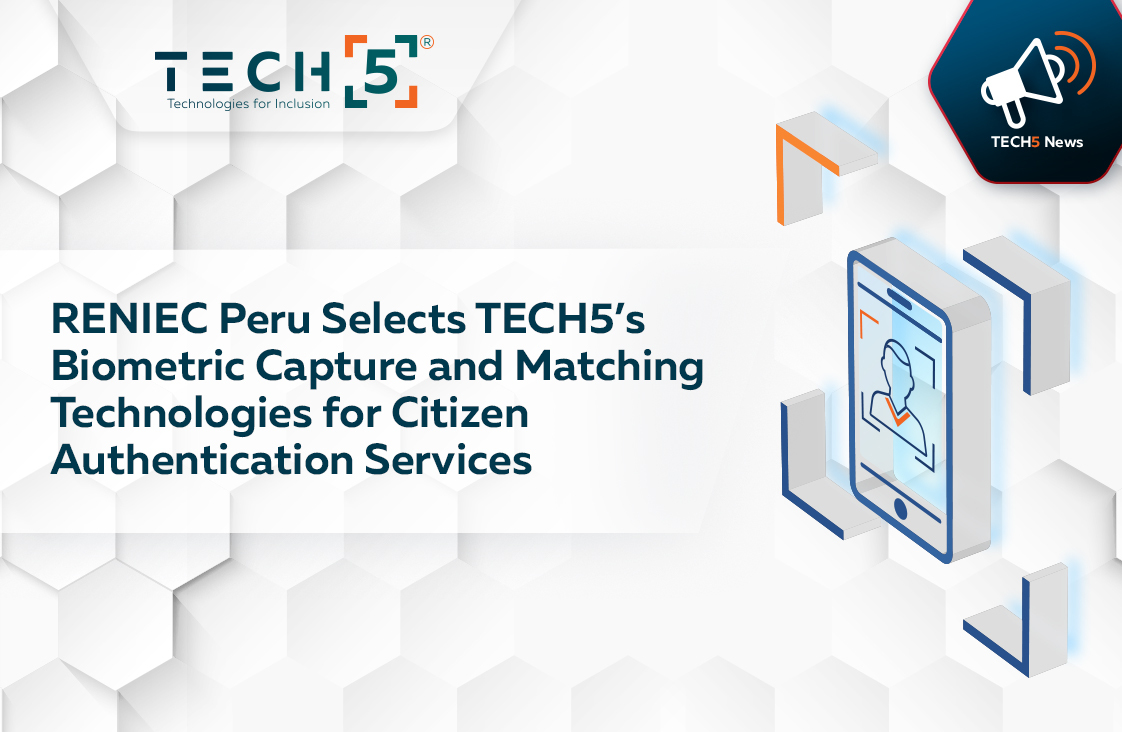
Peru's civil registry RENIEC awarded TECH5 a three-year public-tender contract for AI-based facial capture and multi-biometric ABIS matching, aiming to let citizens authenticate once via phone or browser instead of re-proving identity to every digital service.
3 years
Length of RENIEC-TECH5 contract (2025-2028)
80 USD million
IDB loan to strengthen civil-registration operations (March 2026)
Details
Maturity
Pilot
Promoter
Registro Nacional de Identificación y Estado Civil (RENIEC)
Period
2025–2028
Keywords
digital identity, biometrics, civil registration
Context
RENIEC (Registro Nacional de Identificación y Estado Civil), Peru's national civil registry, already runs one of Latin America's longest-standing biometric de-duplication programmes, automatically fingerprint-matching new enrolments against tens of millions of existing records to keep a 'one citizen, one identity' principle before a national ID (DNI) is issued.
Objectives
Following a competitive public tender in February 2025, RENIEC selected TECH5 to supply two additional platforms for citizen-facing digital services: T5-AirSnap Face, a mobile facial-capture SDK with built-in liveness and ISO/ICAO image-quality checks, and T5-OmniMatch ABIS, a multi-biometric matching engine for identification, de-duplication, verification and authentication. The three-year contract is meant to let residents authenticate remotely via smartphone or browser to access government digital services, reducing the need to physically re-prove identity at each agency.
Activities
The deal followed a turbulent period for RENIEC's identification-registry department, reported by independent trade press in mid-2024 amid internal management concerns. Peru separately signed an agreement with the open-source MOSIP platform in 2024 and received an $80 million Inter-American Development Bank loan in March 2026 to strengthen civil-registration operations.
Conclusions
No published data yet quantifies match accuracy, fraud reduction or citizen time saved under the new TECH5 deployment; the available evidence is the procurement decision itself plus RENIEC's decades of operating experience with biometric de-duplication at national scale, indicating this is one piece of a broader, still-unfolding modernisation effort rather than a single finished system.
Implementation
Indicative cost
Medium (€50k–€500k)
Time to results
Medium (1–3 years) — Three-year contract, 2025-2028, following the February 2025 tender award.
Staffing & skills
Registro Nacional de Identificación y Estado Civil (RENIEC), implementing agency, TECH5, vendor for AirSnap Face and OmniMatch ABIS, MOSIP, platform partnership, Inter-American Development Bank, financing partner for broader civil-registration modernisation
Conditions for success
Decades of existing biometric de-duplication infrastructure and operating experience at national scale
ISO/ICAO image-quality and liveness standards for facial capture
Competitive public tender process for vendor selection
Common failure modes
Turbulent internal-management period reported at RENIEC's identification department in mid-2024
No published accuracy, fraud-reduction or time-saved metrics yet for the new deployment
Commonly funded by
National / regional programmes
Indicative funding routes for practices of this type — always check each programme's current calls and eligibility rules.
Do you run this practice?
Claim it —
verified implementers get a public contact pathway and can propose corrections.
Data sources
Where this practice's information was retrieved from, and when.
Rwanda's National Identification Agency is rolling out a Single Digital Identification System built on an Automated Biometric Information System (ABIS) …