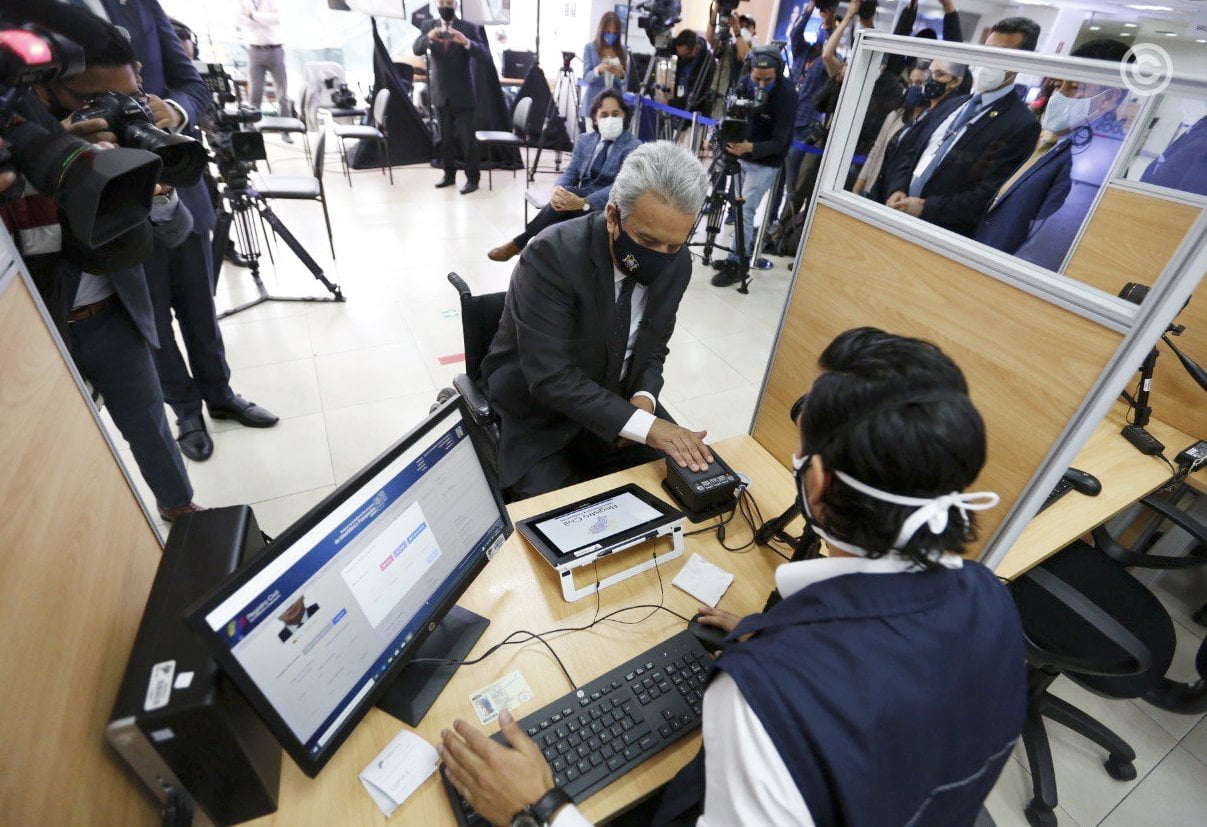
Ecuador's Registro Civil migrated 13.7 million legacy records onto an Innovatrics ABIS platform to issue biometric passports and electronic cédulas from one de-duplicated identity, later extended to enable e-signatures and access to public social-welfare services.
13.7-14 million records
Legacy identity records migrated into the centralised biometric database
26.95 USD million
Implementation contract value
Details
Maturity
Established
Promoter
Registro Civil, Identificación y Cedulación del Ecuador
Period
2020–present
Keywords
digital identity, biometrics, civil registration, social protection
Context
Ecuador was the last country in Latin America still issuing mechanical, non-biometric passports until its civil registry, the Registro Civil, launched the System for Issuing Identity Documents and Passports (SEDIP), built on Innovatrics' Automated Biometric Identification System (ABIS). The Ministry of Communication-led project migrated approximately 13.7-14 million legacy identity records into a single centralised database.
Objectives
SEDIP aims to use fingerprint and facial matching to keep one de-duplicated biometric identity per citizen across both the new biometric passport and the electronic national ID card (cédula), so citizens who previously submitted fingerprints and photos separately to each document now do so once.
Activities
President Lenín Moreno received the country's first biometric passport at the launch on 14 September 2020; the independent newspaper El Universo reported the implementation contract was valued at USD 26.95 million and that electronic cedula issuance was slated to begin that December. The same de-duplicated identity layer was subsequently used to let citizens authenticate for electronic signatures and access public social-welfare services online rather than in person at each agency.
Results
SEDIP migrated approximately 13.7-14 million legacy identity records into the new centralised, de-duplicated biometric database, and the deployment is now more than five years old with continuous public operating history rather than being a recent pilot.
Conclusions
Neither the vendor case study nor contemporary Ecuadorian press coverage publishes matching-accuracy rates, an independent security or privacy audit, or a measured reduction in processing time or duplicate-identity fraud; the evidence is limited to migration and deployment facts, and Ecuador's later, unrelated digital-ID missteps in other agencies mean SEDIP's own track record should be read on its own narrow evidence rather than assumed to generalise.
Implementation
Indicative cost
High (€500k–€5M) — Implementation contract valued at USD 26.95 million per El Universo (Sep 2020).
Time to results
Long (> 3 years) — Launched 14 September 2020; electronic cédula issuance slated for December 2020; deployment now over five years with continuous operation.
Staffing & skills
Ministry of Communication (Ecuador), project lead, Registro Civil, Identificación y Cedulación del Ecuador (implementing agency), Innovatrics (ABIS vendor)
Conditions for success
Centralised biometric database combining fingerprint and facial matching
Single de-duplicated identity shared across passport and cédula documents
Civil registry mandate providing the legal identity framework
Common failure modes
No independent accuracy or security/privacy audit published
Ecuador's later, unrelated digital-ID problems in other agencies mean this track record should not be assumed to generalise
Commonly funded by
National / regional programmes
Indicative funding routes for practices of this type — always check each programme's current calls and eligibility rules.
Do you run this practice?
Claim it —
verified implementers get a public contact pathway and can propose corrections.
Data sources
Where this practice's information was retrieved from, and when.