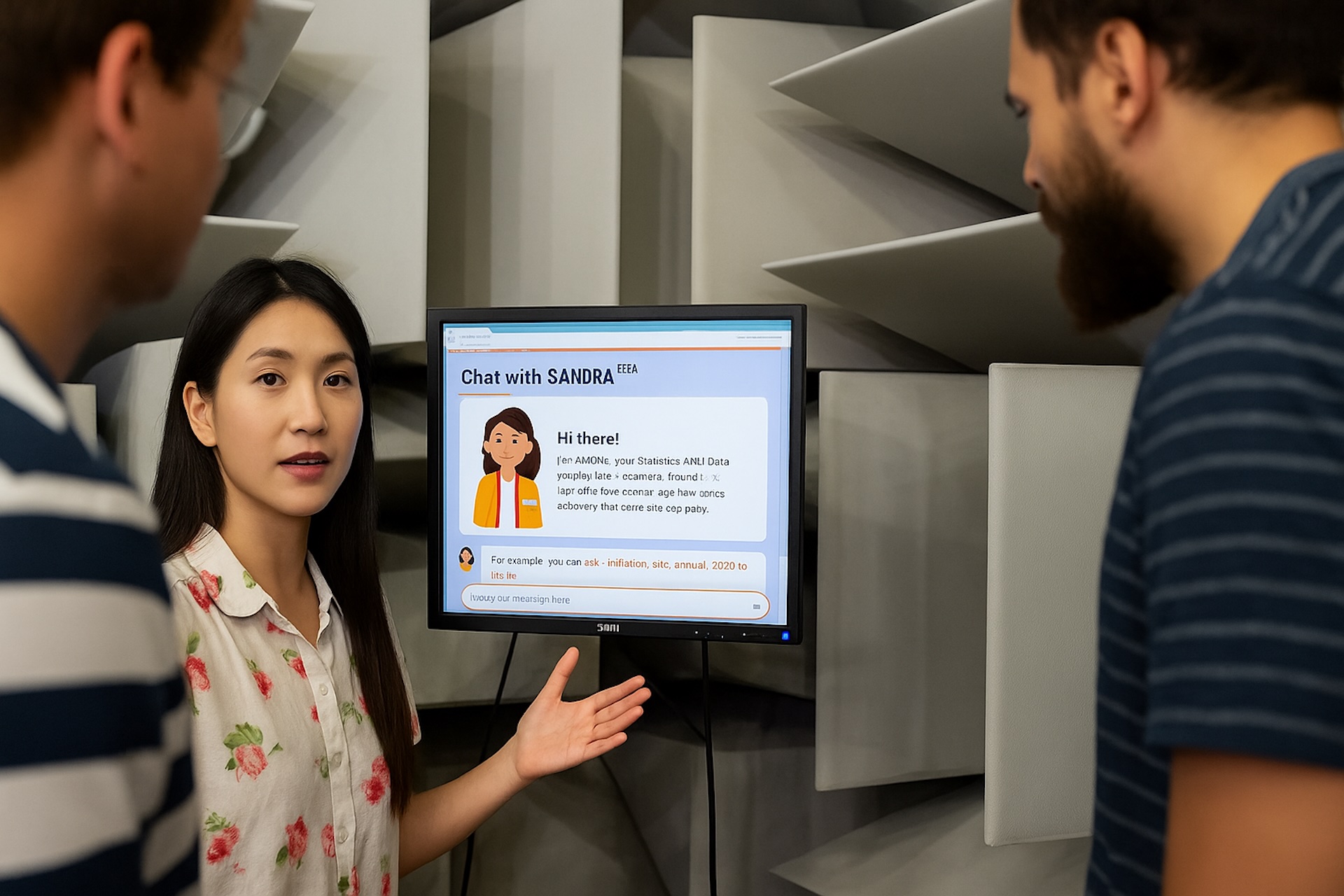
Singapore's Department of Statistics built SANDRA, an AI chatbot letting the public query ~2,400 SingStat data tables from 70 agencies in plain language, using semantic search over ~1,000 vectorised time-series datasets.
2,400 data tables
SingStat Table Builder dataset coverage (as of 2026)
70 agencies
Public-sector agencies providing source data (as of 2026)
1,000 datasets
Time-series datasets vectorised for SANDRA (as of 2026)
Details
Maturity
Pilot
Promoter
Singapore Department of Statistics (DOS)
Period
2025–ongoing (Phase 1, beta)
Keywords
statistics, open data, public administration, digital government
Context
Singapore's Department of Statistics (DOS) manages the SingStat Table Builder, a platform hosting roughly 2,400 data tables sourced from 70 public-sector agencies; search-log analysis and stakeholder interviews found that users typically search using natural language and conceptual terms rather than technical table names, making the existing interface hard to navigate for non-specialists.
Activities
Working with delivery partner PebbleRoad through a four-stage design process (discovery, design, detailing, development), DOS built SANDRA (Statistics ANd Data Retrieval A.I. assistant): metadata from roughly 1,000 time-series datasets was converted into vector embeddings so a large language model can match a plain-language question to the most relevant table and return it as an interactive chart or table, with related-dataset suggestions.
Results
SANDRA Phase 1 launched in 2025 and, as of August 2026, is still labelled "beta" on singstat.gov.sg; it won an OpenGov Asia "AI-Powered Chat eXperience" recognition in May 2026. No independently published figures on query volume, answer accuracy, or measured time savings were found, so its demonstrated impact rests on documented reach and design process rather than measured outcomes.
Implementation
Indicative cost
Low (< €50k)
Time to results
Short (< 1 year)
Staffing & skills
Singapore Department of Statistics (DOS) owns the service, built with delivery partner PebbleRoad
Conditions for success
Design grounded in search-log analysis and stakeholder interviews showing users search in natural language/conceptual terms rather than technical table names
Four-stage design process (discovery, design, detailing, development) preceded build
Metadata converted into vector embeddings so an LLM can match plain-language questions to the right table
Common failure modes
Still labelled 'beta' as of August 2026, over a year after Phase 1 launch
No independently published figures on query volume, answer accuracy, or measured time savings
Where it fits
Governance type
national statistical agency with external delivery partner
Scale
national
Income level
high-income
Commonly funded by
National / regional programmes
Indicative funding routes for practices of this type — always check each programme's current calls and eligibility rules.
Do you run this practice?
Claim it —
verified implementers get a public contact pathway and can propose corrections.
Data sources
Where this practice's information was retrieved from, and when.
Brazil's anti-corruption watchdog CGU and Uruguay's AGESIC piloted an open-source bridge letting citizens query government open data in plain language …