AWS & Code for Schools — Australia's National AI Literacy Curriculum for Schools
Australia
AWS and the non-profit Code for Schools are rolling out Australia's first locally developed, curriculum-aligned AI literacy programme to public, …
Armenia · Yerevan · See the Armenia profile · See the Yerevan profile
Evidence: Observational / pre–post Top 25% 60/100 · Ask Evidence Copilot about this practice
A public-private consortium — Armenia's Ministry of Education, Synopsys Armenia, AGBU and the ICT employers' union — piloted a three-year AI/ML school curriculum in 6 schools; 64 students completed it in 2023–24 before a nationwide MoU expansion and 2025 ministry accreditation.
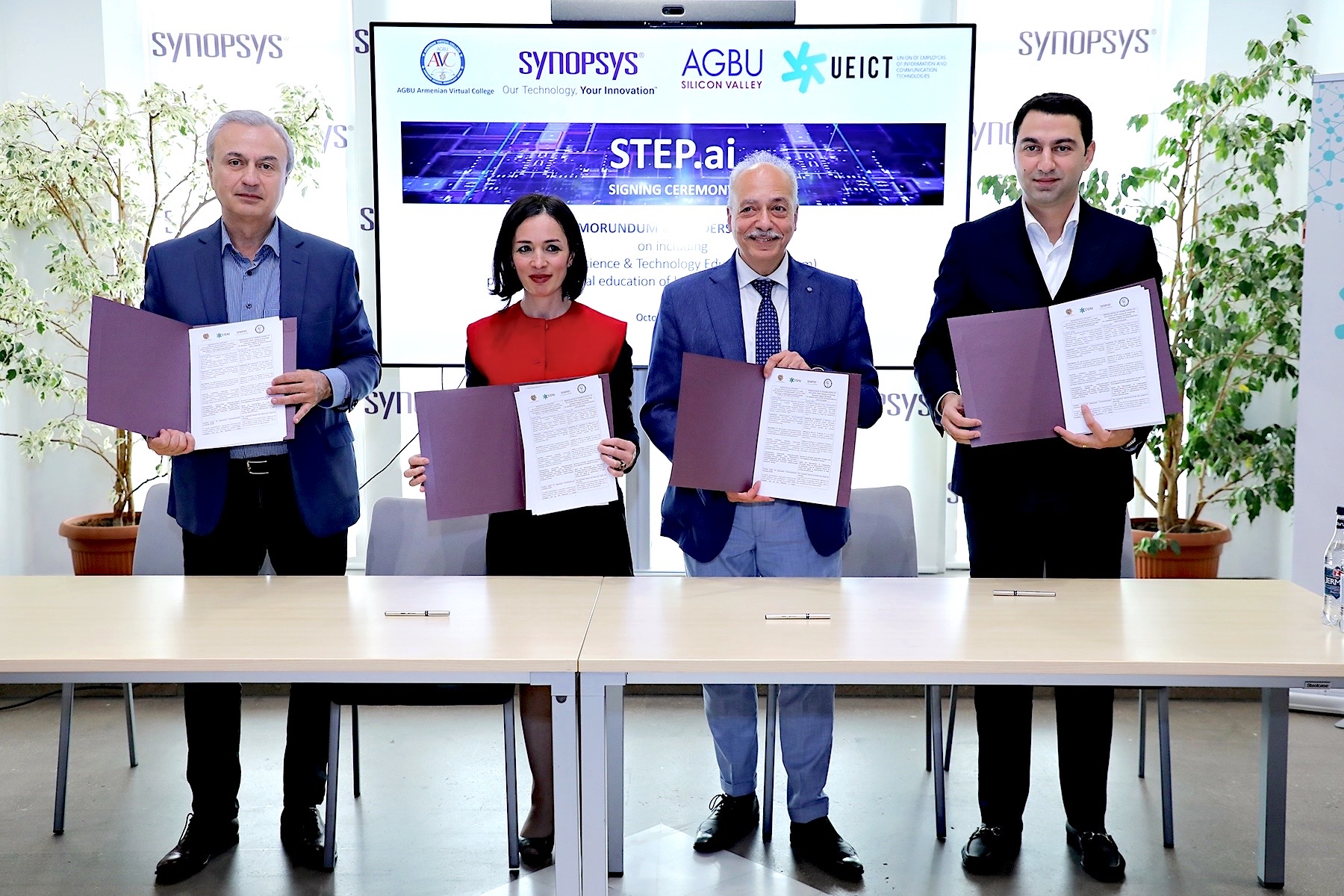
STEP.ai is a three-course Artificial Intelligence and Machine Learning curriculum for grades 10-12 in Armenia, developed from 2022 by Synopsys Armenia together with the AGBU Armenian Virtual College, targeting general and vocational secondary schools.
During the 2023-24 pilot the curriculum ran in 6 schools — 4 in Armenia and 2 serving students resettled after the 2023 displacement from Nagorno-Karabakh/Artsakh — using standardised multimedia lessons and remote-learning materials for the first course, AI & Python. On 9 October 2024, Armenia's Ministry of Education, Science, Culture and Sports and the Ministry of High-Tech Industry signed an MoU with Synopsys Armenia, AGBU and the Union of Employers of Information and Communication Technologies (UEICT) to expand the programme nationwide.
64 students completed the first course during the 2023-24 pilot. Following the MoU, 15 schools joined the programme from the 2025-26 academic year, and on 4 September 2025 the Ministry formally accredited STEP.ai as a group-study elective spanning AI & Python (grade 10), Machine Learning (grade 11), and Natural Language Processing & Robotics (grade 12).
Published evidence covers pilot completion counts rather than standardised learning-outcome assessments, and the national scale-up to 15 schools is only in its first year, so its impact has not yet been independently verified.
National / regional programmes Philanthropic / foundation funding
Indicative funding routes for practices of this type — always check each programme's current calls and eligibility rules.
Do you run this practice? Claim it — verified implementers get a public contact pathway and can propose corrections.
Where this practice's information was retrieved from, and when.
Australia
AWS and the non-profit Code for Schools are rolling out Australia's first locally developed, curriculum-aligned AI literacy programme to public, …
Latvia
Latvia's national chapter of MIT RAISE's 'Day of AI', led by RTU Riga Business School, reached 280 schools and over …
India
India's Ministry of Education, CBSE and NCERT are mandating AI and Computational Thinking as a curriculum strand from Class 3 …
Serbia
Since 2021, Serbia has made AI a compulsory topic in the national Informatics and Computing subject for all grade 7–8 …
Open full copilot Grounded in cited practices — always check the sources.