Terp 360 — Signvrse's AI Sign-Language Avatar for Kenya's Deaf Community
Kenya
Nairobi startup Signvrse built Terp 360, an AI-driven 3D avatar that translates English speech and text into Kenyan Sign Language …
United Kingdom · London · See the United Kingdom profile · See the London profile
Evidence: Descriptive / self-reported Top 68% 56/100 · Ask Evidence Copilot about this practice
A free AI/AR app that translates children's storybooks into sign language via an animated avatar, letting Deaf children and hearing parents read together. Developed by Huawei, Aardman Animations and the European Union of the Deaf, live since Dec 2018 in 15 sign languages.
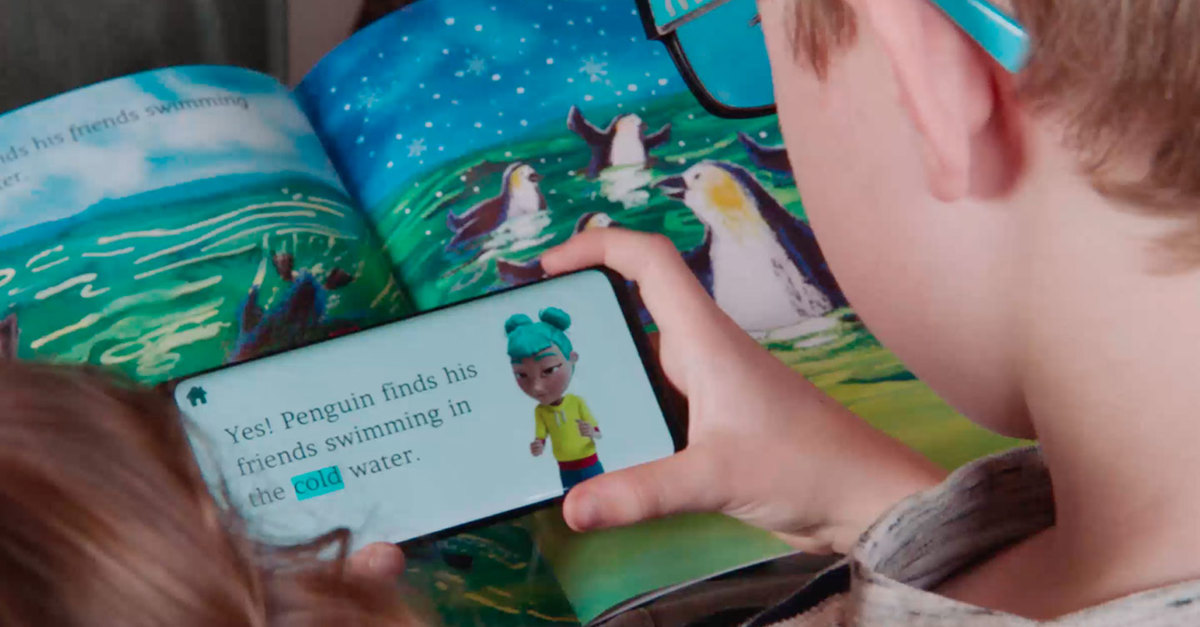
Many Deaf children are excluded from storytime because their hearing parents do not know sign language. StorySign was created to let Deaf children and hearing families read together despite that barrier.
Use AI and augmented reality so an animated avatar can sign a storybook's text back to the reader, giving Deaf children and their hearing parents a shared reading experience.
The AI recognises text on a book page and an animated avatar named "Star" signs the story. Launched 4 December 2018 in 10 European markets and 10 sign languages (British, French, German, Italian, Spanish, Dutch, Portuguese, Irish, Belgian Flemish and Swiss-German Sign Language), the app was developed by Huawei with Aardman Animations, agency FCB Inferno, the European Union of the Deaf (EUD) and the British Deaf Association, with content licensed from Penguin Random House. It has since expanded to 15 sign languages including ASL, BSL and Auslan, and continued to receive updates as of 2024.
Huawei self-reported (via Marketing Week) over 50,000 downloads, 128 million in-app film views and a £375,000 donation to deaf-literacy projects. StorySign won 4 Gold, 1 Silver and 2 Bronze Lions at Cannes Lions 2019, independently reported by ad trade press, and independent outlets (RI Global, Tech Xplore) corroborate its launch and mechanics.
These engagement figures are company-reported, not independently audited, and no independent academic evaluation of reading or comprehension outcomes was located. Content is also limited to a curated set of licensed titles rather than the full universe of children's books, and lead sponsor Huawei is a state-linked telecom firm - a relevant governance consideration when weighing the initiative's independence.
Own resources / municipal budget
Indicative funding routes for practices of this type — always check each programme's current calls and eligibility rules.
Do you run this practice? Claim it — verified implementers get a public contact pathway and can propose corrections.
Where this practice's information was retrieved from, and when.
Kenya
Nairobi startup Signvrse built Terp 360, an AI-driven 3D avatar that translates English speech and text into Kenyan Sign Language …
Fiji
In December 2019 Fiji launched its first uniform, self-learning Fiji Sign Language video dictionary, built with the Fiji Association of …
Saudi Arabia
Three Saudi government bodies jointly launched a Digital Inclusivity Programme in November 2023 targeting WCAG 2.0 AAA and an assistive-technology …
Senegal
Senegal's CNAO, WHO, UNICEF and ATscale are building a $2.5M national assistive-technology system — training 61 fitting specialists, standing up …
Open full copilot Grounded in cited practices — always check the sources.