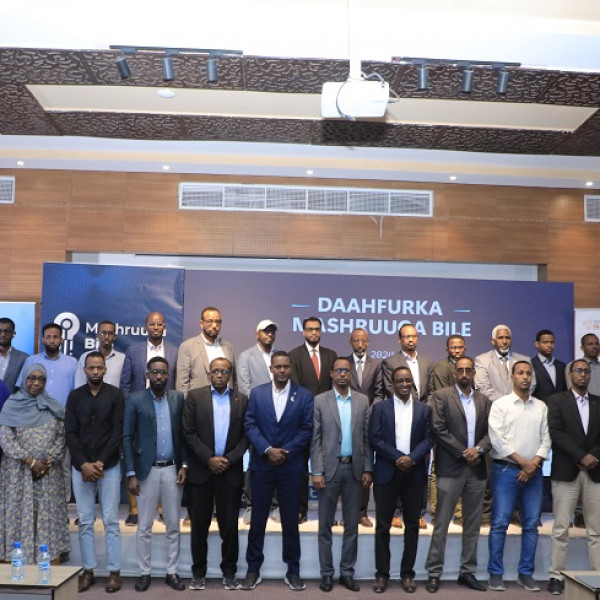
Tabaarak ICT Solutions, SomaliREN and the Hormuud Salaam Foundation trained 160 Somali final-year ICT students, 43% women, in AI, software development, cloud computing and software analysis in Mogadishu — funded entirely by domestic telecom philanthropy.
160 43% women
Students trained, third edition (2026)
300+
Students trained across three cohorts (cumulative) (2024-2026)
150
Initial cohort intake (2024)
Details
Maturity
Scaling
Promoter
Tabaarak ICT Solutions, SomaliREN and the Hormuud Salaam Foundation
The Bile Initiative is a domestically funded tech-skilling programme for final-year Computer Science and ICT students in Somalia, launched October 2024 by Tabaarak ICT Solutions and the Somali Research and Education Network (SomaliREN), funded by the Hormuud Salaam Foundation (the philanthropic arm of Hormuud Telecom).
Activities
Its third edition launched in Mogadishu on 24 August 2026, training 160 students (43% women) drawn from 22 universities across four tracks -- software development, artificial intelligence, cloud computing and software analysis -- alongside a six-month internship at Tabaarak ICT Solutions.
Results
Since its 2024 launch the initiative has trained more than 300 students across three cohorts, growing from an initial intake of 150 students.
Conclusions
Organisers frame the programme's local funding and operation as a deliberate contrast to AI-skilling programmes in the region backed by foreign technology companies. No independent evaluation, skills assessment or job-placement data has been published for any of the three cohorts, and no public AI-ethics, data-protection or curriculum-transparency documentation accompanies the programme; employability claims rest on the internship structure and organisers' statements rather than measured outcomes.
Implementation
Indicative cost
Low (< €50k) — Funded entirely by the Hormuud Salaam Foundation (domestic telecom philanthropy); amount not disclosed.
Time to results
Medium (1–3 years) — Launched October 2024; third edition August 2026, growing cohort sizes.
Staffing & skills
Tabaarak ICT Solutions, Somali Research and Education Network (SomaliREN), Hormuud Salaam Foundation
Conditions for success
domestic (non-foreign-tech) funding via telecom philanthropy, framed as improving long-term sustainability
six-month internship structure connecting graduates to an employer
Common failure modes
no independent evaluation, skills assessment or job-placement data published for any cohort
no public AI-ethics or curriculum-transparency documentation
Where it fits
Governance type
domestic industry philanthropy with academic network partner
Scale
national (Somalia, students from 22 universities)
Income level
low income (Somalia)
Commonly funded by
Philanthropic / foundation funding
Indicative funding routes for practices of this type — always check each programme's current calls and eligibility rules.
Do you run this practice?
Claim it —
verified implementers get a public contact pathway and can propose corrections.
Data sources
Where this practice's information was retrieved from, and when.
A 5-week AI-literacy module for pre-service physics teachers across nine Kazakhstani universities, led by Zhetysu University, raised literacy scores far …
MUST, Mongolia's IIOE National Centre, runs a train-the-trainer micro-certification scheme with UNESCO-ICHEI, giving AI and digital-competency micro-credentials to 1,800+ teachers …