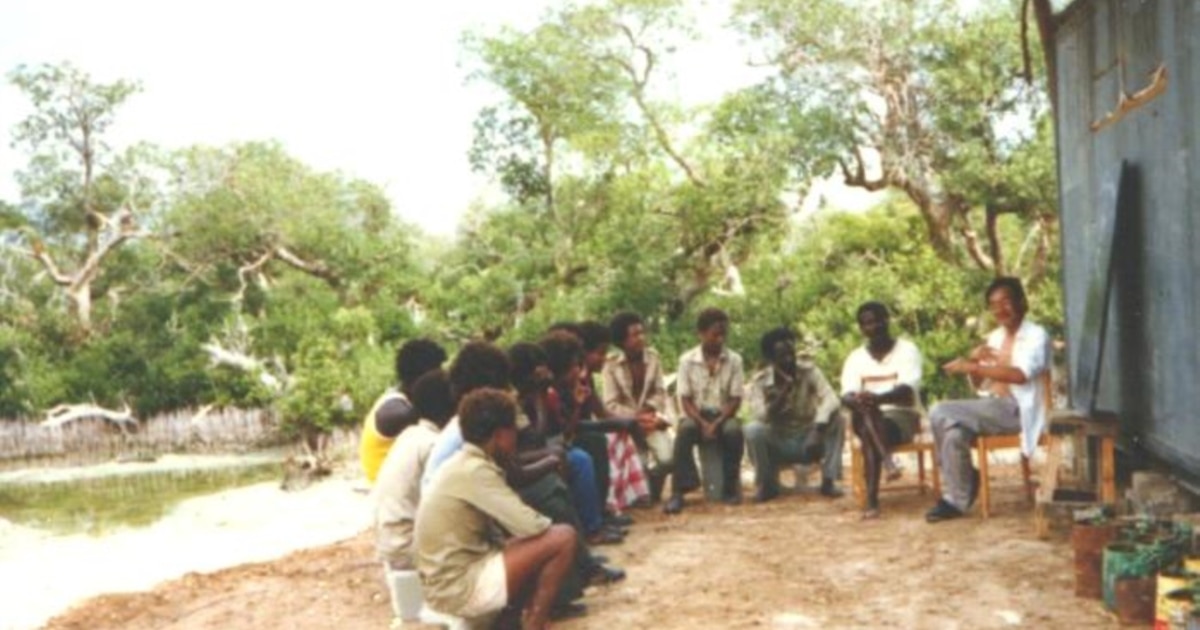
Since 1985, cheap bags of nitrogen, phosphorus and iron buried at each seedling's base have let mangroves take root on Eritrea's barren tidal flats near Hargigo, now an estimated 700,000-1 million trees restoring fish nurseries and mangrove-leaf livestock fodder.
~700,000 trees
Mangrove trees established (2024 peer-reviewed estimate) (by 2024)
~1,000,000 trees
Mangrove trees established (later press/encyclopaedia estimate)
Details
Promoter
Manzanar Project (founded by Dr Gordon H. Sato)
Period
1985–2017 (ongoing legacy)
Keywords
coastal ecosystem restoration, fisheries, livestock fodder, community livelihoods
Context
Eritrea's barren, saline tidal mudflats near Hargigo had repeatedly failed to support mangrove seedlings until Dr Gordon H. Sato began the Manzanar Project there in 1985.
Objectives
The project aimed to establish mangrove stands on nutrient-poor tidal flats using only cheap fertiliser and manual labour, without freshwater, arable soil or heavy machinery.
Activities
Small plastic bags of nitrogen, phosphorus and iron were buried at the base of each seedling and pierced with a hole so nutrients leached out gradually as the tide moved.
Results
A 2024 peer-reviewed account in Ecological Restoration put the total at roughly 700,000 mangrove trees, with later press and encyclopaedia accounts describing growth to nearly one million; crabs, shrimp and juvenile fish returned to support local fisheries, and families began feeding mangrove leaves, supplemented with ground fish remains, to sheep and goats.
Conclusions
No independent hectare-level survey or carbon-stock study of the site was found, and the model rested heavily on Sato personally, who died in 2017, leaving it a community-scale, informally governed restoration rather than a certified or replicable scheme.
Implementation
Indicative cost
Low (< €50k)
Time to results
Long (> 3 years)
Staffing & skills
Dr Gordon H. Sato (project founder), local community members/families in Hargigo
Conditions for success
no freshwater, arable soil or heavy machinery required — only cheap fertiliser and manual labour
gradual nutrient leaching via perforated fertiliser bags timed to tidal action
Common failure modes
model rested heavily on one individual (Sato), who died in 2017, threatening continuity
no independent hectare-level survey or carbon-stock study conducted
informally governed, not a certified or replicable scheme
Commonly funded by
National / regional programmesPhilanthropic / foundation funding
Indicative funding routes for practices of this type — always check each programme's current calls and eligibility rules.
Do you run this practice?
Claim it —
verified implementers get a public contact pathway and can propose corrections.
Data sources
Where this practice's information was retrieved from, and when.
Costa Rica's first marine PES scheme pays Gulf of Nicoya mollusk-harvester associations for verified mangrove conservation, scaling from 157 harvesters …