Kingston Creative — Downtown Kingston Art District & the CREATECH Programme
Jamaica
Since 2017, NGO Kingston Creative has used murals, festivals and a $1.3m IDB Lab programme (2021–24) to regenerate Downtown Kingston's …
Albania · Tirana · See the Albania profile · See the Tirana profile
Evidence: Descriptive / self-reported Top 93% 43/100 · Ask Evidence Copilot about this practice
Tirana partnered with the EBRD (2015–2018) on a Green City Action Plan and adopted a 2016 masterplan pledging a 2-million-tree 'Orbital Forest' and a 29-hectare riverside eco-district — but a 2023 investigation found only ~60 trees planted, exposing a stalled, contested rollout.
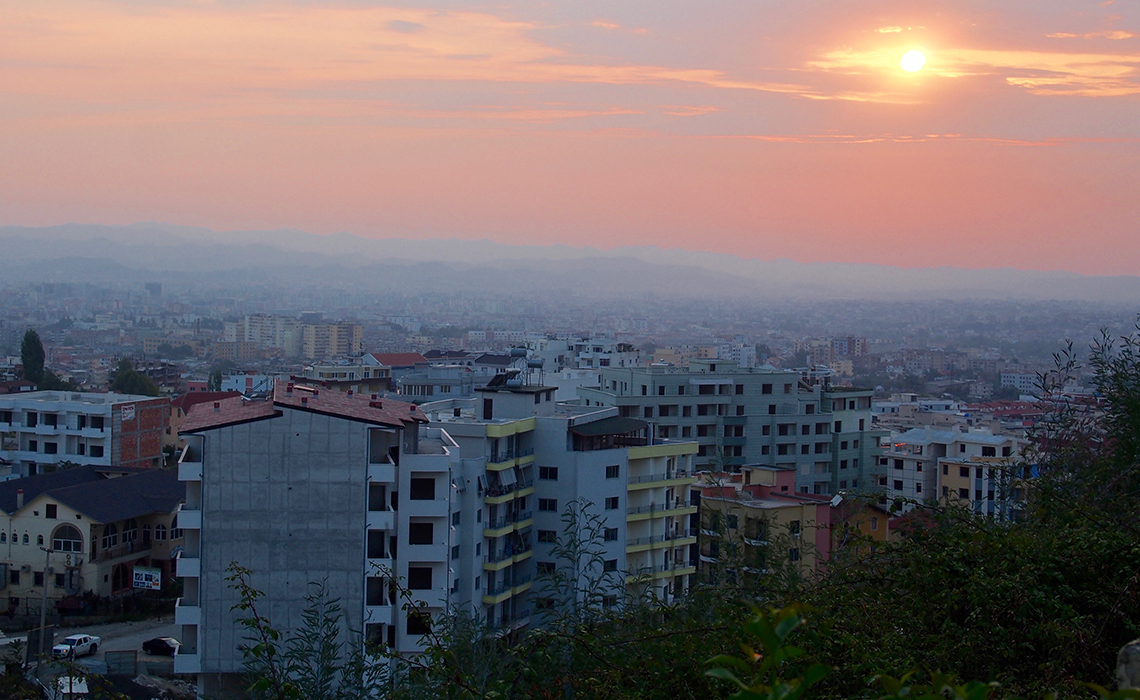
Post-communist Tirana urbanised rapidly and informally, leaving it with one of the lowest per-capita green-space ratios among European capitals and serious air-quality and water-infrastructure gaps. In 2015 the municipality signed a memorandum of understanding with the European Bank for Reconstruction and Development (EBRD) covering urban transport, roads, water and wastewater, solid waste and energy efficiency.
Tirana joined the EBRD's Green Cities Programme in February 2017 and finalised its Green City Action Plan (GCAP) in April 2018. The City Council also approved the 'Tirana 2030' general local plan, designed by Stefano Boeri Architetti, whose flagship elements are the 'Orbital Forest' — a proposed ring of 2 million trees across roughly 14,000 hectares encircling the city — and 'Tirana Riverside,' a 29-hectare mixed-use eco-district intended to house around 12,000 people.
Concrete financing followed the GCAP: a €15 million EBRD loan to the city's water utility, Ujësjellës Kanalizime Tirana, funded a new pipeline and the expansion of the Bovilla water-treatment plant.
A 2023 investigation by the Albanian outlet Citizens.al found that, years into the scheme, only around 60 trees had officially been planted toward the 2-million-tree pledge — implying, at that pace, a rollout measured in centuries rather than years. The same investigation raised conflict-of-interest concerns, since Stefano Boeri's firm, which authored the planning regulations for the zones in question, was also awarded construction contracts within areas it had itself zoned; critics have also warned that some Riverside-area clearances risk displacing residents of adjacent informal settlements without adequate safeguards.
The GCAP and Tirana 2030 plan remain legally in force, and discrete infrastructure investments such as the UKT water project have proceeded via EBRD financing, while the flagship green-ring and riverside components remain in early or contested implementation — an internationally financed, technically credible regeneration framework whose social and environmental ambitions have considerably outpaced physical delivery.
National / regional programmes
Indicative funding routes for practices of this type — always check each programme's current calls and eligibility rules.
Do you run this practice? Claim it — verified implementers get a public contact pathway and can propose corrections.
Where this practice's information was retrieved from, and when.
Jamaica
Since 2017, NGO Kingston Creative has used murals, festivals and a $1.3m IDB Lab programme (2021–24) to regenerate Downtown Kingston's …
Kenya
Since 2006, Kounkuey Design Initiative has co-designed 11 flood-resilient public spaces with Kibera residents on reclaimed dumpsites, installing 520m of …
Bolivia
Since 2000, La Paz's municipal government has upgraded more than 100 of the city's poorest hillside neighbourhoods through 'Barrios de …
Indonesia
Starting in Jakarta in 1969, Indonesia's Kampung Improvement Programme threaded paved paths, drainage, water and sanitation into existing 'kampung' neighbourhoods …
Open full copilot Grounded in cited practices — always check the sources.