999 BSL — UK Emergency Video Relay Service for Deaf Sign Language Users, With Ofcom's Ex-Post Evaluation
United Kingdom
Since June 2022 UK deaf BSL users can call 999 free via a video app with a live interpreter. Ofcom's …
Italy · Roma · See the Italy profile · See the Roma profile
Evidence: Descriptive / self-reported Top 68% 56/100 · Ask Evidence Copilot about this practice
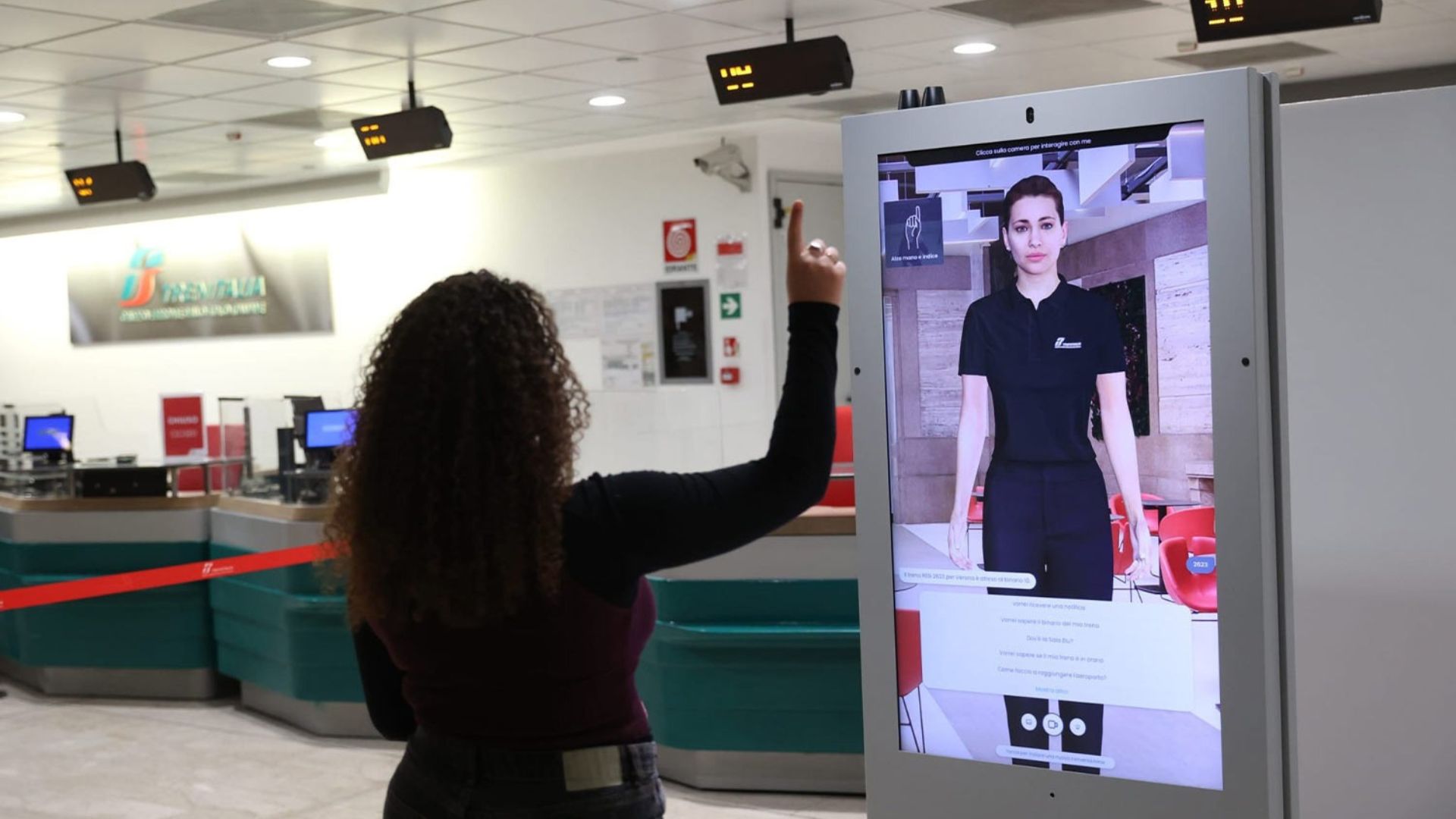
Since March 2026, Trenitalia has trialled an AI avatar at ticket offices in Milan Centrale and Rome Termini that signs in Italian Sign Language and International Sign, developed with Italy's national Deaf association ENS from 30 signers and 8,000 training videos.
ITI43Deaf and hard-of-hearing rail passengers in Italy have long had to rely on written notices, third-party interpreters or family members to get real-time information about platforms, delays and services inside stations.
From 4 March 2026, Trenitalia — Italy's state passenger railway — began trialling a way to close that gap directly at the ticket counter, letting Deaf travellers interact in real time with a digital avatar signing in Italian Sign Language (LIS) and International Sign (IS).
The 'Sistema multimediale LIS e IS' is an interactive kiosk built with Italy's national Deaf association, Ente Nazionale Sordi (ENS), letting travellers independently check available travel options, ticket details such as departure platform, and points of interest inside the station (assistance desks, restrooms, food services), and request remote human support by text or video message in LIS/IS; the same touchpoint also offers text and voice content in 14 spoken languages. The avatar's signing was built from roughly 8,000 videos recorded with 30 Deaf signers, so its vocabulary and movement come directly from the community it serves rather than from a generic animation library.
As of publication the service was live only at the ticket offices of Milan Centrale and Rome Termini, two of Italy's busiest stations, with Trenitalia describing a 'progressive extension' to other major Italian stations as the trial matures, but no usage or satisfaction figures had yet been published.
Because the system launched in March 2026, there is no independent post-launch evaluation yet of translation accuracy, traveller satisfaction or usage volumes, and its footprint remains two stations pending the promised wider rollout.
National / regional programmes
Indicative funding routes for practices of this type — always check each programme's current calls and eligibility rules.
Do you run this practice? Claim it — verified implementers get a public contact pathway and can propose corrections.
Where this practice's information was retrieved from, and when.
United Kingdom
Since June 2022 UK deaf BSL users can call 999 free via a video app with a live interpreter. Ofcom's …
Brazil
Brazil's federal government embeds a free, open-source 3D avatar that machine-translates Portuguese text into Libras (Brazilian Sign Language) across public …
Kenya
eKitabu, a Nairobi edtech nonprofit, builds born-accessible e-books for blind/low-vision learners and Kenyan Sign Language video storybooks for deaf learners …
Ireland
An EU Horizon 2020 project (€5.6M, 2021–2023) led by Dublin City University co-created a sign-language translation app with the European …
Open full copilot Grounded in cited practices — always check the sources.